How to Stop Seeking Validation: When Other People’s Reactions Start Defining Your Worth
You can make a good decision and still want someone else to tell you that it was the right one. You may accomplish something objectively valuable and still feel strangely disappointed when nobody notices or gives you the kind of feedback you expected. You may also ask for someone’s opinion because you genuinely want information and find yourself feeling personally diminished when they disagree with you. If you recognize yourself in these situations, you may be wondering how to stop seeking validation without becoming someone who simply stops caring what other people think.
Sometimes you are looking for information. Sometimes you are looking for reassurance because you don’t trust your own judgment yet. And sometimes, something deeper is happening: you are looking outside yourself for evidence of your own worth.
That is where validation seeking becomes worth examining.
And learning how to stop seeking validation isn’t about becoming someone who never cares what other people think. It’s about understanding what you are actually asking other people to give you and noticing when their response starts determining how you see yourself.
What Is Validation Seeking?
Validation seeking is the repeated tendency to look to other people for confirmation that you are good enough, competent enough, successful enough, lovable enough, or worthy enough. In the context of self-worth, validation seeking becomes especially important when another person’s response starts functioning as evidence of your value, competence, lovability, or adequacy.
It can appear in surprisingly ordinary situations, like, you might repeatedly ask your colleagues whether your work was good. You might need your partner to reassure you that they are not disappointed in you. You might find yourself checking how other people reacted to an achievement rather than noticing how you feel about it yourself. Or you might tell someone about a decision you’ve made, asking for their opinion, while secretly hoping they will confirm that you made the right choice.
The important part is not simply wanting approval. Most human beings enjoy recognition. We are social creatures, and positive feedback matters. The more interesting question is what happens when you don’t get the reaction you were hoping for.
That is where validation seeking behavior can become easier to recognize.
Validation Seeking vs. Reassurance Seeking
These two can overlap, which is exactly why they are easy to confuse.
Suppose you are considering buying an investment property abroad and ask someone: “Do you think this is a good idea?”
You might genuinely be seeking information. Perhaps they point out tax considerations, local regulations, property management issues, or risks you hadn’t considered.
If you are primarily seeking information, you might think: “I hadn’t considered that. I should investigate those points before making a decision.”
The information changes your assessment of the opportunity. You keep the decision-making in your own hands. And more importantly, your sense of yourself remains relatively intact.
Reassurance seeking is different.
You may already have doubts about your judgment and ask someone because you want help feeling more certain. If they list twenty reasons why the investment might fail, you may feel anxious because you suddenly think: “Maybe I’ve made a terrible decision.” The central fear is about the decision.
Sometimes the question shifts from “Was this a good decision?” to “What does this decision say about me?”
If they list twenty reasons against the investment, your reaction might become: “I’m totally incapable of making serious financial decisions.”
Now the information isn’t merely changing your opinion about the investment. It is changing your opinion about yourself. That distinction matters.
A simple way to tell them apart
Ask yourself: If this person gives me the answer I wasn’t hoping for, what will it make me think about myself?
If the answer is: “I’ll probably realize that I missed something“, you may simply be seeking information.
If it is: “I’ll feel like I can’t trust myself and need someone to tell me what to do” you may be seeking reassurance.
If it is: “I’ll feel stupid, incompetent, irresponsible, unworthy, or like I’m not good enough”, you might be looking for something closer to external validation.
And one reaction alone doesn’t prove anything. Look for the pattern.
What Does Validation Seeking Behavior Look Like?
Validation seeking doesn’t always look like pursuing compliments. Sometimes it is much quieter.
You might, for example:
- repeatedly ask people whether they think you did a good job;
- over-explain your decisions so other people will approve of them;
- check someone’s reaction before deciding how you feel about your own achievement;
- feel disproportionately disappointed when recognition is smaller than expected;
- downplay accomplishments until someone else acknowledges them;
- compare yourself with others to determine whether you are doing “well enough”;
- repeatedly seek confirmation that you’re attractive, competent, successful, intelligent, or lovable;
- change your opinion quickly when someone you respect disagrees with you;
- struggle to enjoy an achievement if nobody else seems impressed by it.
But again, none of these behaviors is automatically a problem.
The more revealing question is: what happens inside you when the validation doesn’t arrive?
How To Stop Seeking Validation? The Mini Focus Shift That Can Reveal the Pattern
This is one of the simplest ways to examine your own validation seeking behavior.
Instead of asking: “What reaction am I hoping to get?”
ask yourself: “If I didn’t get the reaction I expected, what would that tell me about myself?”
In other words: “What happens to my sense of self when the validation doesn’t come?”
The shift is tiny, but it changes what you are looking at.
Imagine you solved a long-standing problem at work and saved the company thousands of dollars. Your manager says: “Good job.” That’s it. No enthusiastic praise, no public recognition, no particular mention in the next team meeting. Of course, you might feel disappointed. Recognition feels good, and your manager may genuinely have handled the situation poorly.
But go one step further, because “I don’t feel respected” alone is too general, it might not help you understand exactly what you are missing.
If your thought is: “I wish they had acknowledged the contribution more clearly.” that’s one thing. If it becomes: “Apparently I’m not valued here.” ask what valued means.
Would a bonus or promotion make you feel valued? Do you specifically need public recognition, the feeling that other people now know that you are exceptional? Wanting a bonus, promotion, fair compensation, or professional recognition is not the same thing as seeking validation. Those can be reasonable expectations in their own right. The more revealing question is what the absence of that recognition comes to mean about you.
Validation Seeking vs. Conditional Self-Worth
Validation seeking can also overlap with conditional self-worth, but they aren’t identical.
Conditional self-worth is the underlying belief that your value depends on meeting certain conditions. It sounds something like:
“I’m worthy if I’m successful.”
“I’m lovable if I’m easy to be around.”
“I’m valuable if I’m useful.”
“I’m good enough if I’m competent.”
Validation seeking can become one of the ways you check whether you’ve met those conditions.
For example, someone might unconsciously believe: “I am valuable when I am exceptionally competent.” Then recognition becomes evidence.
A manager praising them confirms competence. Someone asking for their expertise confirms competence. And criticism threatens it.
This is why external validation can become so compelling. It temporarily answers a question that was never really about the other person’s opinion: “Am I enough?”
External validation is inherently dependent on something outside your control. People may disagree or even misunderstand you. They might overlook your work. A manager can also have a bad day, and a partner can be distracted, as well.
If your sense of worth depends on those reactions, your internal state can become extremely vulnerable to other people’s attention.
Why You Can’t Simply “Stop Caring What People Think”
This is where advice about validation seeking like “stop caring about others’ opinion” often becomes too simplistic.
You won’t develop a stable sense of self-worth simply by deciding that other people’s opinions don’t matter anymore. We are relational beings, and other people’s responses do contain useful information.
The goal isn’t to become “feedback-proof”, but to stop confusing feedback about your behavior with your worth. The first might be only about the situation, while the second is about your identity. You wouldn’t equate the two, would you?
Build More Internal Evidence
If you want to stop seeking validation, one way is to deliberately build what we might call internal evidence. Not affirmations, evidence.
Instead of waiting for someone else to tell you that you’re competent, begin noticing the actual evidence that you can rely on yourself.
You might want to collect past experiences, like:
- What decisions have you made well?
- What problems have you solved?
- What have you learned from mistakes?
- Where have you handled something difficult without someone telling you what to do?
- Where have you acted according to your values even when nobody rewarded you for it?
This doesn’t mean pretending you’re always right, but it may strengthen your self-trust when you know: “I can make a decision, evaluate the outcome, admit when I was wrong, learn something, and make another decision.”
That is far more stable than needing every decision to be validated in advance.
The same applies to achievement. Instead of asking only: “Did they recognize what I did?“, also ask: “Do I recognize what I did?“
You don’t have to become indifferent to other people’s opinions. You can listen, reconsider, apologize, learn, negotiate, or change your mind.
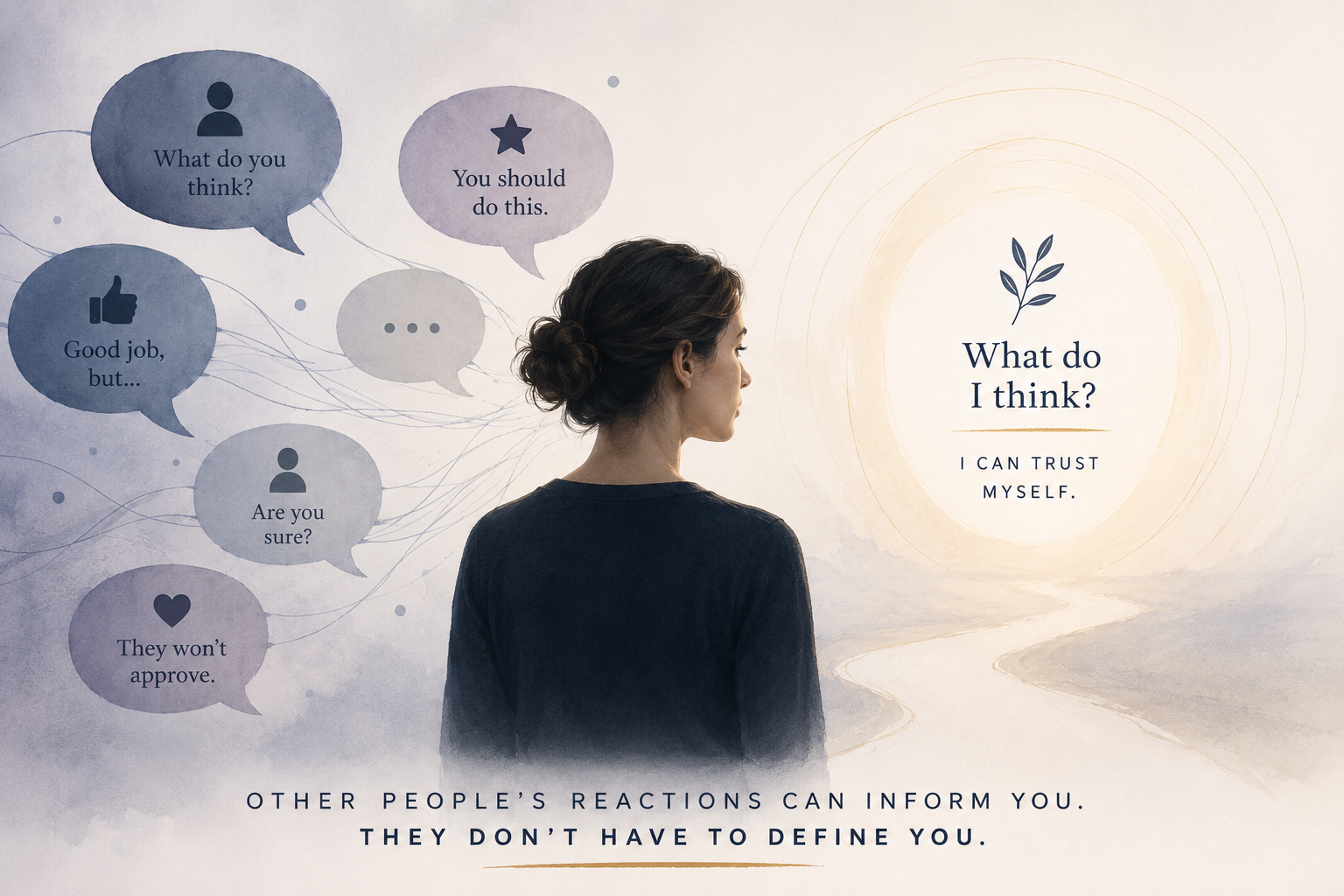
The goal is simply to leave yourself enough room to say: “This tells me something about what happened. It doesn’t get to tell me everything about who I am.”
The more you practice making that distinction, the more you build something external validation cannot give you: evidence that you can trust yourself to evaluate what happens, learn from it, and keep going without needing someone else to define what it means about you.
The Pattern Matters More Than the Moment
There is one final distinction worth keeping in mind.
You don’t need to analyze every time you ask someone for their opinion. You don’t need to wonder whether every compliment you enjoy is a sign of unhealthy validation seeking. And you certainly don’t need to turn every emotional reaction into a psychological diagnosis.
A single decision tells you very little, but a pattern of repeated reactions can tell you much more.
If you repeatedly need other people to confirm that you are competent, lovable, successful, attractive, responsible, or worthy, and their absence of approval repeatedly changes how you see yourself, that’s worth paying attention to.
The goal isn’t to stop valuing other people’s opinions, but to make sure they remain information related to the actual situation and not your worth.
The Self-Worth Map: Where Does Validation Seeking Fit?
Validation seeking sits within a much larger system of self-worth. That is why it can look so similar to several other patterns while still deserving its own place.
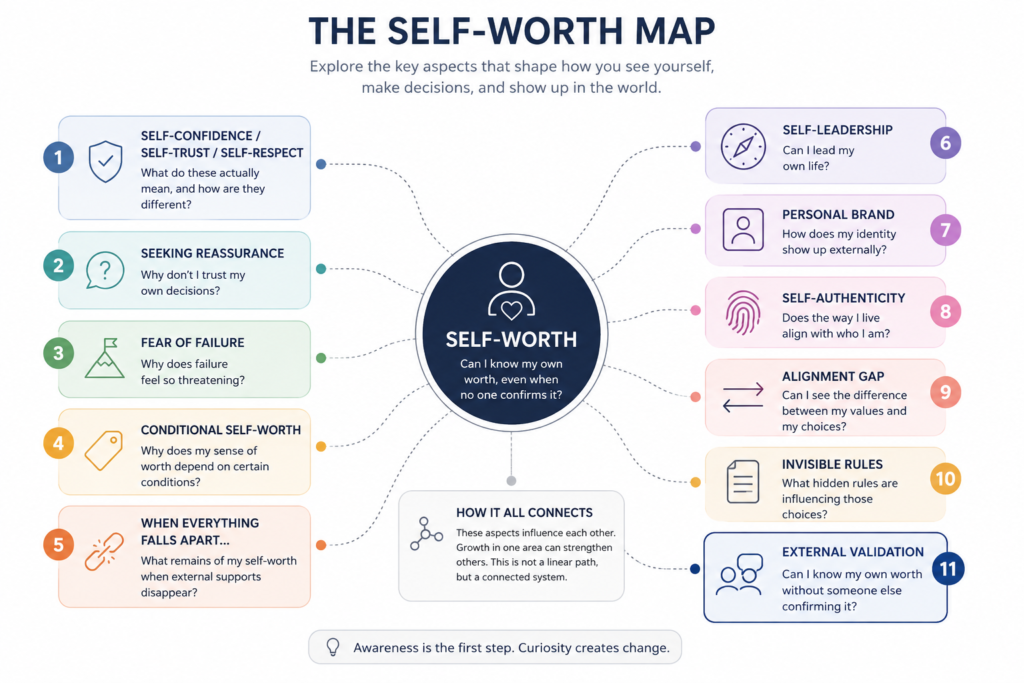
SELF-WORTH – HOW DO I SEE MYSELF?
Self-Confidence / Self-Trust / Self-Respect
→ What is the difference between them?
→ Why don’t I trust my own decisions?
→ Why does failure become threatening?
→ Why does my sense of worth depend on certain conditions?
Invisible Assets, or, When Everything Falls Apart What Still Remains
→ What remains of my self-worth when external anchors disappear?
→ Can I lead my own life?
→ How does my identity show up externally?
→ Does the way I live align with who I am?
→ Can I see the difference between my stated values and my actual choices?
→ What hidden rules influence those choices?
External Validation
→ Can I know my own worth without someone else confirming it?
These patterns overlap because people are complex. The point is to notice the slightly different question underneath each one. And with validation seeking, that question is often surprisingly simple:
If nobody confirms it, can I still know it about myself?
AI Transparency : At SelfWorkNotes, we use generative AI as a collaborative tool during the research, writing and creative process. Every article is carefully reviewed, edited and finalized by the author, who remains fully responsible for the published content. Unless otherwise stated, illustrations are created using generative AI.
Gentle reminder: The content on SelfWorkNotes is provided for informational and educational purposes only. It does not constitute medical, psychological, legal or financial advice. Always consult a qualified professional regarding your personal situation.