The Alignment Gap: Why You Keep Choosing Against What Matters Most
Have you ever caught yourself making the same promise over and over again and still found yourself wondering: why can’t I change?
“Next week I’ll leave work on time.”
“I’ll finally start exercising.”
“I really need to spend more time with my family.”
“Next time I’ll ask for help instead of doing everything myself.”
At the time you make these promises, you genuinely mean them. Your intentions are sincere, and the values behind them matter deeply to you. Yet somehow, a few days later, you’re working late again, skipping another workout, saying yes to one more request or quietly taking on responsibilities that were never yours to carry. After a while, the question becomes almost inevitable:
Why do I keep doing this when I know it isn’t what I really want?
The surprising part isn’t that this happens.
It’s that the reason is often completely different from what we first assume.
Many of us answer that question with self-criticism: “Why do I keep doing this when I know it isn’t what I really want? Why can’t I change, even when I genuinely want to?” We assume we’re undisciplined, weak or simply not trying hard enough. But there may be another explanation. If you’ve ever asked yourself “Why can’t I change?”, perhaps the problem isn’t a lack of willpower at all. Perhaps your daily choices have been following a pattern of priorities that you’ve never consciously examined.
We Can Hold Two Important Values at The Same Time
One of the biggest misconceptions about values is that they always point us in one clear direction. In reality, many of our most important values coexist peacefully until everyday life forces us to choose between them.
You may value your health, while also valuing achievement and financial security. You may genuinely believe that your family comes first, while also feeling deeply responsible for providing the best possible future for them. Or, you may value honesty, but also kindness. You may believe in helping others, while also wishing you were better at protecting your own time and energy.
None of these values are wrong. The difficulty begins when one of them repeatedly receives more space in your life than the others.
When Good Intentions Stop Matching Everyday Life
Choosing work over rest once tells us very little. Staying late at the office during an important project doesn’t tell the full story, either.
The Alignment Gap pattern becomes visible when the same choice quietly repeats itself month after month. At some point you notice that although health remains one of your most important values, your calendar tells a different story. Or perhaps you keep saying that your children are your highest priority, yet most evenings they are already asleep before you close your laptop.
This is often where an uncomfortable inner dialogue begins.
“Why can’t I just leave earlier?”
“Why is it so difficult to say no?”
“Why do I always end up doing everything myself?“
These questions are important because they signal something subtle but valuable: you are no longer only noticing your behavior. You are becoming curious about the pattern behind it.
SelfWorkNotes Definition: The Alignment Gap

The Alignment Gap
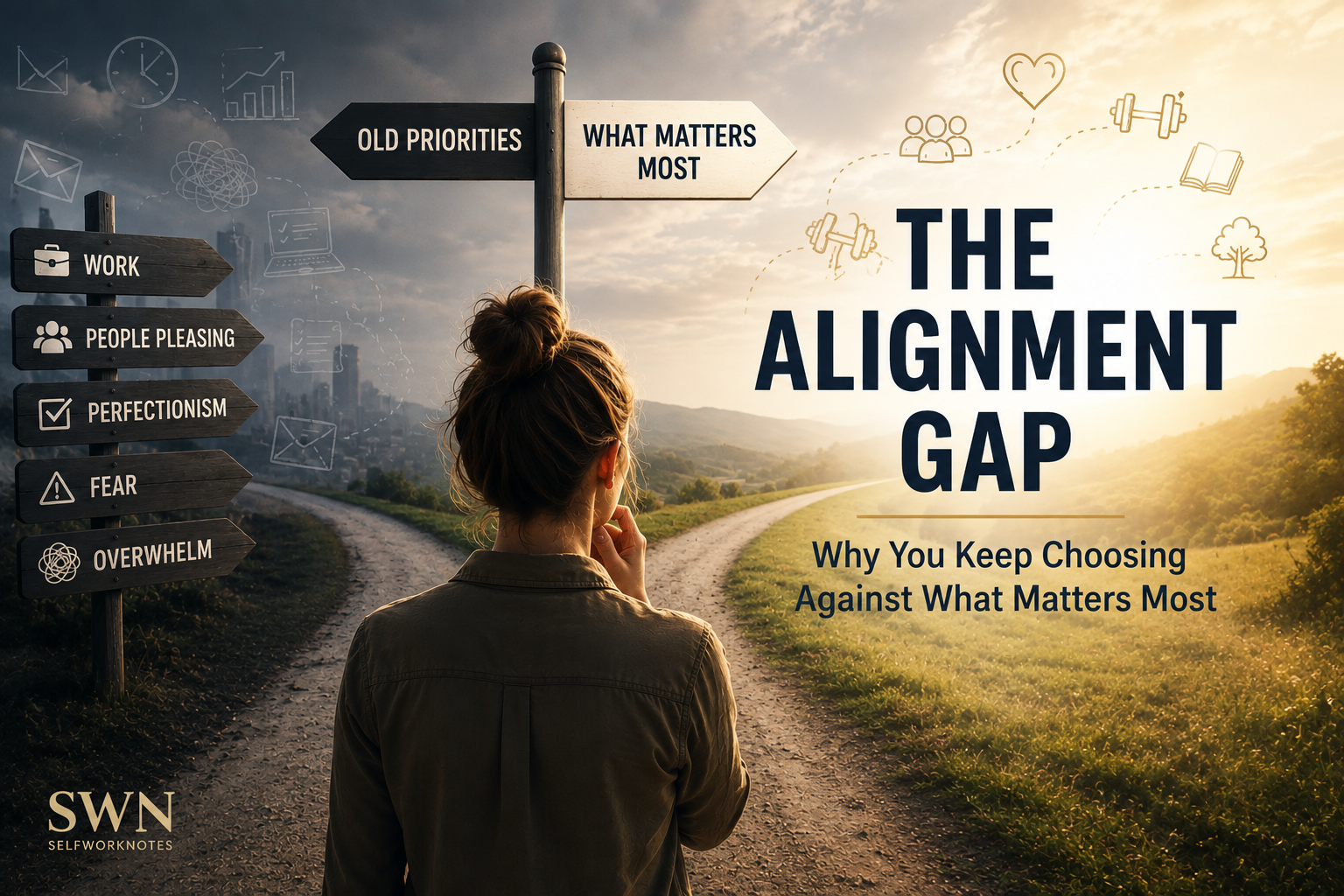
The Alignment Gap is the distance between the values you consciously hold and the priorities your repeated daily choices consistently reveal.
The important word here is priorities.
The Alignment Gap doesn’t tell you what you value or should value. It doesn’t suggest that your family, health or relationships are unimportant simply because work currently takes up most of your time. Instead, it reveals which values your everyday life has gradually started prioritizing, whether intentionally or not.
That distinction matters because values live inside us, but priorities become visible through repeated behavior.
Before Trying to Change Your Behavior, Understand What Keeps Creating It
Many people reach this point after asking themselves the same frustrating question: “Why can’t I change?” And once they recognize this gap, many immediately try to force themselves to behave differently. They promise themselves that next Monday everything will change. Sometimes it does, for a few days. Then life returns to its familiar rhythm.
The answer to “Why can’t I change?” often isn’t as simple as lacking discipline. Perhaps it happens because the real problem is not the behavior itself, but the underlying pattern that runs it.
Imagine someone who consistently chooses work over rest. At first glance, it seems obvious that they simply work too much. But what if work isn’t actually winning because they love working? What if it wins because financial security feels uncertain? Because asking for help feels uncomfortable? Because achievement has quietly become the safest place to seek reassurance?
The repeated behavior is only the visible part. The pattern underneath is often what keeps the cycle alive.
Instead of asking “What’s wrong with me?”, try asking a different question:
What might this behavior be trying to protect me from or help me achieve?
That single question shifts the conversation from judgment to understanding.
Don’t Fight the Pattern. Interview It.
Imagine your patterns as colleagues sitting around a meeting table.
Workaholic is convinced that slowing down is dangerous.
People Pleaser believes disappointing someone will damage an important relationship.
Perfectionist insists that mistakes are unacceptable.
Fear quietly argues that changing the current routine carries too much risk.
The goal isn’t to throw any of them out of the room. Most of them developed for a reason, often to protect you in situations that once felt threatening or uncertain.
Instead of fighting them, become curious. Ask them what they’re trying to accomplish. What are they afraid would happen if they stepped aside for a moment? Often, understanding the purpose of a pattern gives you far more freedom than trying to suppress it.
This Is Where the CEO Steps In
Earlier on SelfWorkNotes, we introduced the idea that you are the CEO of your own life. The Alignment Gap is where that idea becomes practical.
A good CEO doesn’t ignore different departments. They listen to all of them before making a decision. Each of the above patterns argues for something different, then maybe Health raises another, Ambition wants even greater recognition, Fear reminds you about what might happen in the future.
None of these voices are wrong. The problem begins when one department quietly starts making every decision on behalf of the entire organization.
The CEO’s role isn’t to silence Fear or dismiss Ambition. It’s to decide who gets to lead today’s meeting. Perhaps today, Ambition doesn’t need to dominate every decision. Perhaps Family or Health should finally have a seat at the table again.
Your Invisible Assets Are What Make Change Possible
Recognizing an Alignment Gap doesn’t automatically change anything. What it creates is something even more valuable: choice.
This is where your Invisible Assets become important. Curiosity helps you understand the pattern instead of judging it. Self-awareness notices when you’re slipping back into autopilot. Courage allows you to make one different choice, even when it feels uncomfortable. Patience reminds you that deeply rooted habits rarely disappear after a single successful day.
And willpower? It still matters. But now it has a different job. Instead of fighting yourself, your willpower can finally be directed toward building a life that reflects the priorities you consciously want to live by.
A Small Change Can Begin Closing the Gap
You don’t have to transform your life overnight.
If your family has slowly moved into the background, perhaps today’s decision is simply leaving work one hour earlier.
If protecting your health has become difficult, maybe today’s choice is taking a walk before opening your laptop.
Or, if asking for help feels almost impossible, perhaps today you delegate one task instead of executing everything yourself.
These decisions may seem small, but they create something powerful: new evidence.
Over time, repeated choices begin telling a different story. And just as your previous habits gradually shaped your identity, new evidence can slowly reshape it again.
Identity rarely changes first. More often, it follows the evidence we repeatedly create with our daily actions.
A Final Thought
The purpose of the Alignment Gap isn’t to tell you that you’ve been living your life incorrectly, but to make your current priorities visible.
Once you can see them clearly, you no longer have to run on autopilot. You can decide whether those priorities still reflect the life you want to build.
If they do, you’ve gained confidence that your daily choices already align with your values.
If they don’t, you don’t need to become a different person. You simply need to begin giving a little more space to the values that have quietly been waiting in the background.
Meaningful change rarely begins with a dramatic decision. It begins the moment you stop asking, “Why can’t I change?” and start asking,
“What kind of life are my repeated choices creating? Is that the life I want to keep building?”
Related Patterns:
- CEO of Your Life
- Invisible Assets
- A Personal Branding Exercise That Helps You See Yourself Differently
- Self-Authenticity Gap
- What Is Self-Worth? And Why We Often Look for It in the Wrong Places
AI Transparency : At SelfWorkNotes, we use generative AI as a collaborative tool during the research, writing and creative process. Every article is carefully reviewed, edited and finalized by the author, who remains fully responsible for the published content. Unless otherwise stated, illustrations are created using generative AI.
Gentle reminder: The content on SelfWorkNotes is provided for informational and educational purposes only. It does not constitute medical, psychological, legal or financial advice. Always consult a qualified professional regarding your personal situation.