Perfectionism and Self-Worth: When High Standards Start to Define Your Value
Being a perfectionist can look like a strength from the outside. But there is a point where high standards stop being simply about the quality of what you do. They start becoming a way of deciding whether you are good enough. That is where perfectionism and self-worth can become closely connected.
The problem isn’t necessarily that you want to do something well. The more interesting question is what happens inside you when you don’t.
Can you think, “That wasn’t my best work, but I can learn from it”? Or does the thought quickly become: “I should have done better. What is wrong with me?”
Those two reactions may look similar from the outside. Internally, however, they are very different.
Perfectionism and Self-Worth: When the Standard Becomes Personal
Perfectionism is not simply the same thing as having high standards. Research generally treats perfectionism as a multidimensional concept, with different aspects that can have different relationships with wellbeing and self-evaluation. Earlier models, for example, distinguished between perfectionism directed toward oneself, perfectionism involving expectations of others, and the feeling that other people expect perfection from you (Hewitt & Flett, 1991).
Another influential model identified several features of perfectionism, including concern over mistakes, doubts about actions, and excessively high personal standards (Frost et al., 1990).
In everyday life, though, you don’t need a psychological questionnaire to notice the difference.
Consider these two thoughts: “I want to do this really well.” and “I need to do this really well, because otherwise it means I’m not good enough.”
The first keeps the focus on the task. The second makes the task about your worth.
That distinction matters.
Research published in 2024 found a moderate negative association between perfectionistic concerns and self-esteem across 83 studies involving more than 32,000 participants. In other words, people who reported more perfectionistic concerns also tended to report lower self-esteem. The relationship between perfectionistic strivings and self-esteem was much smaller and slightly positive (Khossousi et al., 2024).
That doesn’t mean that striving for excellence is automatically healthy, or that perfectionistic concerns automatically mean you have low self-esteem. These are relationships found across groups of people, not a diagnosis of an individual.
But the distinction gives us something useful to think about.
How Perfectionism Affects Self-Esteem
One of the clearest ways to understand the connection is to look at what your achievement is allowed to mean about you.
Imagine you give a presentation at work. If you have high standards, you might leave thinking: “I prepared well, but I rushed the last part. Next time I’ll leave more time for questions.”
You noticed something that could be improved. Your standard remains high.
But if your self-worth is tied closely to your performance, the same experience might sound more like: “I should have been better than that. Everyone probably noticed. I’m not as capable as I thought I was.”
The actual event hasn’t changed, the meaning you’ve attached to it has.
This is one reason perfectionism can become exhausting. There is no stable point at which achievement finally allows you to feel good enough. A successful outcome can bring temporary relief, but the standard remains there, waiting for the next test.
And if something goes wrong, the consequences can feel much bigger than the mistake itself.
When Achievement Becomes a Condition for Feeling Worthy
This idea overlaps with research on contingencies of self-worth: situations in which a person’s sense of worth becomes dependent on doing well in particular areas.
Jennifer Crocker and colleagues described self-worth as potentially becoming tied to domains such as achievement, relationships, appearance, or approval. When something important to your self-worth depends on success in one of these areas, succeeding can feel especially rewarding, but failure can also feel especially threatening. (Crocker et al., 2006)
This doesn’t mean that caring about achievement is unhealthy. Most of us care about things that matter to us.
The question is whether achievement is one source of satisfaction or whether it becomes evidence that you are worthy. That is a very different relationship with success.
Why Am I A Perfectionist?
If you’ve ever searched for “why am I a perfectionist?”, you may have been hoping for one simple explanation. Probably there isn’t one.
Perfectionism can involve different patterns and experiences.
You may have learned, for example, to associate mistakes with criticism. You may have become accustomed to being the responsible one, the high achiever, or the person who always gets things right. You may simply have developed very demanding standards for yourself over time. These are possible pathways, not a checklist for where your perfectionism must have come from.
And sometimes the pattern is much less obvious.
Perhaps nobody explicitly told you that you had to be perfect. You may simply have discovered that achievement brought approval, while mistakes brought discomfort, disappointment, or self-criticism.
Over time, you may start to experience a simple pattern: doing well feels safe, while falling short feels threatening.
That doesn’t mean your perfectionism has a single hidden cause. It also doesn’t mean you need to trace every tendency back to childhood to change it. It can be enough to notice the rule you’re living by now.
Perfectionistic Concerns Vs. Perfectionistic Strivings
This is where the distinction between perfectionistic concerns and perfectionistic strivings becomes useful.
Perfectionistic concerns are more about the negative side of perfectionism: worrying about mistakes, feeling that you have fallen short, being highly self-critical, or worrying about how your performance will be judged.
Perfectionistic strivings are more about setting demanding standards and wanting to achieve a high level of performance.
The two can overlap. In real life, they often do. You can be ambitious and terrified of making a mistake. You can care deeply about doing excellent work and still feel that anything less than excellent says something bad about you.
This is why we wouldn’t frame the goal as simply becoming less ambitious or lowering your standards.
A more useful question might be:
Can you keep your standards without making your self-worth depend on meeting them?
Perfectionism And Low Self-Esteem: Look at What Happens After a Mistake
The connection between perfectionism and self-worth often becomes easiest to see after something goes wrong. If you’re wondering whether perfectionism and low self-esteem might be connected in your own life, pay attention to what happens after something goes wrong.
Do you think: “I made a mistake.” Or does it quickly become: “I’m silly / I’m a failure.” Do you think: “This could have been better.” Or: “I should have been able to do this perfectly.”
Do you accept a compliment about something you did well, while still knowing what you could improve? Or does your mind immediately produce a list of reasons why the achievement doesn’t really count?
That last pattern is particularly important.
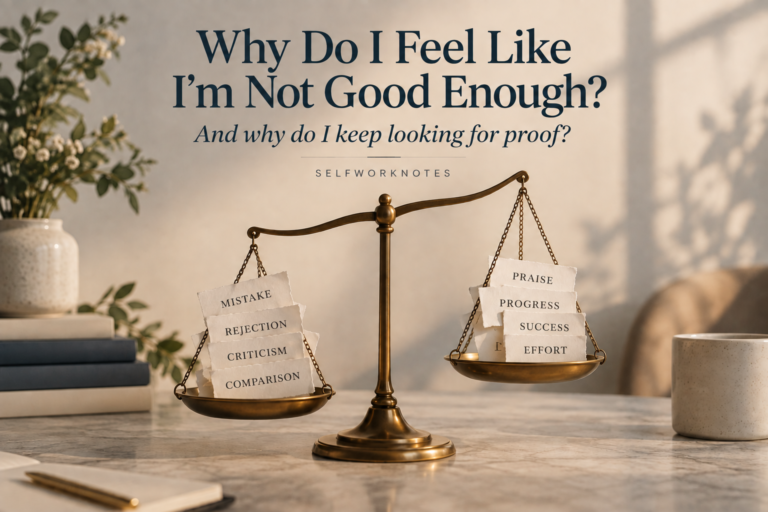
Because if every success gets discounted while every mistake becomes evidence against you, your internal scoring system is never going to give you much credit. You can achieve a lot and still feel like you’re falling behind.
Perfectionism and Self-Worth: You Don’t Necessarily Need Lower Standards
This is the part of perfectionism that deserves more attention.
You don’t necessarily need to stop caring. You don’t need to become someone who thinks “good enough” about everything. Nor do you have to convince yourself that mistakes are wonderful.
You can still want to do your work well and you can also still have ambitious goals.
What may need to change is the condition attached to them. This is where perfectionism and self-worth become important to separate: you can care about the quality of your work without making your worth dependent on the result.
Instead of “I need to do this perfectly to feel good about myself.” try moving toward “I want to do this well because it matters to me. But how well I did it is not a complete measure of who I am.”
That is a much smaller, and potentially much more realistic shift.
Perfectionism and Self-Worth: A Quick Self-Check
If you’re wondering whether your high standards are helping you grow or becoming tied to your self-worth, pause and ask yourself:
1. What are you trying to prove?
Are you trying to do this well because you care about the result or because you need it to prove that you are good enough?
2. When you fall short, what do you tell yourself?
Can you see a mistake or imperfect result as something you can learn from without turning it into a judgment about you?
3. Can you recognize when it’s good enough?
Can you stop improving the work when it has reached a reasonable standard, without feeling as though you are giving up on yourself?
You don’t need to answer these questions perfectly. The point is to notice whether your standards are helping you improve your work or quietly becoming a measure of your worth.
How to Move from Perfectionistic Concerns Toward Healthier Striving
You don’t have to change this pattern overnight. In fact, trying to do that perfectly would be a rather unfortunate way to approach perfectionism.
Instead, start by separating the task from the self.
When something doesn’t go as planned, describe what actually happened before judging yourself. You could try: “The result wasn’t what I wanted.”
Then ask: What would you change if this mistake didn’t make you feel like you’re not good enough?
Maybe the answer is that you would prepare differently or ask for help. Maybe you would stop editing after the point where further improvement has little practical value.
The goal is to care deeply about your work without making your worth dependent on the outcome.
And perhaps that is a more useful definition of progress than becoming less of a perfectionist.
You don’t have to lower the bar for everything and accept mediocrity. You just might want to learn that falling short occasionally doesn’t mean you’re incapable of meeting the standard.
FAQ
Is perfectionism linked to low self-esteem?
It can be. In particular, perfectionistic concerns – such as worrying about mistakes, feeling that you have fallen short, or being highly self-critical – are associated with lower self-esteem. But perfectionism isn’t one single pattern, and not everyone who has high standards struggles with their self-esteem.
Is having high standards the same as being a perfectionist?
No. You can have high standards and still be comfortable with the fact that your work won’t always be perfect. The more important question is what happens when you fall short: can you see it as feedback, or does it quickly become a judgment about yourself?
Can perfectionism and self-worth be related?
Yes, especially when achievement becomes a condition for feeling worthy. If doing well makes you feel like a worthwhile person and falling short makes you question your value, your standards may be doing more than guiding your work — they may be shaping how you see yourself.
Can you be ambitious without being a perfectionist?
Absolutely. You can care about doing excellent work, set challenging goals, and want to improve without making your worth dependent on the outcome. The goal isn’t necessarily to lower your standards. It’s to separate the standard you set for your work from the value you place on yourself.
Further Reading
- Hewitt, P. L., & Flett, G. L. (1991). Perfectionism in the self and social contexts: Conceptualization, assessment, and association with psychopathology. Journal of Personality and Social Psychology, 60(3), 456–470. Read the research
- Frost, R. O., Marten, P., Lahart, C., & Rosenblate, R. (1990). The dimensions of perfectionism. Cognitive Therapy and Research, 14(5), 449–468. Read the research
- Khossousi, V., Greene, D., Shafran, R., Callaghan, T., Dickinson, S. J., & Egan, S. A. (2024). The relationship between perfectionism and self-esteem in adults: A systematic review and meta-analysis. Behavioural and Cognitive Psychotherapy, 52(6), 646–665. Read the research
- Crocker, J., Brook, A. T., Niiya, Y., & Villacorta, M. (2006). The pursuit of self-esteem: Contingencies of self-worth and self-regulation. Journal of Personality, 74(6), 1749–1772. Read the research
- Gäde, J. C., Schermelleh-Engel, K., & Klein, A. G. (2017). Disentangling the common variance of perfectionistic strivings and perfectionistic concerns: A bifactor model of perfectionism. Frontiers in Psychology, 8, 160. Read the full open-access article
AI Transparency : At SelfWorkNotes, we use generative AI as a collaborative tool during the research, writing and creative process. Every article is carefully reviewed, edited and finalized by the author, who remains fully responsible for the published content. Unless otherwise stated, illustrations are created using generative AI.
Gentle reminder: The content on SelfWorkNotes is provided for informational and educational purposes only. It does not constitute medical, psychological, legal or financial advice. Always consult a qualified professional regarding your personal situation.