Why Do I Feel Like I’m Not Good Enough? And Why Do I Keep Looking for Proof?
Have you ever noticed how quickly one small thing can change the way you see yourself and make you ask: Why do I feel like I’m not good enough?
You make a mistake at work and suddenly you’re thinking, I’m just not good at this. Someone doesn’t choose you, and it becomes, Of course. I’m not interesting enough. You see someone else moving forward, and somehow their progress becomes evidence that you’re falling behind.
Then something good happens. Someone compliments you, you handle something well, or you achieve something you’ve been working toward. But instead of letting it count, you let it slip or even find a reason why it doesn’t count: I just got lucky. It wasn’t that difficult. They were probably just being nice.
If you’ve ever wondered why you feel like you’re not good enough, the answer may not be as simple as having low confidence or needing to think more positively.
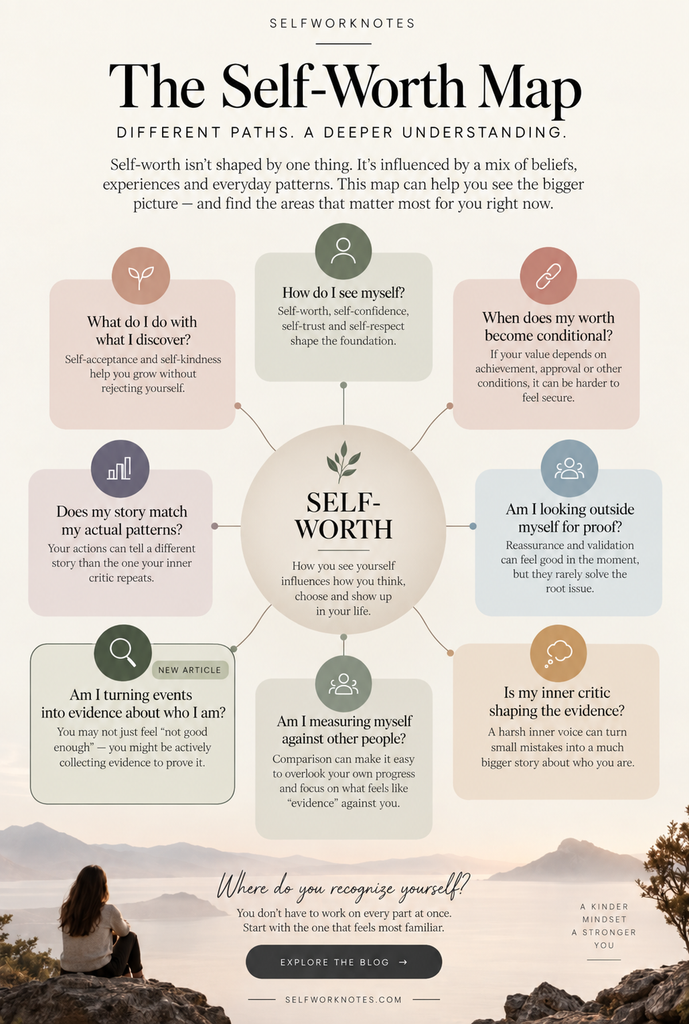
Sometimes, the more interesting question is this: what if you’re not only feeling “not good enough,” but also collecting evidence that seems to prove it?
When an Event Becomes a Verdict
There is a big difference between what happens and what we decide it means.
Imagine you don’t get a job you really wanted. The event might easily get an interpretation: They didn’t think I was good enough. And sometimes, without even noticing, this interpretation can quickly turn into a judgment about your identity: I’m not good enough.
It doesn’t mean that your feelings are imaginary or that every negative experience has a positive explanation. Sometimes you really do make a mistake. Sometimes you have something you need to learn or improve. The question is not whether what happened matters. It’s whether it tells you as much about who you are as you’re making it mean.
This can become especially powerful when your sense of worth is tied to particular conditions, such as achievement, approval, appearance, relationships, or being successful at something. In that case, a setback can feel like a threat to your sense of worth. (Park et al., 2007)
That is one reason it’s useful to separate the event from the verdict. A single event can give you information about that event. It doesn’t automatically give you a complete description of who you are.
And this is where the question “Why do I feel like I’m not good enough?” becomes more interesting. Perhaps part of the answer lies in how quickly ordinary experiences become personal evidence.
Why Do I Feel Like I’m Not Good Enough? And Why Does the Same “Proof” Keep Appearing?
Once you already carry a particular story about yourself, information that fits the story can become especially noticeable.
This is related to what psychologists have studied as confirmation bias: the tendency to favor, seek, interpret, or remember information in ways that are consistent with an existing belief or judgment. Research suggests that people can actively seek information that supports a prior choice or belief, rather than treating all available information equally. (Kaanders et al., 2022; Rollwage et al., 2020)
You don’t even have to consciously decide to do this, it often looks much more ordinary.
You make one mistake and then you say: See? I always do this. Someone criticizes you: I knew I wasn’t good enough. Someone praises you: They’re probably just being nice. You succeed: I got lucky.
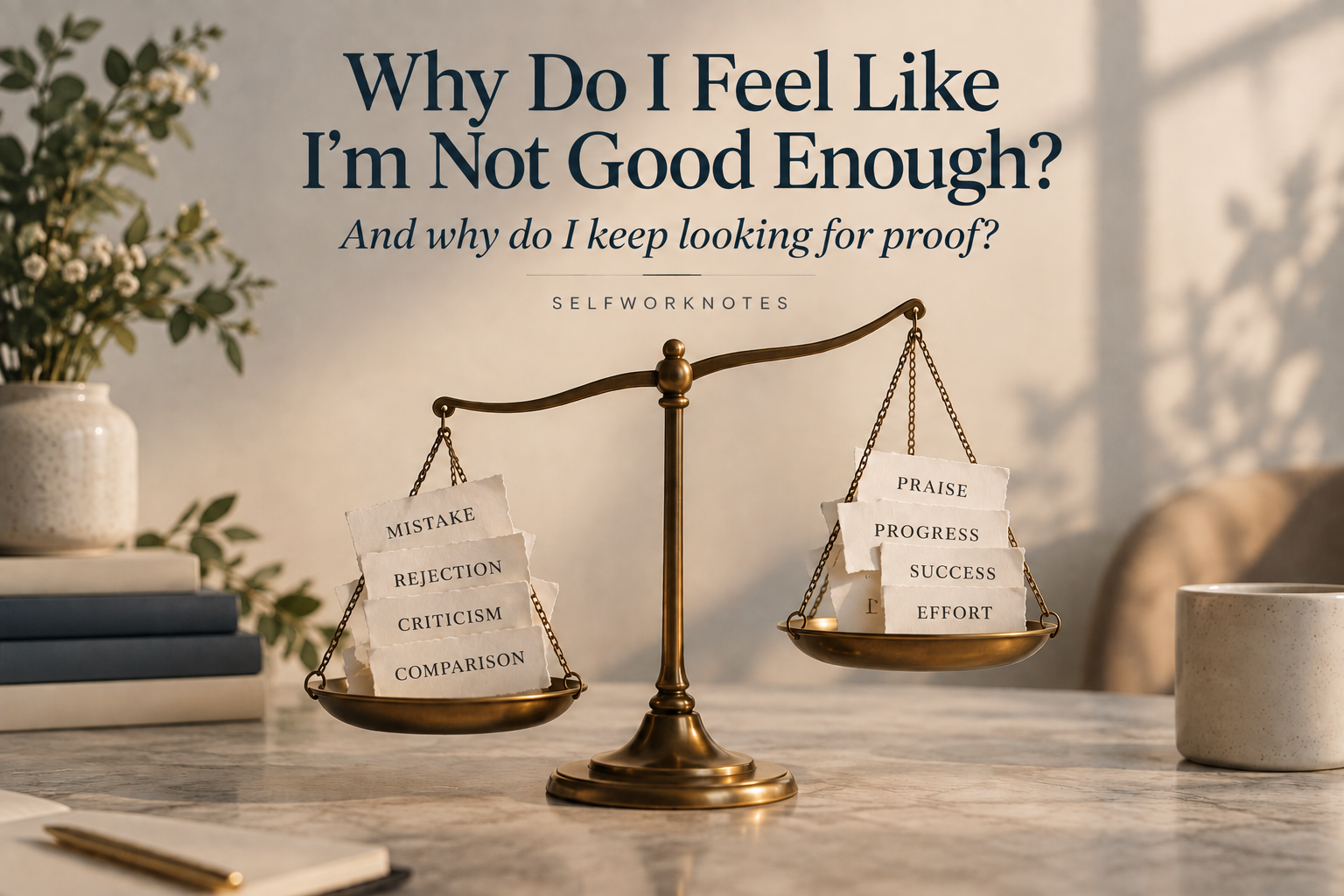
Negative information can start to feel especially convincing, while positive information gets explained away. Over time, that can create a very uneven record, because not everything is being given the same weight..
That creates a strange internal rule: positive evidence needs an explanation for why it doesn’t count. Negative evidence needs no explanation, because it often feels like confirmation.
Now imagine someone you love were being judged this way in court, with some evidence dismissed and other evidence treated as conclusive. You’d probably be outraged. So why would you use the same unfair process when judging yourself?
The Inner Critic Can Turn Information Into Identity
Your inner critic doesn’t always invent a problem, sometimes it starts with something real.
For example: you missed a deadline, you said something you regret or didn’t prepare enough. The useful information might be: I need to handle this differently next time. But the inner critic can add another layer: Of course you messed this up. You always do.
Now the conversation isn’t about the deadline anymore, but you.
This is one reason self-criticism can be so exhausting. A specific problem becomes evidence for a much broader story. The goal isn’t to silence every negative thought or convince yourself that everything you do is wonderful. It’s to notice when a thought has moved from “I did something wrong” to “There is something wrong with me.” There is a big difference between the two.
You might also keep moving the goalposts
You might tell yourself: I’ll finally feel good about myself when I get this promotion. You get it. Then: I’ll feel better when I earn more. You reach that goal. Then there’s another one.
This is one reason conditional self-worth can be exhausting: if your worth depends on constantly meeting the next condition, achievement may provide only temporary relief rather than a stable sense of enoughness.
And comparison can make the evidence even harder to interpret.
Someone else’s progress can become evidence against you. You see what they have achieved, but you don’t see every failed attempt, uncertainty, delay, or private struggle that came before it. Meanwhile, you have access to all of your own unfinished business. That’s not exactly an equal comparison.
Why Do I Feel Like I’m Not Good Enough? Ask What the Evidence Actually Proves
Instead of creating another list of things you’re supposed to think positively about, try examining the jump between the evidence and the conclusion.
You can do this in a few simple steps:
1. Name the event.
What actually happened? Not the story. Just the event.
For example: they didn’t invite me. I made a mistake. I didn’t get the job.
2. Name the interpretation.
What did you immediately make it mean?
For example: they don’t like me. I’m bad at this. I’m not good enough.
This is often where the pattern behind the reaction starts to become visible.
3. Name the verdict.
What did the event seem to say about you as a person?
For example: I’m boring. I’m incompetent. I’m behind. I’m not someone people choose.
This is the point where a situation can become an identity story.
4. Look at the size of the conclusion.
Now ask: Is the conclusion bigger than what happened?
One mistake may tell you that you made a mistake. It doesn’t necessarily tell you that you’re a failure. One rejection tells you that a situation didn’t work out, but it doesn’t necessarily mean that you’re unwanted.
If rejection tends to become personal very quickly, you may also find it useful to explore why rejection can feel so personal in the first place.
5. Ask whether it’s a moment or a pattern.
This step matters because self-kindness shouldn’t become an excuse to ignore real problems.
If you miss one deadline, that’s one event. If you have missed the last ten deadlines, there may be a pattern worth addressing.
A real pattern deserves attention, but it just doesn’t automatically deserve to become a proof of your identity.
This is where the idea of the Self-Authenticity Gap becomes useful: sometimes our repeated actions really do tell us something worth looking at. The goal isn’t to dismiss that information, but to look at it honestly without turning it into a verdict about our entire worth.
Don’t Make the Opposite Mistake
There is another trap here. Once you learn to question negative self-judgments, it can be tempting to swing too far in the other direction, like: “I didn’t do anything wrong”, “Everyone else is the problem”, “It doesn’t matter”.
That’s not what we’re aiming for.
Maybe you really do need to improve something. But you can take that information seriously without using it as proof that you’re not good enough.
In fact, research on self-compassion suggests that responding to personal failure with greater self-compassion can coexist with, and in some situations support motivation to improve. In experiments, people in self-compassion conditions showed greater motivation to make amends, avoid repeating mistakes, study after failure, and work on weaknesses. (Breines & Chen, 2012)
So kindness doesn’t have to mean lowering your standards. It can mean looking at the event without attacking the person who has to deal with it.
What Do You Do with the Evidence You Actually Find?
After you separate the event from the story, you may discover one of three things.
1. There is something you might need to change.
Now you have something concrete to work on.
2. There is something you might need to accept.
Not everything can be fixed, controlled, or changed.
3. There isn’t actually enough evidence for the conclusion you drew.
Then you don’t need to keep building a case against yourself.
This is where self-acceptance and self-kindness become practical rather than abstract.
Self-compassion isn’t about pretending that mistakes don’t matter. Research describes it as responding to yourself with kindness and understanding in the face of suffering, inadequacy, or failure, rather than relying on self-judgment. (Neff, 2023)
You Don’t Have to Keep Proving Your Worth
You will make mistakes and you will be rejected sometimes. There will also be people who are better than you at certain things. But none of that makes you less worthy.
The goal isn’t to convince yourself that every negative experience means nothing, either. It’s to become more careful about what you allow those experiences to mean.
A mistake can be information without becoming an identity. A rejection can hurt without becoming a conclusion about who you are. Someone else’s success can be real without becoming evidence against you.
And something you need to improve can remain exactly that: something to improve – not proof that there is something wrong with you.
So if you’ve been asking this question “why do I feel like I’m not good enough?”, perhaps there’s another question worth asking too:
What have I been counting as proof about my identity and what have I been leaving out?
Further Reading
- Park, L. E., Crocker, J., & Kiefer, A. K. (2007). Contingencies of self-worth, academic failure, and goal pursuit. Personality and Social Psychology Bulletin, 33(11), 1503–1517. Read the research
- Kaanders, P., Sepulveda, P., Folke, T., Ortoleva, P., & De Martino, B. (2022). Humans actively sample evidence to support prior beliefs. eLife, 11, e71768. Read the article
- Rollwage, M., Loosen, A., Hauser, T. U., Moran, R., Dolan, R. J., & Fleming, S. M. (2020). Confidence drives a neural confirmation bias. Nature Communications, 11, 2634. Read the article
- Breines, J. G., & Chen, S. (2012). Self-Compassion Increases Self-Improvement Motivation. Personality and Social Psychology Bulletin, 38(9), 1133–1143. Read the research
- Neff, K. D. (2023). Self-Compassion: Theory, Method, Research, and Intervention. Annual Review of Psychology, 74, 193–218. Read the research
AI Transparency : At SelfWorkNotes, we use generative AI as a collaborative tool during the research, writing and creative process. Every article is carefully reviewed, edited and finalized by the author, who remains fully responsible for the published content. Unless otherwise stated, illustrations are created using generative AI.
Gentle reminder: The content on SelfWorkNotes is provided for informational and educational purposes only. It does not constitute medical, psychological, legal or financial advice. Always consult a qualified professional regarding your personal situation.