Self-Confidence, Self-Trust, Self-Worth, and Self-Respect: Why They Are Not the Same Thing
Most people use words like confidence, self-worth, self-respect, and self-trust interchangeably. But they are not the same thing. In fact, you can be strong in one area while struggling in another. You can be highly confident at work and still doubt your personal decisions. You can know your worth and still struggle to set boundaries. You can trust yourself in a crisis and still seek validation from others. And if you don’t know which one is actually missing, it becomes very difficult to understand what needs attention. Because the solution depends on the problem. In the below article, we look at the difference between self-confidence vs self-trust, self-worth and self-respect.
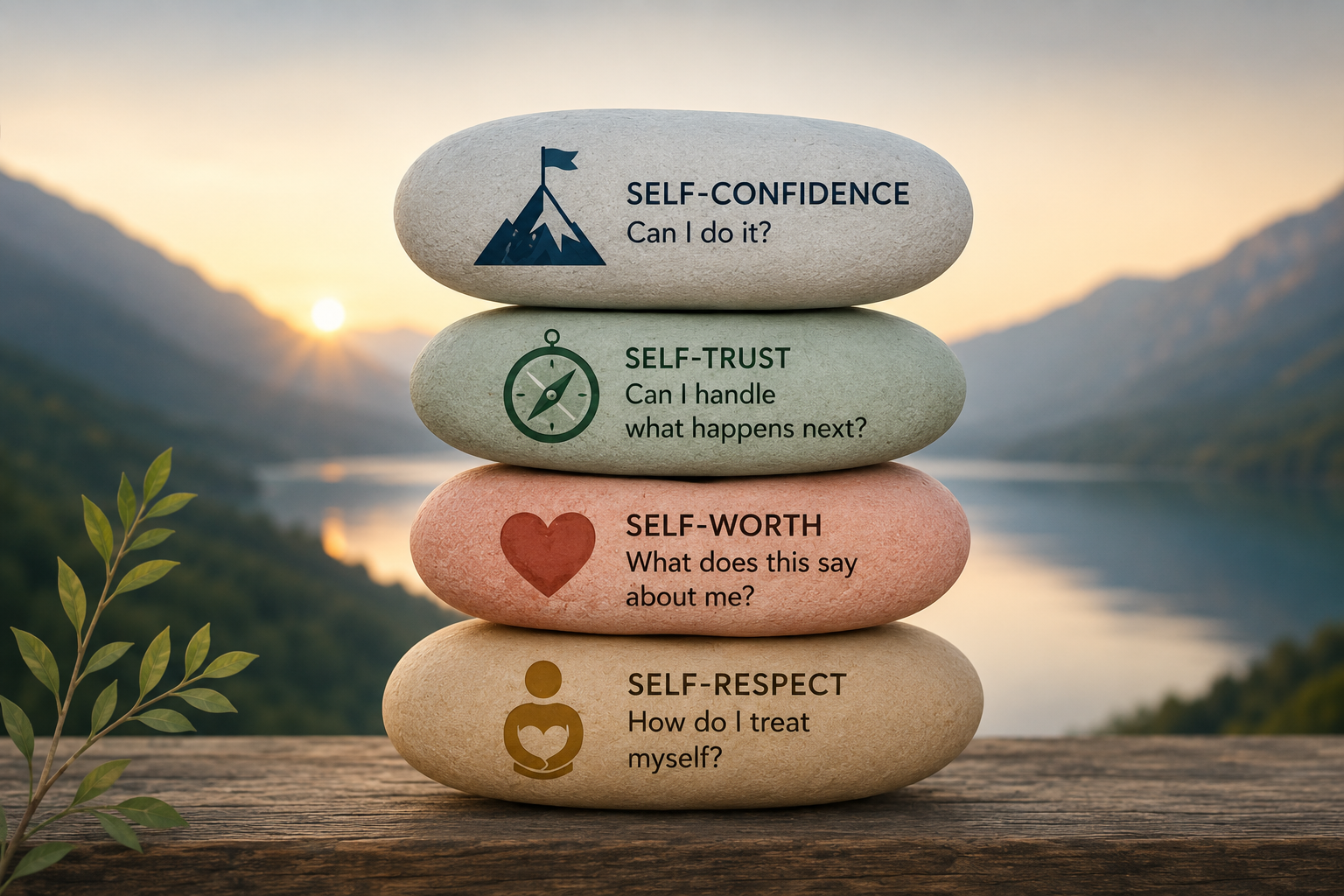
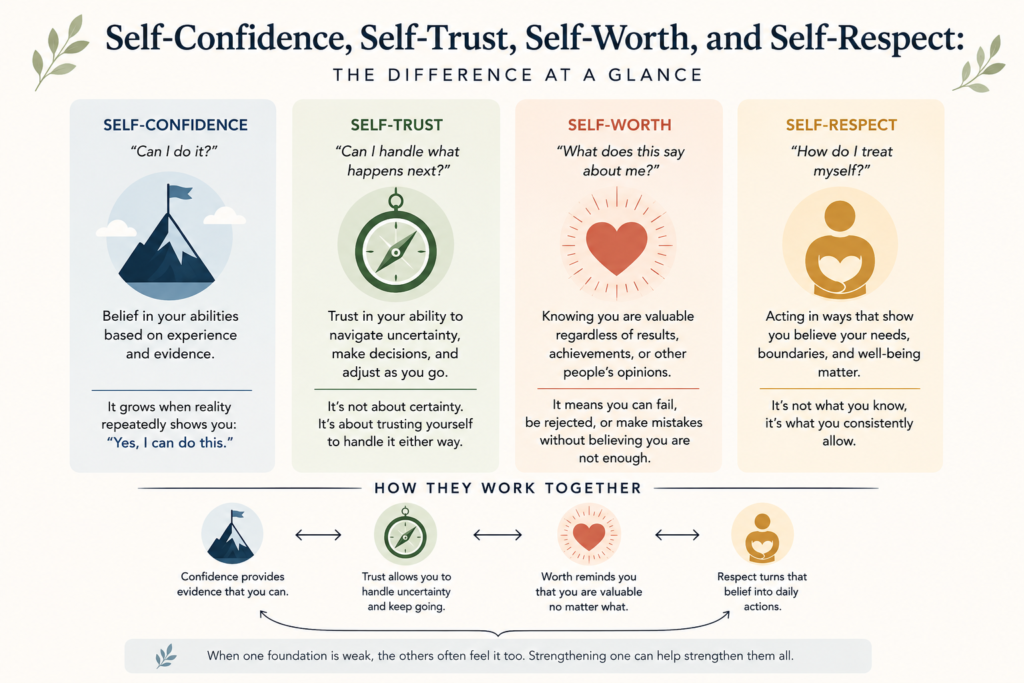
Self-Confidence: “Can I Do It?”
Self-confidence is probably the concept people are most familiar with.
At its core, confidence answers one question: “Can I do this?”
Unlike what many people assume, confidence is often built through experience.
A CEO becomes confident leading a company because they have done it before.
A musician becomes confident performing because they have practiced for years.
A surgeon becomes confident because they have successfully completed countless operations.
Confidence grows when reality repeatedly shows you:
“Yes, I can do this.”
This is why confidence is often specific.
Someone can feel highly confident in their profession and deeply insecure in dating.
Confident in public speaking and uncertain in relationships.
Confident in a crisis and nervous in social situations.
Confidence is usually connected to (positive) evidence and experiences. The more you collect of these, the stronger it becomes.
Self-Trust: “Can I Handle What Happens Next?”
This is where many people confuse confidence with something else.
Self-trust is not about believing that you will always make the right decision. It is more about believing that you can handle the consequences even if you make the wrong decision. You may not know whether changing jobs is the perfect choice, whether a relationship will work or a new opportunity will succeed.
Self-trust says:
“I don’t need certainty before I move forward. I will do it anyway and make adjustments if needed.”
Many people who struggle with self-trust spend years searching for the perfect answer, the perfect plan, or one more opinion.
Not because they lack intelligence or capability, but because they don’t fully trust themselves to handle uncertainty.
The goal of self-trust is not to eliminate risk, but to trust your ability to navigate it.
Self-Worth: “What Does This Say About Me?”
This is where things become deeper.
Self-worth is not about what you can do. It is about what you believe you are worth regardless of outcomes.
Self-worth says:
“If I fail in making the right decision, it doesn’t mean I am a failure. It just means I might need to change something in how I made that decision.”
Self-worth means you can be rejected without concluding that you are unlovable. You can make mistakes without concluding that you are inadequate.
When self-worth is fragile, achievements often become evidence. Evidence that you matter, that you are enough or that you deserve appreciation.
This is why so many patterns we have discussed before often connect back to self-worth:
- people pleasing
- emotional responsibility
- burnout
- validation seeking
- perfectionism
The hidden question underneath many of these behaviors is often:
“What does this outcome say about me?”
And unfortunately, no achievement can permanently answer that question.
Because if your worth depends on outcomes, there will always be another outcome to chase. Another success, another promotion, another person to impress, another reason you must prove yourself again.
Self-Respect: “How Do I Treat Myself?”
Self-respect is where self-worth becomes visible. Because it is one thing to believe that your needs matter and another thing to act like they do. This is why self-respect often appears in moments where there is a cost.
When setting a boundary may disappoint someone, resting may trigger guilt, or saying no may create tension.
Self-respect asks:
“Do I treat myself as if I believe I am valuable?”
Because many people know exactly what they deserve.
The challenge is not always the awareness itself, but also acting on it.
For example:
When you know you need rest, do you take it?
When you are aware that your relationship is unhealthy, do you leave it?
When you absolutely feel that this workload is unsustainable. Do you do something about it?
Self-respect is not what you believe, it is what you consistently allow.
Why Different People Struggle with Different Foundations
At this point, you may be wondering:
“Why do I struggle with self-trust but not confidence?”
Or perhaps:
“Why can I see my worth intellectually, but still struggle to act like it?”
The answer is that these qualities often develop through different experiences and patterns.
When Self-Confidence Is Missing
Self-confidence is usually the most experience-based of the four.
It often grows when you repeatedly face challenges and discover that you can handle them. This is why confidence can improve relatively quickly when you gain skills, knowledge, and experience.
But confidence may struggle to develop if your attempts were repeatedly criticized, discouraged, or interrupted before you had the chance to build trust in your own abilities. Because you may start to feel: “You can’t do this.”
In a critical environment you may start doubting abilities you have already demonstrated many times. The skills may still be there, what changes is their confidence in those skills.
When Self-Trust Is Missing
Self-trust often struggles when your own judgment is repeatedly replaced by someone else’s.
Perhaps a parent constantly corrected your decisions. Maybe mistakes were treated as something dangerous rather than something you could learn from. Or maybe someone was always there to decide for you, solve problems for you, or tell you what the “right” choice was.
Over time, you learned: “Other people know better than I do.”
This is why many adults who struggle with self-trust constantly seek reassurance, additional opinions, or perfect certainty before making decisions.
Not because they lack intelligence, but because they learned to trust other people’s judgment more than their own.
When Self-Worth Is Missing
Self-worth often becomes fragile when love, approval, attention, or acceptance feel conditional.
The child might learn it through experience that they are only valuable when they perform.
Because praise appears when they achieve, approval appears when they behave. Attention appears when they make others happy. The hidden rule says they are valuable because of what they do.
This pattern often sits underneath people pleasing, perfectionism, exhaustion which feels like burnout, validation seeking, and the constant pressure to prove yourself.
When Self-Respect Is Missing
Self-respect often struggles when protecting yourself feels selfish, dangerous, or unacceptable.
Perhaps you learned that other people’s needs come first. Perhaps conflict felt unsafe.
Perhaps saying “no” led to guilt, criticism, or disappointment.
Over time, many people become very skilled at understanding what they need, they they simply struggle to give themselves permission to act on it.
Because most probably they learn a hidden rule, like: “Taking care of myself comes at someone else’s expense.”
As a result, people may repeatedly abandon their own needs, not because they don’t matter, but because prioritizing themselves feels uncomfortable.
One important thing to remember is that these foundations do not exist in isolation, they constantly influence one another.
Self-Confidence vs Self-Trust vs Self-Worth vs Self-Respect
Although these concepts are different, they highly influence one another. Also, a challenge in one area can sometimes affect the others.
For example, someone may have years of experience, strong skills, and plenty of evidence that they are capable. Yet a highly critical environment can slowly make them question their own judgment. At first, the problem seems to be with the confidence, but sometimes the deeper issue is trust. Not: “Can I do this?”, but “”Can I trust my own assessment of what I can do?”
Likewise, when self-worth becomes fragile, self-respect often becomes more difficult. Because it is much harder to protect your needs, boundaries, or wellbeing when part of you doubts whether they matter in the first place. This is why personal growth is rarely about fixing a single quality in isolation.
The foundations support one another. And strengthening one of them often helps strengthen the others as well.
Confidence, for example, can strengthen trust. Every time you successfully handle a challenge, you collect evidence that you are capable.
It also works the other way round: trust can strengthen confidence. The more you trust yourself to recover from mistakes, the less afraid you become of trying.
Self-worth supports self-respect. It is easier to protect something when you genuinely believe it matters.
And again, the other way round: self-respect often strengthens self-worth. Because every time you keep your own boundaries, needs, and values, you send yourself a powerful message:
“I matter, too.”
This is why personal growth rarely happens through one dramatic breakthrough, but rather through small moments repeated consistently.
A boundary, a difficult conversation, a decision you make without endless reassurance, or a day of rest without guilt.
And this is great news for two reasons:
- you can use this pattern consciously to strengthen any field you feel you might need to improve.
- you don’t need dramatic changes, only tiny steps, and to show up every single day.
Where Do You Start?
Many people read concepts like these and immediately ask:
“Which one do I need to work on first?”
Start with the one that feels weakest. If you constantly doubt your abilities, build confidence through experience. If you struggle to make decisions, practice trusting yourself in smaller situations first. If your value feels tied to performance, begin questioning what achievements are carrying for you. If you know your needs but rarely honor them, practice self-respect through small boundaries.
How do you start? Try to seek success in your past. Even if just tiny stories that feel insignificant. Because they are most probably not. They already may show you: how you were able to make right decision alone, or how you overcame a challenge. It is okay if this past success “only” happened at work, in an environment which may feel second nature for you. Maybe such an “insignificant” story will highlight that you could actually set boundaries, and it met acceptance. Or taking care of yourself didn’t meet any criticism.
Most importantly: what can you implement from those mini success stories for your long-term development? And how can you put these into practice in small, daily, baby-steps?
What would you do if nothing were at stake?
You do not need to transform everything overnight, you only need to strengthen one foundation enough for the others to begin growing with it.
These Qualities Are Not Permanent Achievements
One final thing is worth remembering: life will always continue testing your confidence, trust, worth and respect.
A difficult relationship, for example, may challenge your self-worth. Or a critical environment may challenge your confidence. A major decision may challenge your self-trust. A demanding situation may challenge your self-respect.
Challenging situations don’t come up again and again because you haven’t developed a tiny bit, but because life happens. The aim is not to become untouchable, but to be able to see if any of these fields have been harmed and how you can rebuild them.
Final Thoughts
Many people spend years trying to improve their confidence when confidence was never the real issue. Sometimes the missing piece is trust or self-worth. Maybe it is respect. Understanding the difference can change the way you approach personal growth. Because these qualities support one another, but they are not interchangeable.
You can do it. (Self-confidence.)
You can handle it. (Self-trust.)
You are valuable. (Self-worth.)
Act like it. (Self-respect.)
If you found this article interesting, stay tuned, we will explore self-trust and self-worth in more detail in the future articles.
AI Transparency : At SelfWorkNotes, we use generative AI as a collaborative tool during the research, writing and creative process. Every article is carefully reviewed, edited and finalized by the author, who remains fully responsible for the published content. Unless otherwise stated, illustrations are created using generative AI.
Gentle reminder: The content on SelfWorkNotes is provided for informational and educational purposes only. It does not constitute medical, psychological, legal or financial advice. Always consult a qualified professional regarding your personal situation.