A Personal Branding Exercise That Helps You See Yourself Differently
A practical exercise for building self-worth and identity through branding.
Most personal branding exercises are designed to help you shape how others see you. This personal branding exercise is different. Instead of focusing on promotion, it uses the branding process to help you better understand yourself.
Most of us spend a surprising amount of time thinking about who we are. We ask ourselves questions like: Am I good enough? What are my strengths? Why do I keep doubting myself? How can I become more confident? Interestingly, very few of us would describe these questions as being about our personal brand. We usually associate personal branding with careers, LinkedIn profiles or social media. But what if your personal brand had much less to do with promoting yourself, and much more to do with understanding yourself?
One of the biggest challenges about seeing our self-worth is that we try to look at ourselves from the inside. And that turns out to be surprisingly difficult. After all, we’re trying to evaluate something we’re standing inside of.
When we try to evaluate ourselves directly, our experiences, insecurities, expectations and emotions all become part of the picture. We are simultaneously the product, the marketer, the customer and often our own harshest critic. No wonder the picture sometimes feels blurry.
So what if, instead of looking inward even harder, you simply changed the perspective?
Don’t be surprised if this personal branding exercise takes longer than you expected. Most people discover that describing a brand objectively is much easier than describing themselves.
Why This Personal Branding Exercise Starts with Your Existing Brand
Whether you’ve consciously built it or not, people already experience something when they interact with you. The question isn’t whether your personal brand exists, because it does. Just think about the opinion people have of you.
The question is whether you’re intentionally shaping your own brand or leaving it to chance.
By shaping your own brand, we don’t mean carefully managing how people see you or trying to appear perfect. Rather, we mean becoming intentional about the values, boundaries and qualities your actions consistently communicate.
This isn’t about curating an image on social media. It’s more about defining your values, boundaries, your strengths and the experience you want to create when connecting to people. Because if you don’t define these yourself, circumstances often define them for you. And that’s rarely the kind of identity people truly want to build.
Perspective Change: Looking at Yourself Like a Personal Brand
Imagine, for a moment, that you are not evaluating yourself, you’re evaluating a brand. Not a famous company, but a brand called You. You can even name the brand after yourself. Why a brand? Because you can look at a brand much more objectively than when you evaluate yourself.
Even the questions you ask are different. You may start to consider what the brand’s value proposition is, what it promises, how it is different from others, who it is for or what your brand experience is.
Interestingly, none of these questions ask whether the brand is “good enough”, and real-life brands also don’t usually grow by constantly asking whether they deserve to exist. They grow by becoming clearer about who they are.
Maybe if you also start looking at your own personal brand values, you might also become clearer about your self-worth, as well.
From Invisible Assets to Identity
In the previous article, we explored the idea of Invisible Assets: the abilities and qualities that quietly sit behind your visible achievements. These can be, for example: communication, humor, empathy, persistence, curiosity, resilience.
Those qualities matter because they remain, even when circumstances change. But knowing your assets is only the beginning. Next comes “branding”, when you try building an identity from these values. This is what this personal branding exercise aims to help you with.
A company doesn’t become successful simply because it owns valuable resources, either. It becomes successful because it knows how to combine them into something coherent.
Identity works much the same way. Self-worth might not grow only by discovering your strengths, it might also grow by understanding what they stand for together. Because communication on its own is just a skill, curiosity is just another one, empathy is also another. But together they may describe someone who naturally builds trust, someone who helps people feel understood.
The individual qualities matter, but the pattern they make matters even more.
Where Do You Position Yourself? A Strong Brand Doesn’t Try to Be for Everyone
One of the most fascinating things about branding is something many people find uncomfortable: not to fit in at all costs.
People spend enormous amounts of energy trying to be accepted by everyone. We soften our opinions, tend to hide parts of our personality to be accepted, or say yes when we’d rather say no. We adapt so often that we eventually lose sight of what we actually stand for.
This personal branding exercise invites you to pause and shift your focus for a moment. Instead of asking whether you are acceptable or not, what if you asked a different question this time: if you were a brand, where would you position it?
This time don’t look at yourself through the critical lens of yours or others: “This person is so awkward”, or “pathetic”, you name it. This time, look at yourself as if you had to build this brand for a company. Where would you position it?
A good brand has a clear view of who their target audience is and who are not, what it stands for and what it doesn’t.
Great brands aren’t trying to appeal to everyone. In fact, they become stronger because they don’t. A luxury brand doesn’t apologize for being expensive. A budget brand doesn’t pretend to be exclusive. Neither is objectively better, they’re simply clear about who they are.
Self-worth often isn’t only about believing that you have value but allowing yourself to be specific. To know what you represent and what you don’t. To understand that not everyone has to choose your brand for you to be valuable.
That is not rejection, it’s positioning. Setting boundaries. Self-respect. Identity.
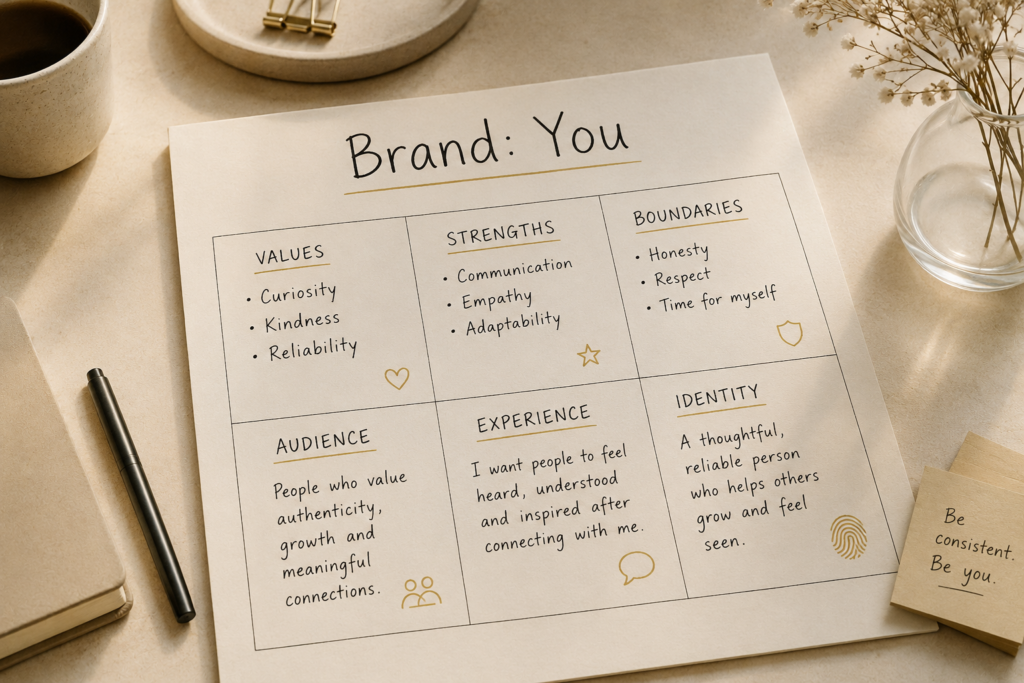
A Personal Branding Exercise
This exercise follows a similar logic to the actual brand-building practice of big companies. You can build this model to three levels. First, you might want to gain clarity of your invisible assets, as well as your strengths, weaknesses to see your “current” identity. Second, if you want to adjust this picture, you could define how this brand could look like in the future, and third, you could set up how you could get to that desired brand image.
Step 1 – Personal Brand Audit: Who Am I Today?
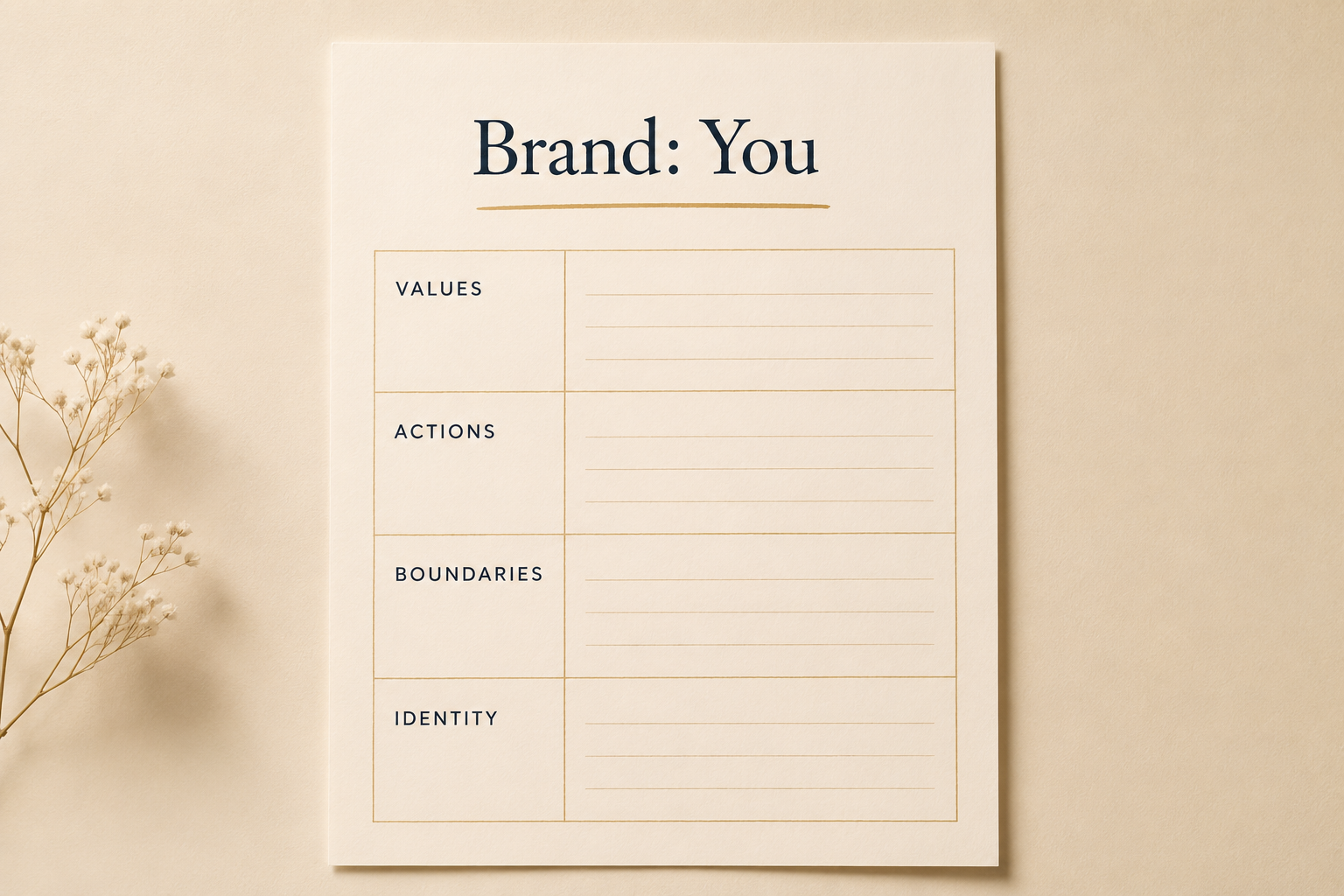
Take a sheet of paper and write one sentence at the top.
Brand: Your Name
Forget your CV, your job title or your achievements. Imagine you have to build this brand from the ground up.
Answer questions like below. You can list both your positive and negative traits to have an honest view of yourself and see what you can build on and what you may want to work on later.
- What does this brand stand for?
- What values does it have and what would people consistently associate with it?
- Strengths and weaknesses?
- What makes it different from others?
- What experience does it create?
- Who naturally connects with it?
- Who is this brand for? Who isn’t?
- Which Invisible Assets make this brand possible?
- What partnerships would this brand give its name to, and what would it refuse? Don’t forget, the image of your partner brands also affects your own image.
- What treatment does this brand allow?
- What are your brand’s boundaries? Would it accept if it was lied to, would it accept if someone else tried to set the conditions or you would go on your own terms?
Don’t worry about finding perfect answers. You don’t have to invent a better version of yourself right now, the goal of this personal branding exercise is to get clear about your identity and your self-worth first.
What you could also aim for is to get as detailed and as specific as possible, because it also helps the process of getting clarity about your identity.
One note about the potential weaknesses: “I’m awkward” and similar “traits” might often feel true, but they still don’t really tell you what can actually be changed. Vague answers like that cannot take you any closer to a solution. But if you give yourself a specific reason why you feel awkward: maybe because you often have hard time setting boundaries and you often please people? Or because you often overthink and monitor others’ emotions in social gatherings? Such answers can already show some patterns you might want to work on.
And yes, at first, the exercise feels almost artificial. You’re describing a fictional brand, then, after a few minutes, you realize you’re no longer talking about a brand, but yourself.
The patience you listed, the curiosity, the calmness under pressure, reliability, the humor, the ability to explain complicated things simply, or the ability to make connections with strangers easily. Those aren’t branding slogans, they’re your everyday behaviors.
Step 2 – Personal Brand Positioning: Define Your Desired Brand
Once you have clarity about your values, you might also want to define if you want to change anything in yourself and who you want to become. In other words, what would your Desired Brand would like in five years.
Staying with the above example, let’s say, your brand’s values are:
- Reliable
- Curious
- Calm
- Helpful
Weakness:
- Overthinks social situations
Compared to this, the Desired Brand could look something like:
- Still reliable
- Still calm
- But communicates more openly
- Shows more personality
- Initiates conversations
- Builds relationships intentionally
Step 3 – Turn Your Personal Branding Exercise into Action
Once you have a view of how your current and Desired Brand look like, you might want to define how you are getting there.
Just think about companies: when they want to become a more youthful brand, they don’t just sit and keep repeating: “We are a youthful brand”, but they make changes in their visuals, communications, marketing, customer experience, even maybe in the product design, as well.
Similarly, if your personal brand wants to be more open, your strategy won’t be a sentence like ”Starting tomorrow, I will be extroverted.”
Ask yourself: What is one small thing this brand would do differently this week?
You could apply small, persistent steps that with time lead to a more open version of yourself.
You could start, for example, contacting an acquaintance you haven’t seen for a while, visit a nearby event, initiate a very brief small talk at the cashier, or just smile at someone, even if it’s a stranger.
One important point here is, just like in most cases when you want to put changes into practice, you do small steps, repeatedly and consistently, until the new becomes ordinary.
Perhaps that’s why strong brands aren’t built in a day, and neither are strong identities. Both grow through small, consistent choices that gradually become part of who they are.
Final Thoughts
This personal branding exercise doesn’t ask you to convince yourself that you’re valuable, it asks you to understand what kind of values you already have and create, and it may also support your personal growth in different areas of your life.
And maybe that’s a more stable foundation for self-worth, because achievements, jobs, relationships change. Even our roles in life can change. But when you are clear about what you, “your brand” truly stands for, you become clearer about your identity, as well.
And perhaps that’s where self-worth becomes a little less dependent on the world outside you, because you’ve finally found a clearer way of seeing who you’ve been all along and who you want to become in the future.
AI Transparency : At SelfWorkNotes, we use generative AI as a collaborative tool during the research, writing and creative process. Every article is carefully reviewed, edited and finalized by the author, who remains fully responsible for the published content. Unless otherwise stated, illustrations are created using generative AI.
Gentle reminder: The content on SelfWorkNotes is provided for informational and educational purposes only. It does not constitute medical, psychological, legal or financial advice. Always consult a qualified professional regarding your personal situation.