The Self-Authenticity Gap: Does Your Life Reflect the Person You Believe You Are?
If you haven’t read the previous exercise yet, start with The Personal Branding Exercise for Self-Worth. This article about the Self-Authentictiy Gap builds directly on it.
In the previous exercise, you looked at yourself like a personal brand. You explored your values, strengths, boundaries and the qualities you believe define you. The goal wasn’t to create a better image, but to step outside yourself long enough to see your identity more clearly.
But every brand eventually faces the same question: does the experience match the promise? This question can also be applied to us.
Not because we are products; this is not what we mean.
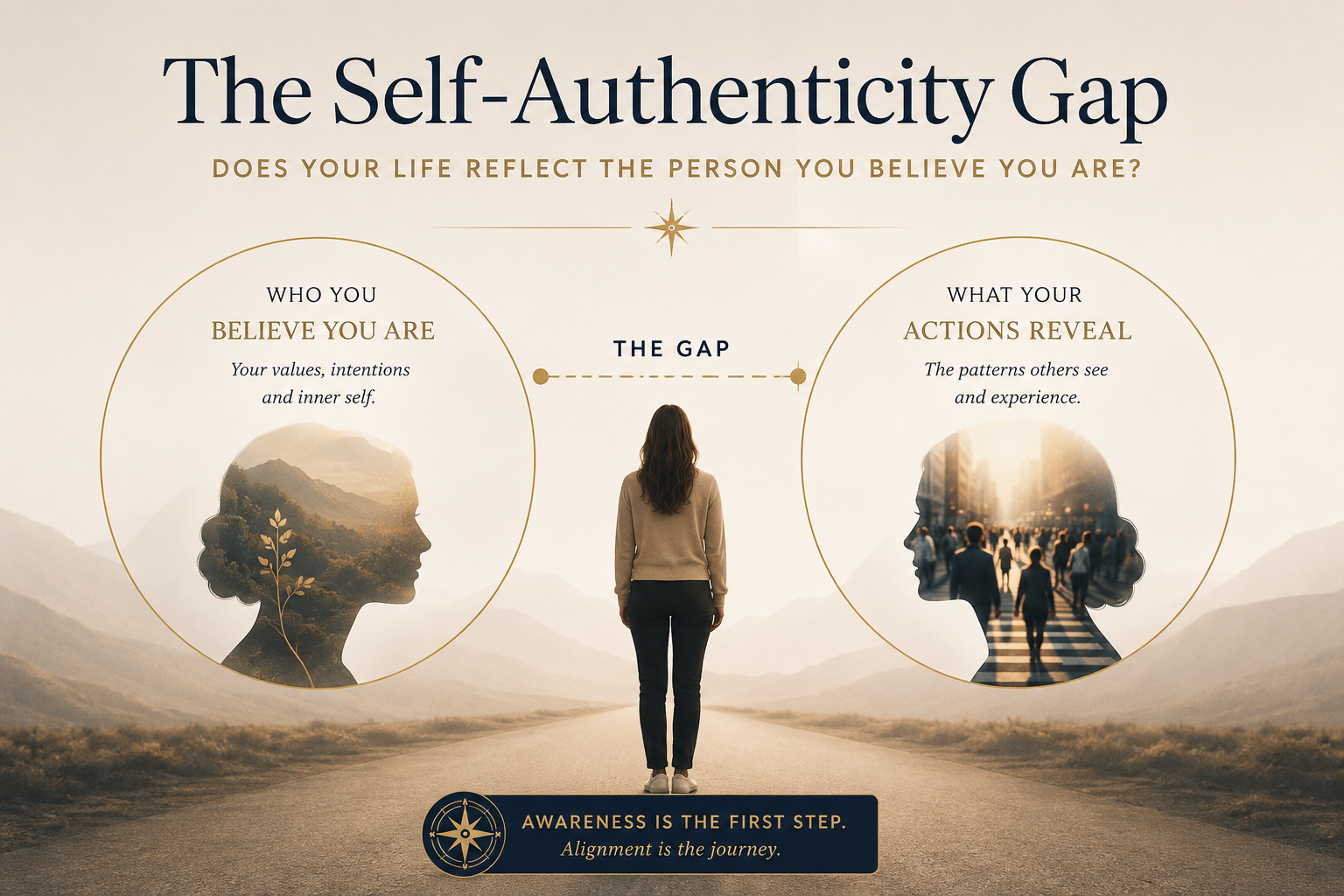
But we often know ourselves through our intentions, while everyone else only sees our patterns through our daily actions.
And sometimes, those two don’t exactly add up.
We Know Our Intentions. Other people can only observe our repeated behavior.
The interesting part is that neither perspective is necessarily wrong.
You know your reasons – a difficult week at work, a family situation others might not know about. You might also be the only one to know the anxiety behind saying yes, or the exhaustion behind cancelling plans.
Other people don’t have access to any of that. They can only observe what happens repeatedly.
If someone asked you who you are, you would probably describe your values.
You might say, for example, you’re honest, curious, kind, reliable, and creative. But these are descriptions from the inside.
Now imagine something different. What if you could only observe your own actions from the last three months through the eyes of a complete stranger? Only actions, nothing else. No intentions, internal dialogue, explanations, memories, reasons., only what repeatedly happened.
- How did you spend your time?
- Where did your energy go?
- What did you repeatedly say yes to?
- What did you consistently avoid?
- When someone criticized you, how did you usually respond?
- How often did you choose rest over productivity?
- How often did you protect your boundaries?
Based only on those repeated actions, what values would you assume this person has? That question is uncomfortable, but it can also be incredibly revealing.
Self-Authenticity Gap Explained
Self-Authenticity Gap
The distance between the person you believe you are and the story your repeated actions tell is what we’ll call your Self-Authenticity Gap. It is not a measure of your worth, but a way of comparing your values with the patterns your daily behavior consistently reveals.
It’s information about patterns. And these are more like data than verdicts. If your actions don’t consistently reflect your values, the most useful response isn’t self-criticism, but asking why it might happen so.
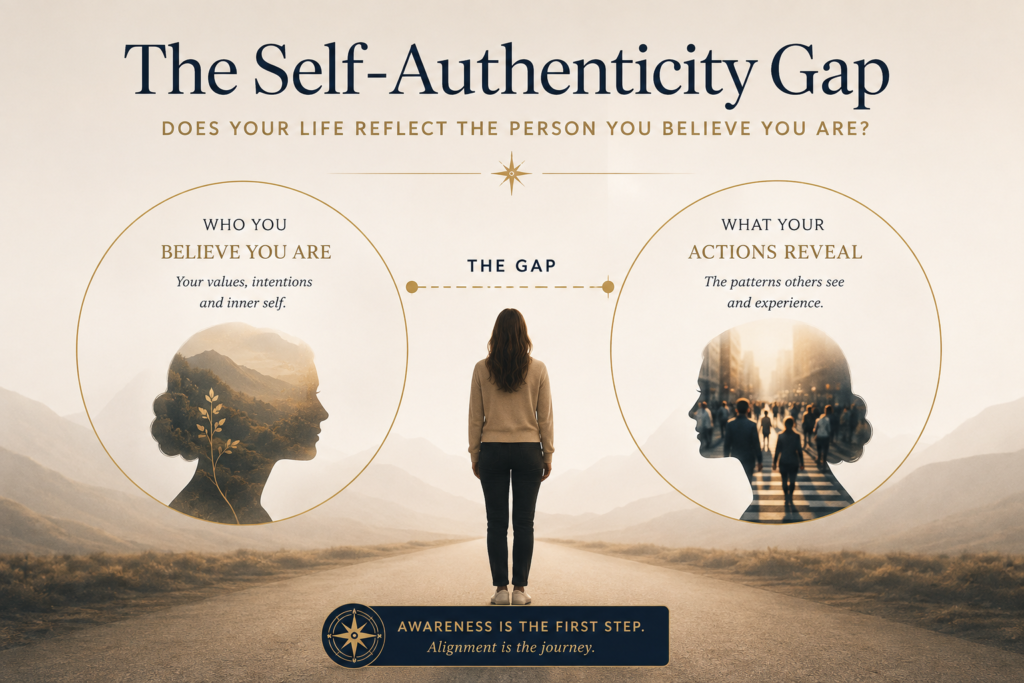
Why Gaps Exist
There are many reasons why our behavior doesn’t always reflect what matters most to us. It can be fear, people-pleasing, habits, stress, exhaustion, just to mention a few.
Sometimes values collide. For example, you value honesty, but you also value kindness. You value ambition, but also your health. Or you value helping others, but struggle to ask for help yourself. Life is rarely simple enough for perfect consistency.
Which is exactly why the Self-Authenticity Gap exercise isn’t about judging yourself, but about understanding yourself.
Many discover the gap and immediately turn it into criticism: “I’m weak.” “I’m just not disciplined enough.” “Maybe this isn’t who I really am.” That isn’t the purpose of this exercise.
Instead of asking what’s wrong with you, try asking a different question: what keeps creating this pattern. Other people can only observe our repeated behavior.
Building Evidence Instead of Chasing Identity
Now return to the Brand Audit from the previous exercise and compare the description you created there with the patterns you’ve just noticed. Where do they align and where do they differ? This difference will give the Self-Authenticity Gap.
You don’t have to change everything at once, maybe it’s not even realistic. Just choose one small behavior that would make the two pictures slightly more consistent. That brings the two closer together.
For example: if your values include honesty, you could express one difficult opinion respectfully instead of staying silent. If it doesn’t go easily, you could first try in a situation where the stakes are low.
Or, if your values include protecting your time, perhaps you could decline an invitation that you would normally accept out of guilt.
Or, if your values include creativity, you could spend twenty minutes a week creating something instead of only thinking about it.
Identity transformation doesn’t happen overnight, but if you keep repeating small actions, they become repeated patterns. And those can create new evidence. Over time, our identity often begins to follow this evidence.
A Final Thought
You don’t become a different person because you decide to, but because, little by little, your actions begin telling a different story. Not a perfect one, just a story that reflects your values a little more honestly than yesterday.
The goal of the Self-Authenticity Gap model is not necessarily to become someone else, just slowly reduce the distance between who you believe you are and what your life consistently reveals.
If you haven’t completed the Brand Audit yet, you might want to visit this article.
AI Transparency : At SelfWorkNotes, we use generative AI as a collaborative tool during the research, writing and creative process. Every article is carefully reviewed, edited and finalized by the author, who remains fully responsible for the published content. Unless otherwise stated, illustrations are created using generative AI.
Gentle reminder: The content on SelfWorkNotes is provided for informational and educational purposes only. It does not constitute medical, psychological, legal or financial advice. Always consult a qualified professional regarding your personal situation.