
How to Be Proud of Yourself Without Putting Yourself Down
Learning how to be proud of yourself can sound like a simple thing. You accomplish something difficult, you do something well, or someone tells you they are impressed, and you let yourself feel good about it.
But for many people, that isn’t what happens.
You finish a difficult project and immediately think about what could have gone better. Someone tells you that you handled something exceptionally well, and you explain why it wasn’t actually that impressive. Someone compliments your clothes, and instead of simply saying thank you, you point out how old or inexpensive they are.
You may not even notice that you’re doing it. The response can be almost automatic.
And this is where learning how to be proud of yourself becomes more interesting. The goal isn’t to become someone who constantly praises themselves. It’s to become someone who can hear something good about themselves without immediately building a case against it.
Being proud of yourself and being comfortable with praise aren’t exactly the same thing, but they can overlap in an important way: both require you to allow positive information about yourself to count.
Why Is It So Hard to Be Proud of Yourself?
Sometimes the problem isn’t that you don’t achieve enough. It’s that you don’t allow what you achieve to count.
You might reach a goal you’ve worked towards for months, only to move the goalposts immediately. You finally finish something difficult, then tell yourself that it wasn’t actually that hard. Or you compare your achievement with someone else’s and decide yours doesn’t really count.
This can create a strange cycle: you keep doing things that should give you a sense of accomplishment, but the feeling never quite arrives.
There are several reasons this can happen. Perfectionism can make it difficult to appreciate something that wasn’t done perfectly. Comparison can make even a meaningful achievement look small next to someone else’s. And if your sense of self-worth is strongly tied to achievement, success itself can become complicated: instead of simply being something you can enjoy, it becomes another test of whether you’re good enough.
Research on contingencies of self-worth has explored how people’s self-esteem can become tied to success and failure in particular areas of life. When an important part of your self-worth depends on achievement, getting something right can feel important — but getting something wrong can feel equally personal. (Crocker & Wolfe, 2001.)
That doesn’t mean every person who struggles to feel proud has low self-esteem or a particular psychological problem. There can be many reasons for this habit. But if you regularly find yourself minimizing your accomplishments, it can be worth paying attention to the pattern.
When Your Achievement Doesn’t Feel Like an Achievement
Consider what happens after you accomplish something. Maybe you finally complete a project you’ve been putting off. You get through a difficult conversation, learn a skill that used to intimidate you, or reach a goal that once seemed far away.
Your first thought might be: “Well, I had to do it anyway.” Or: “It wasn’t that difficult.” “Other people have done much more.” “I could have done it better.”
None of these thoughts necessarily contains a completely false statement. Maybe someone else really could have done it better. Maybe the task wasn’t as difficult as you expected.
But none of that automatically cancels out the fact that you did something you were trying to do.
This is an important distinction.
Giving yourself credit doesn’t require you to pretend that your work was perfect. It means you allow yourself to acknowledge what is actually true about it.
You can say, “I handled that well,” while also knowing that there are things you could improve next time. You can be proud of finishing something and still have higher goals. You can recognize progress without deciding that you’ve reached the end.
Why Do We Downplay Our Achievements?
One common pattern is what you might call the “yes, but” reflex.
Someone points out something positive, and your mind immediately supplies the correction. “You did a great job.” Yes, but I made that mistake.
“You handled that really difficult situation well.” Yes, but I only managed because someone helped me.
“You’ve made so much progress.” Yes, but look how far I still have to go.
The correction may be factually reasonable. The problem is when the positive part never gets to exist on its own.
Research on compliments and self-esteem suggests that people with lower self-esteem can have more difficulty accepting positive feedback, particularly when the compliment conflicts with how they already see themselves. In one series of studies, participants with lower self-esteem were less likely to internalize positive feedback from their romantic partners when they interpreted it through their existing self-views. (Kille et al., 2017)
This connects with earlier research on self-verification, which explored how people’s existing self-views can shape the kind of feedback they seek and accept. (Swann, Pelham & Krull, 1989)
This doesn’t mean that every compliment you reject is evidence of a negative self-image. But it does offer an interesting question: what happens when positive information about you doesn’t fit the way you already see yourself? Sometimes the easiest way to resolve that discomfort is to dismiss the compliment.
You Don’t Only Have to Accept Your Own Praise
This pattern isn’t limited to your own accomplishments. It can show up when someone else says something positive about you, too.
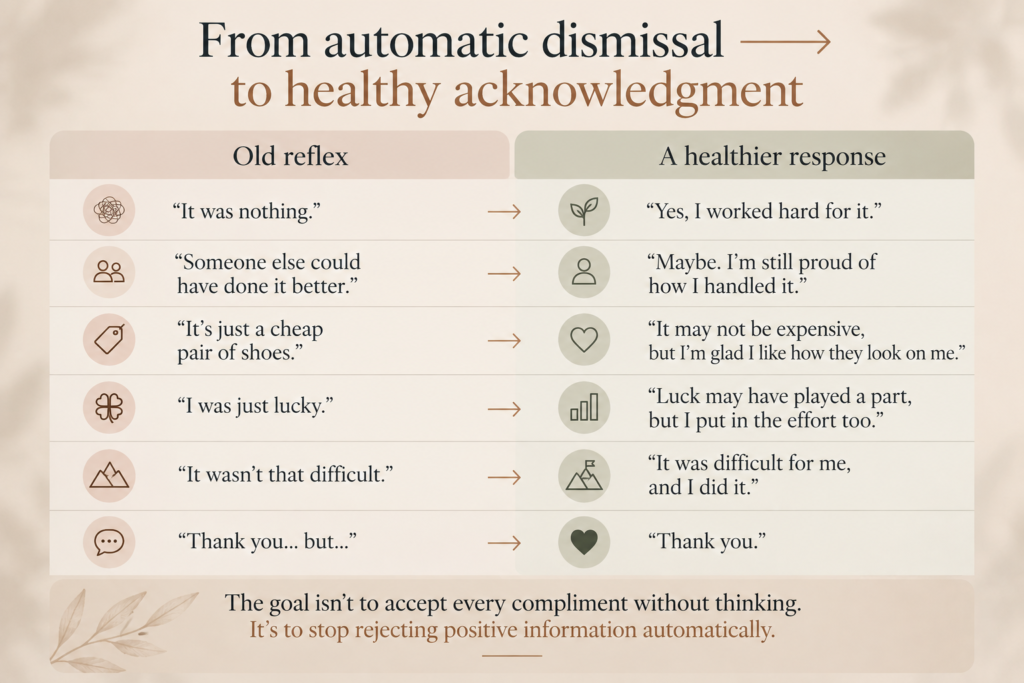
Imagine a colleague says: “That was a really difficult task, and you handled it really well.” And you respond: “Oh, it wasn’t that difficult. Anyone could have done it.”
Or a friend says: “That shirt looks really good on you.” And you immediately answer: “This old thing? It’s cheap and I’ve had it forever.”
It can seem harmless. Sometimes it is simply a conversational habit or a way of being modest. But if you find yourself consistently correcting, minimizing, or explaining away positive feedback, it may be worth asking why.
You’re not necessarily just being humble.
You may have learned that positive attention feels uncomfortable, that praise needs to be justified, or that accepting a compliment somehow says too much about you.
And that brings us to an important distinction.
How to Be Proud of Yourself Without Becoming Arrogant
There is a difference between being humble and refusing to acknowledge anything good about yourself.
You can say: “I’m really proud of how I handled that.” without saying: “I’m better than everyone else.”
You can also acknowledge that you’re good at something without turning it into a ranking.
This matters because we often carry an underlying rule that if we praise ourselves or accept others’ praise, we are arrogant and we sound full of ourselves. We even often think that good people don’t talk about their own achievements.
If you grew up around strong expectations about modesty, this distinction may be especially important.
You can be humble without making yourself smaller.
Humility can mean knowing your strengths without needing to make yourself the most important person in the room. It doesn’t require pretending those strengths aren’t there.
Being Proud of Yourself Doesn’t Mean Believing Every Compliment
Not every compliment is accurate. Sometimes people are simply being kind. Sometimes they see something in you that you don’t see yet. And sometimes they are exaggerating.
You don’t need to decide which one it is in the first three seconds. You can simply receive the information and decide what, if anything, you want to do with it later.
How to Start Giving Yourself Credit
You don’t have to wake up tomorrow feeling incredibly proud of yourself, either. In fact, trying to force that feeling may not be particularly useful. A better place to start is with the way you respond.
1. Stop correcting the compliment
The next time someone says something positive about you, try not to immediately explain why they’re wrong. You don’t have to agree with every compliment. But you also don’t have to automatically argue against it.
Just start with a thank you. Then leave it there. The point isn’t to force yourself to believe the compliment. It’s to stop automatically arguing with it.
If someone says you handled something well, you don’t need to list the things you could have done better. Just think about this question: did you handle it well or not? If yes, just accept it.
Or if someone tells you that something looks good on you, you don’t need to explain where you bought it.
Just let the positive comment exist. They gave you a positive observation. They didn’t ask you to defend it.
2. How to Be Proud of Yourself Without Needing Everyone’s Approval
This is where things can become more interesting.
Maybe you say: “Thank you… but it was mostly luck.” Or: “Thank you, but honestly, anyone could have done it.” Instead of immediately saying the second half, pause and ask yourself why you feel the need to correct this.
You may discover that you aren’t actually protecting accuracy. You may simply be uncomfortable allowing yourself to receive something positive.
3. Separate acknowledgment from self-importance
Try replacing: “If I admit I did this well, I’m being arrogant.” with: “I can recognize something I did well without believing I’m better than everyone else.”
That’s a much more balanced position.
4. Let your accomplishments count without making them your identity
This is especially important when self-worth and achievement get mixed together.
You don’t need to turn: “I did something difficult.” into: “Therefore, I’m valuable.” And you don’t need to turn: “I failed.” into: “Therefore, I’m not valuable.”
Your achievement can simply be an achievement. You worked hard, learned something, solved a problem, made progress. Let that be true without asking it to prove everything about you.
How to Be Proud of Yourself: What Changes Over Time
Saying “thank you” to a compliment may seem almost too simple to matter. And while it can be useful to stop correcting the compliments in the very moment you receive them, on its own, it probably isn’t enough to transform the way you see yourself.
The longer-term change comes from what happens after the automatic dismissal becomes less automatic.
You start noticing positive information instead of immediately neutralizing it. You begin to recognize your own contribution instead of explaining it away.
For example, someone says, “You handled that really well.” At first, you may only practice not arguing with it. Later, you may start noticing something else: “Actually, I did prepare carefully. I did solve the problem. Maybe the compliment wasn’t as exaggerated as I thought.”
And perhaps most importantly, you become better at acknowledging two things at the same time: “I did something well.” and “I still have things to learn.”
Those statements don’t contradict each other.
Self-compassion research is relevant here because it suggests that approaches designed to reduce harsh self-criticism can be helpful, although the evidence is not a reason to assume that every form of self-compassion will work for everyone. A systematic review and meta-analysis of 19 randomized controlled trials found a moderate reduction in self-criticism following self-compassion-related interventions, while also noting limitations in study quality and substantial variation between studies. (Wakelin, Perman & Simonds, 2022.)
The point isn’t to replace your inner critic with someone who constantly tells you how wonderful you are. It’s to become a little less dependent on that critic’s approval.
You Don’t Have to Praise Yourself All the Time
Being proud of yourself doesn’t mean celebrating every small thing or convincing yourself that everything you do is impressive. Some days you may simply feel satisfied and other days you’ll be disappointed. Some things genuinely won’t go well.
Healthy self-recognition leaves room for all of that. You can look at something you did and say: “That could have been better.” without turning it into: “I’m not good enough.”
You can hear someone say: “You did a great job.” and respond: “Thank you.” without needing to prove that they’re wrong.
And you can feel proud of something you’ve accomplished without making anyone else smaller.
You don’t need to become your own biggest fan. You just need to stop automatically cross-examining every good thing said about you.
Sometimes the healthiest response to a good thing isn’t a bigger compliment but letting the good thing be true.
FAQ
How can I be proud of myself without becoming arrogant?
Being proud of yourself doesn’t mean believing you’re better than other people. You can recognize something you’ve done well without turning it into a comparison or making anyone else smaller. Humility doesn’t require you to deny your strengths.
Why is it so hard for me to accept compliments?
There can be several reasons. You may have learned to associate accepting praise with arrogance, feel uncomfortable with positive attention, or simply be used to minimizing your own achievements. If positive feedback doesn’t fit the way you already see yourself, accepting it can also feel uncomfortable. The important thing is not to assume that every difficulty accepting compliments has the same cause.
How do I learn how to be proud of myself?
Start small. When someone says something positive about you, try responding with a simple “thank you” instead of immediately explaining why they’re wrong. You don’t have to convince yourself that every compliment is completely accurate. The first step is simply allowing the positive feedback to exist without automatically arguing against it.
How can I acknowledge my accomplishments without bragging?
Try separating recognition from comparison. Saying “I’m proud of how I handled that” doesn’t mean “I’m better than everyone else.” You can acknowledge the effort, progress, skill, or result involved in something you did without turning it into a statement about your superiority.
What if I don’t believe a compliment I receive?
You don’t have to force yourself to believe every compliment. Sometimes people exaggerate, misunderstand a situation, or are simply being kind. Instead of immediately dismissing the feedback, you can pause and consider whether there is something specific in it that might be true. You don’t have to accept the entire judgment to recognize a useful piece of information.
Further Reading
- Crocker, J., & Wolfe, C. T. (2001). Contingencies of self-worth. Psychological Review, 108(3), 593–623. Read the research
- Kille, D. R., Eibach, R. P., Wood, J. V., & Holmes, J. G. (2017). Who can’t take a compliment? The role of construal level and self-esteem in accepting positive feedback from close others. Journal of Experimental Social Psychology, 68, 40–49. Read the research
- Swann, W. B., Jr., Pelham, B. W., & Krull, D. S. (1989). Agreeable fancy or disagreeable truth? Reconciling self-enhancement and self-verification. Journal of Personality and Social Psychology, 57(5), 782–791. Read the research
- Wakelin, K. E., Perman, G., & Simonds, L. M. (2022). Effectiveness of self-compassion-related interventions for reducing self-criticism: A systematic review and meta-analysis. Clinical Psychology & Psychotherapy, 29(1), 1–25. Read the research
AI Transparency : At SelfWorkNotes, we use generative AI as a collaborative tool during the research, writing and creative process. Every article is carefully reviewed, edited and finalized by the author, who remains fully responsible for the published content. Unless otherwise stated, illustrations are created using generative AI.
Gentle reminder: The content on SelfWorkNotes is provided for informational and educational purposes only. It does not constitute medical, psychological, legal or financial advice. Always consult a qualified professional regarding your personal situation.