Why You Keep Seeking Reassurance Before Making Decisions
Have you ever noticed how sometimes you already know what you want to do, yet still find yourself asking someone else for their opinion? You think about it for days, you weigh the pros and cons, imagine different outcomes. You even feel yourself leaning toward one option. And yet, before making the decision, you ask one more friend, or look for one more sign. At first glance, this may seem like a desire for more information. But often, something deeper is happening. You might be seeking reassurance.
Many people who repeatedly seek reassurance are not actually searching for answers. They are searching for certainty. And certainty is something no amount of reassurance can permanently provide.
Reassurance Is Not the Same as Advice
Before we go any further, it is important to make one distinction.
Seeking advice is not a problem. Sometimes another perspective helps us see what we might miss. And even we might gain useful insights from someone who has much more experience or knowledge that can genuinely improve our decisions.
When you are seeking advice, you already trust yourself that based on that knowledge you can make a decision, that, if it happens to be wrong, you can handle the consequences, as well. The reason why you seek advice is because you want to seek the whole picture. But once you see it, you are not afraid to make the decision and face the consequences.
But when you are seeking reassurance, you are not just aiming to see the whole story. You rather might be seeking either the decision itself from someone else, or permission to make your choice, because you might be afraid to face the consequences. Not because you are not able deal with them. Because probably you are not fully convinced you can deal with them. This is why you might be seeking someone else’s permission.
Healthy advice seeking sounds like:
“I would like another perspective.”
Reassurance seeking sounds more like asking for permission:
“Please tell me I’m not making a mistake.”
The Hidden Goal Behind Reassurance
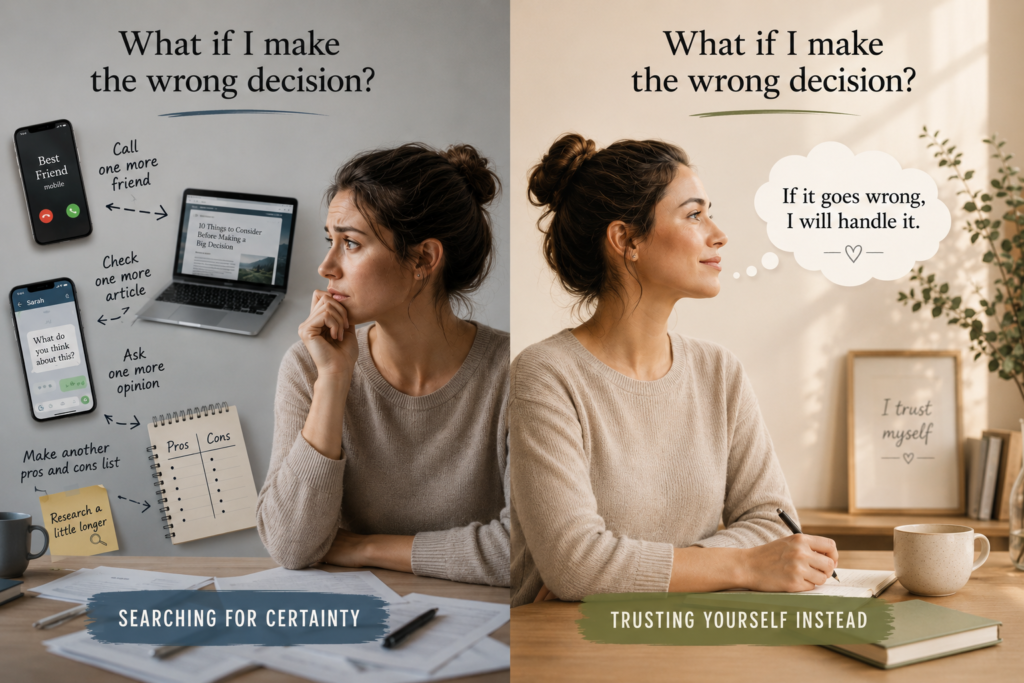
Most people believe they seek reassurance because they need more information. But if that were true, reassurance would work. You would ask someone and receive an answer. Feel confident and then move forward.
Instead, many people experience something different. They ask for reassurance, feel better for a moment, and then the doubt returns. So, they ask someone else. Or they revisit the same conversation. Or they start researching again.
This cycle often continues because the real goal was never information. It was certainty. Which is rarely available in real life.
No one can guarantee that a relationship will work, that changing jobs is the right decision or that a new opportunity will succeed.
As long as self-trust remains fragile, every answer can be questioned. Every opinion can be challenged. Every decision can feel incomplete. And at some point, every meaningful decision requires a leap into uncertainty.
Where This Pattern Often Comes From
Reassurance seeking rarely appears out of nowhere. Often, it develops through experiences that slowly teach us not to trust our own judgment.
Perhaps your decisions were constantly corrected growing up. Maybe mistakes were treated as something dangerous rather than something you could learn from. Maybe someone was always there to decide for you, solve problems for you, or tell you what the “right” choice was.
Or perhaps you spent years in a highly critical environment where your judgment was repeatedly questioned.
Over time, many people begin to internalize a simple but powerful message:
“Other people probably know better than I do.”
The result is not necessarily low intelligence or poor decision-making ability. In fact, many reassurance seekers are highly thoughtful people. They just might have learned to trust external opinions more than their own.
The Real Fear Is Usually Not the Decision
Most people are not actually afraid of making the wrong decision, they are afraid of what happens if they do. They fear regret and failure.
The deeper fear often sounds like:
“What if I can’t handle the consequences?”
This is where reassurance seeking connects directly to self-trust.
Because self-trust is not the belief that you will always choose perfectly, it is the belief that you can handle what happens next, even if you fail to make the right decision.
When self-trust grows, the need for reassurance often begins to shrink.
Not because uncertainty disappears, but because your relationship with uncertainty changes.
How To Start Rebuilding Self-Trust
The goal is not to stop asking for advice, but to stop believing that someone else must remove all uncertainty before you can act.
1. Record It Instead of Repeating It
When you’re stuck in a decision, the instinct is often to ask one more person, maybe someone will finally say the thing that makes everything clear.
But before you ask for another opinion, you may want to try something different. I actually tried this when I was burnt out, and I felt that I needed a change but was unsure what exactly I should do. What I knew for sure was that I needed clarity, but what I realized in the end was much more than just a summary of how I was feeling at that moment. Because later when I heard back my own voice and all the emotions in it, I realized, it was not “just” temporary overwhelm, it was something much deeper that I needed to address and this is one of the things that helped me realize I needed professional support.
How can you do this? Open a voice note and explain the situation as if you were talking to a trusted friend. Describe the options, your concerns, and what feels difficult about the decision. You don’t even have to organize your thoughts, just tell everything that’s coming up. What I recommend though is to be brutally honest with yourself about the situation (even if it’s not too flattering about yourself).
When you’re done recording, don’t analyze it immediately.
Come back the next day or somewhat later and listen to your notes with fresh ears.
You may also be surprised by what happens next. What felt overwhelming in the moment often sounds much clearer from a distance. Because sometimes distance allows us to see patterns that are difficult to notice while we are emotionally involved in a situation.
2. Ask Yourself: “What Happens If I’m Wrong?”
Reassurance seeking is often driven by the need for certainty: you want to know that your decision will work out before you make it. But life rarely offers that guarantee. The goal is not to eliminate uncertainty. The goal is to remember that you are capable of responding to it.
You don’t need a solution for every possible future scenario. You only need enough trust in yourself to believe that if a challenge arises, you will deal with it when the time comes.
Instead of asking:
“How can I be sure this is the right choice?”
try changing perspective:
“What happens if this turns out to be the wrong choice?”
Then take it one step further:
“What would I do next?”
This shifts your attention from predicting the future to trusting your ability to handle it. And you may start to feel a little calmer, simply because your focus shifts from predicting every possible outcome to remembering that you can respond to whatever happens.
You may take this even one step further: So, what if this decision goes wrong? We will cross that bridge once we get there. Or, as another saying puts it: “Don’t borrow trouble from the future.” Because ultimately, what if you make the right choice?
Self-trust grows when you stop demanding certainty and start trusting your own resilience.
3. Ask: “Who Am I Trying to Please?”
This question can be uncomfortable, but it is often revealing.
When you feel stuck, ask yourself:
Who might be disappointed by my decision?
Whose approval am I trying to keep?
Who am I afraid of upsetting?
Sometimes reassurance seeking is not really about the decision itself, it is about managing other people’s reactions.
The more opinions you collect, the easier it becomes to avoid taking ownership of the choice. But eventually every meaningful decision asks the same thing:
Can you live with someone else’s disappointment if it means being honest with yourself?
Stop Measuring Decisions By Outcomes Alone
One reason people struggle with self-trust is that they judge decisions entirely by the final result. If the outcome was positive, they assume the decision was good. If the outcome was negative, they assume the decision was bad.
Real life is rarely that simple.
Sometimes good decisions lead to disappointing outcomes, and sometimes poor decisions happen to work out.
A healthier question is:
“Did I make the best decision I could with the information I had at the time?”
Because self-trust grows when you learn to respect your decision-making process, not just the outcome.
Final Thoughts
Before asking another person what they think you should do, pause for a moment and ask yourself:
Am I looking for advice or am I looking for permission?
The answer to that question often reveals more than the advice itself. Because sometimes the reassurance we keep searching for is not information.
It’s permission to trust ourselves.
If this resonated with you, you might want to learn more about the difference between self-trust and confidence, why you keep overthinking, what emotional patterns might run behind overthinking and what are the quiet signs of burnout you shuoldn’t ignore.
AI Transparency : At SelfWorkNotes, we use generative AI as a collaborative tool during the research, writing and creative process. Every article is carefully reviewed, edited and finalized by the author, who remains fully responsible for the published content. Unless otherwise stated, illustrations are created using generative AI.
Gentle reminder: The content on SelfWorkNotes is provided for informational and educational purposes only. It does not constitute medical, psychological, legal or financial advice. Always consult a qualified professional regarding your personal situation.