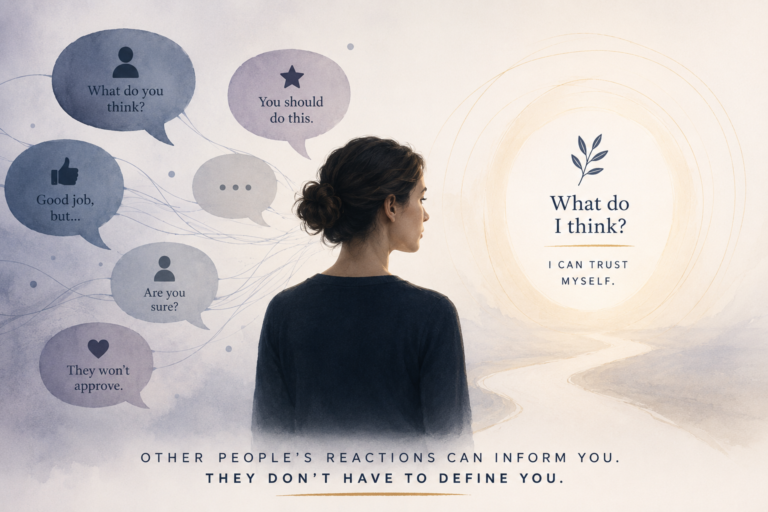

How to Accept Yourself Without Needing to Like Everything About Yourself
You probably already know that there are things about yourself you would like to change. Maybe you procrastinate more than you’d like, you avoid difficult conversations, get defensive too quickly, struggle with money, or tend to take on too much and then resent it. Maybe there are parts of your appearance, personality, or past decisions that you simply don’t like. And perhaps you’ve been told that the answer is self-acceptance but learning how to accept yourself can be much more difficult in reality.
Self-acceptance doesn’t require you to like everything about yourself or approve of every decision you’ve made. You don’t even have to stop working on things that matter to you. It can simply require you to become more careful about what you conclude from the information you discover about yourself.
Because there is a big difference between describing what happened and drawing a conclusion about who you are from it.
And that difference can change what you do next.
What Self-Acceptance Actually Means
Self-acceptance is often grouped together with self-esteem and self-love, but they aren’t quite the same thing. Self-acceptance and self-esteem are related but distinct concepts. In one small study of people with severe and enduring mental health problems, self-acceptance was more closely associated with general psychological well-being, while self-esteem was more closely associated with affective states such as depression.
The distinction matters.
Self-esteem is, at least partly, evaluative: How do I feel about my value? How positively do I see myself?
Self-acceptance asks something different: Can I acknowledge what is true about me without needing that truth to be flattering?
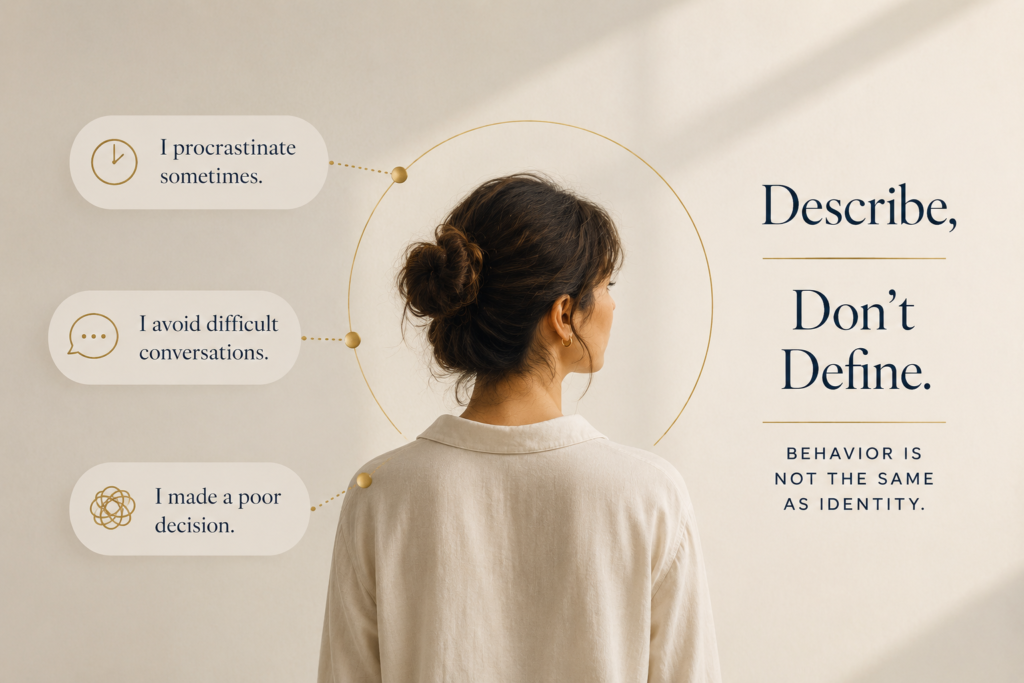
You can accept that you made a poor decision without immediately concluding that you are a poor decision-maker. You can acknowledge that you procrastinate without deciding that you are fundamentally lazy. You can recognize that you behaved badly in a particular situation without turning that behavior into a permanent definition of your character. And self-acceptance doesn’t mean resignation, either.
You can accept that something is currently true about you and still decide to change it. The more interesting question is what happens between noticing something about yourself and deciding what it means.
How to Accept Yourself Without Making Every Problem Your Identity
Imagine that you’ve been procrastinating on an important task that could move an area of your life forward.
You could say: I need to understand what I’m avoiding. That’s information and curiosity.
Or you could say: I always procrastinate, I’m just not disciplined. That’s already something else. You’ve turned a recurring behavior into a description of yourself.
Maybe procrastination really is a recurring problem for you. That doesn’t make the observation false. But once the description becomes an identity, you may stop asking when the behavior occurs, what triggers it, or what you might be afraid of. You simply expect yourself to behave according to the label. From that point on, changing the behavior may also become harder.
Acceptance and Commitment Therapy (ACT) places psychological flexibility at the center of its approach. This includes learning to relate to thoughts and self-descriptions more flexibly, rather than automatically treating them as facts that should dictate your behavior.
You don’t need to argue with the thought “I procrastinate“, but this is way too vague to give you clarity about what exactly is happening. Instead, you can make it more precise: “I tend to procrastinate when a task feels ambiguous.” Or “I avoid starting when I’m afraid I won’t do it well”. You could also say, “I procrastinate more when I don’t know what the first step is”. Now you have something you can work with.
The problem hasn’t disappeared. You’ve simply stopped turning it into a conclusion about your entire personality, and you may also start to see a pattern in when or why procrastination shows up.
That is an important part of learning how to accept yourself: becoming able to see a weakness clearly without allowing it to become the only thing you see.
What Are You Focusing On?
This is where a small focus shift can make a surprisingly large difference in learning how to accept yourself.
Self-acceptance doesn’t mean focusing on the positive and ignoring the negative. It means being able to see both without letting one side become the whole story.
Suppose you know you procrastinate. You could spend your energy thinking about how frustrating it is, how far behind you are, how many times you’ve done it before, and how much more disciplined you should be.
Or you could shift your focus slightly:
When does procrastination appear?
Does it happen when the task is boring? When you aren’t sure what to do? When there is a possibility of failure? When the outcome matters too much? When completing the task would require you to make a decision or action you’ve been avoiding? Those questions don’t excuse the behavior; they make it easier to understand and change.
You might discover that your procrastination isn’t simply a lack of discipline. Perhaps it appears most strongly around situations where you fear being evaluated. Maybe you delay decisions because making the wrong choice feels threatening. Maybe you’ve learned to avoid tasks when you can’t guarantee that you’ll do them well.
Now the question changes from: “What’s wrong with me?” to: “What’s happening here, and what do I need to pay attention to?” The second question gives you somewhere to go.
If you know that certain situations repeatedly trigger avoidance, you can consciously pay attention when you encounter them again. You can notice the familiar impulse to delay, look at what tends to trigger it, and decide whether you still want to follow it.
What Are You Counting?
There is another focus shift that is easy to miss when you’re evaluating yourself:
What if the problem isn’t that you’re seeing something negative? What if your internal scoreboard simply isn’t recording everything that’s happening?
The mistake you made in yesterday’s meeting? The conversation where you sounded uncertain? The project you handled badly? The person you disappointed? Probably.
But what about the ten conversations where you communicated clearly? The problem you solved last week? The difficult decision you handled well? The project you completed despite being uncertain? The small gesture that was a meaningful help for your friend? Those things may be easier to overlook when you are already focused on what went wrong.
Your internal picture of yourself isn’t necessarily a neutral summary of the evidence. If you repeatedly collect evidence against yourself while barely registering evidence in your favor, you can end up with a convincing but incomplete story. This doesn’t mean the negative evidence isn’t real; it means it may not be the whole dataset.
Part of learning how to accept yourself is learning to look at the whole picture, rather than building your self-image around the evidence that hurts the most.
When something goes badly, don’t immediately try to make it feel better. Instead, describe the whole dataset. You made a mistake in the presentation. What else is true?
You handled a conversation badly. What else is true about how you generally treat people?
You made a poor financial decision. What else have you learned, managed, or handled responsibly?
You don’t need to make the bad thing smaller. You simply don’t need to make it the only thing that counts.
A Past Version of You Is Still Evidence, But It Isn’t the Whole Story
There is one more focus shift that may be even more important in learning how to accept yourself.
What you did in the past matters. Sometimes it matters a lot. Self-acceptance doesn’t require you to rewrite history. But a description of your past should not automatically mean you will do exactly the same in the future.
So ask yourself:
How much is your past deciding who you can become?
And there is another question worth considering:
If you met yourself today for the first time, would you see yourself the same way?
You might still notice the same flaws. You might still identify areas that need work. But perhaps you would see a person who is also learning, changing, succeeding in some areas, struggling in others, and behaving differently in different circumstances. In other words, you might see a person rather than a category.
Don’t Confuse Self-Acceptance With Stopping Growth
Self-acceptance is not equal to lowering your standards. You can want to become fitter, more reliable, more patient, more financially responsible, better at communicating, or more courageous. You can decide that certain behaviors genuinely need to change.
The important question is why you want them to change. Because if you tie your self-worth to reaching the goal, it makes your worth conditional on reaching the goal.
Going back to the above example: “I want to stop procrastinating because it gets in the way of things that matter to me” is very different from “I need to stop procrastinating because people who procrastinate are lazy and undisciplined, and I don’t want to be that kind of person”.
This is where self-acceptance can coexist with serious self-improvement.
You don’t need to reject yourself in order to change yourself. You can take responsibility without turning every weakness into a statement about your worth. You can want more from yourself without deciding that the current version of you is unacceptable.
A Practical Exercise: How to Accept Yourself Without Defining Yourself
The next time you notice a trait or behavior you dislike, try a small experiment.
Write down the first version exactly as it appears in your head. For example: “I’m terrible at managing money. I always make bad decisions”.
Then rewrite it without turning the behavior into an identity. Something like:
“I’ve made several financial decisions that I think now are too risky. I tend to make decisions before I’ve fully considered the long-term consequences, so I need a better process for larger financial commitments”.
The second version isn’t necessarily kinder; it’s just more precise. And precision is useful because it gives you something you can actually respond to.
You can examine your decision-making process, you can slow down before major financial commitments. You can learn more, ask for information. You can also change your behavior. But you can’t do much with “I’m just bad with money.”
The same exercise works with almost anything:
“I’m lazy” becomes “I avoid tasks when I don’t know how to begin.”
“I’m terrible at relationships” becomes “I tend to withdraw when conflict becomes emotionally intense.”
This is one practical way to learn how to accept yourself without turning self-awareness into self-criticism. You don’t have to like every part of what you discover. You simply need to be able to see it clearly enough to decide what, if anything, you want to change.
Three Questions to Help You Accept Yourself
If you want to make this practical, you don’t need a complicated self-acceptance routine. The next time you catch yourself forming a strong conclusion about who you are, try three focus shifts.
First: What am I focusing on?
What gets my attention? Am I looking only at the flaw, or am I also looking at the situation around it?
Second: What am I counting?
What evidence am I including and leaving out? Am I building my self-image primarily from mistakes, failures, and weaknesses?
Third: What am I making this mean about me?
Am I allowing an older version of myself to determine what I believe is possible for the person I can become?
Self-acceptance doesn’t ask you to look at yourself and conclude that everything is good. It isn’t about replacing negative conclusions with positive ones. It asks you to become capable of seeing what is true without immediately deciding what that truth says about your worth.
You may genuinely need to change something. You may have habits that hold you back, mistakes that require repair, or weaknesses that will continue to cost you something if you ignore them. You can know what you need to work on without making it the definition of who you are.
Sources & Further Reading
- Macri & Rogge (2024) – Examining domains of psychological flexibility and inflexibility as treatment mechanisms in Acceptance and Commitment Therapy
- MacInnes (2006) – Self-esteem and self-acceptance: an examination into their relationship and their effect on psychological health
AI Transparency
At SelfWorkNotes, we use generative AI as a collaborative tool during the research, writing and creative process. Every article is carefully reviewed, edited and finalized by the author, who remains fully responsible for the published content. Unless otherwise stated, illustrations are created using generative AI.
Gentle reminder: The content on SelfWorkNotes is provided for informational and educational purposes only. It does not constitute medical, psychological, legal or financial advice. Always consult a qualified professional regarding your personal situation.