What Is Self-Worth? And Why We Often Look for It in the Wrong Places
What is self-worth really? Imagine two people: one has just received a long-awaited promotion, the other has just lost their job. Which one is more valuable?
Most of us immediately know the answer: neither.
A promotion can change many things. It can change your income, your daily routine, your responsibilities, or even your confidence. But ideally, it shouldn’t change your self-worth, yet, for many of us, it quietly does.
Not because we consciously decide that our value depends on achievement, but because, over time, our brain can begin linking our worth to things that were never meant to define it. To success, to productivity, to being needed, or to being the person who never disappoints anyone.
Without realizing it, we slowly stop asking who we truly are but ask instead what we need to do to be enough. Although they may sound similar, they lead us in very different directions.
What Is Self-Worth?
If you ever wondered what it really is, the simplest definition is this: self-worth is your sense of value as a person.
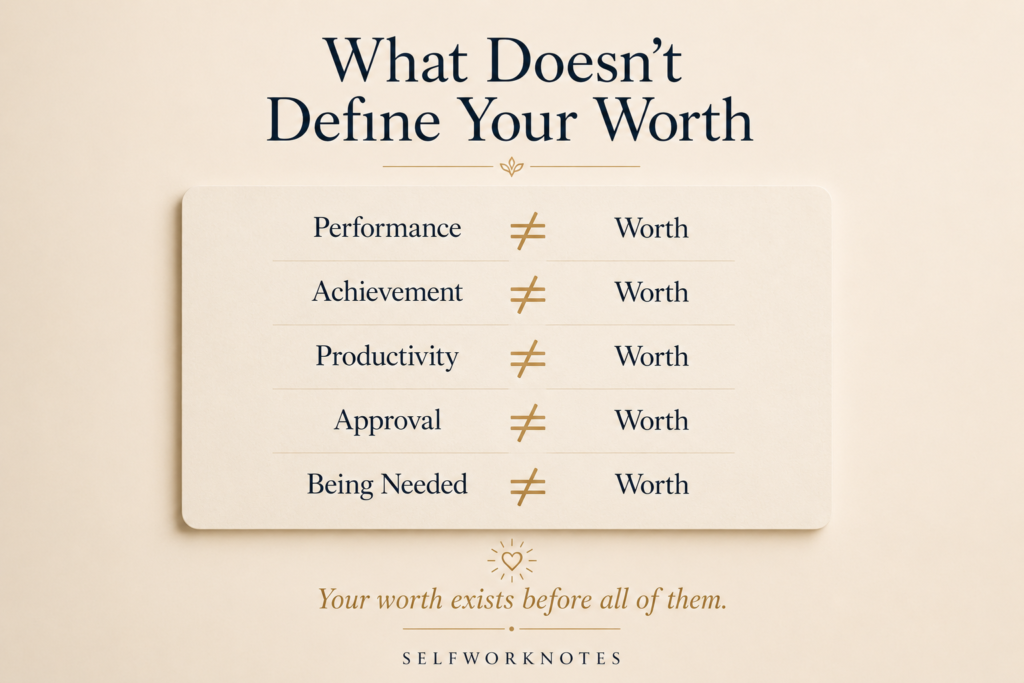
It’s the quiet belief that your value exists independently of your achievements, your mistakes, other people’s opinions, or how well you’re performing in different areas of life. It doesn’t mean believing you’re perfect or you’re better than anyone else. It doesn’t mean you never doubt yourself, either.
Rather, it means that even when many things can change in your life, your value as a human being doesn’t have to change with them.
And this is where many people become trapped without realizing it. Because self-worth often gets confused with other things that naturally rise and fall throughout life. For example, performance, careers, relationships, even health can change.
And if our worth becomes attached to any of these, then every change suddenly begins to feel much bigger than it actually is.
This is when a full sentence like “I lost my job” can quietly become expanded with another one: “Maybe I’m not enough anymore.” And before we realize it, we can easily create a narrative in our mind about our self-worth while the reality might tell a totally different story.
Why We Look for Our Worth in the Wrong Places
One way our brain seems to learn about the world is by noticing what helps us feel accepted or safe. As children, we don’t usually analyze this consciously, of course, we just notice patterns.
Perhaps we receive praise after good grades, people smile when we’re helpful or maybe conflict disappears when we stay quiet. Perhaps we learn that being “easy,” “responsible,” or “strong” makes life feel safer.
None of these experiences are automatically harmful, in fact, many of them can teach valuable life skills.
The problem begins when our brain quietly reaches a different conclusion: “Helping others is what makes me valuable.” or “My value depends on how productive I am.” or “People appreciate me because of what I do.”
The problem is the hidden equation behind this pattern, not the behavior.
Don’t Let One Sentence Answer Everything
One of the reasons thoughts like “I lost my job, therefore I’m not good enough” feel so convincing is because they give our brain an immediate explanation.
The problem, however, is that they’re usually far too broad. So, sometimes it may be helpful to try to be specific with ourselves and define what exactly is not good enough.
Can you see the difference? Instead of one vague conclusion “I’m not good enough”, you suddenly have a more specific explanation: “XY skill or attitude was not acceptable for them”. Which means you can already have specific aspects that you might want to address to improve.
But none of them automatically say anything about your value as a person. Because you still remain, let’s say, a fun, caring personality who people go to for advice, as well.
The Places We Most Often Look for Our Worth
If self-worth isn’t something we earn, why do so many of us spend years trying to earn it?
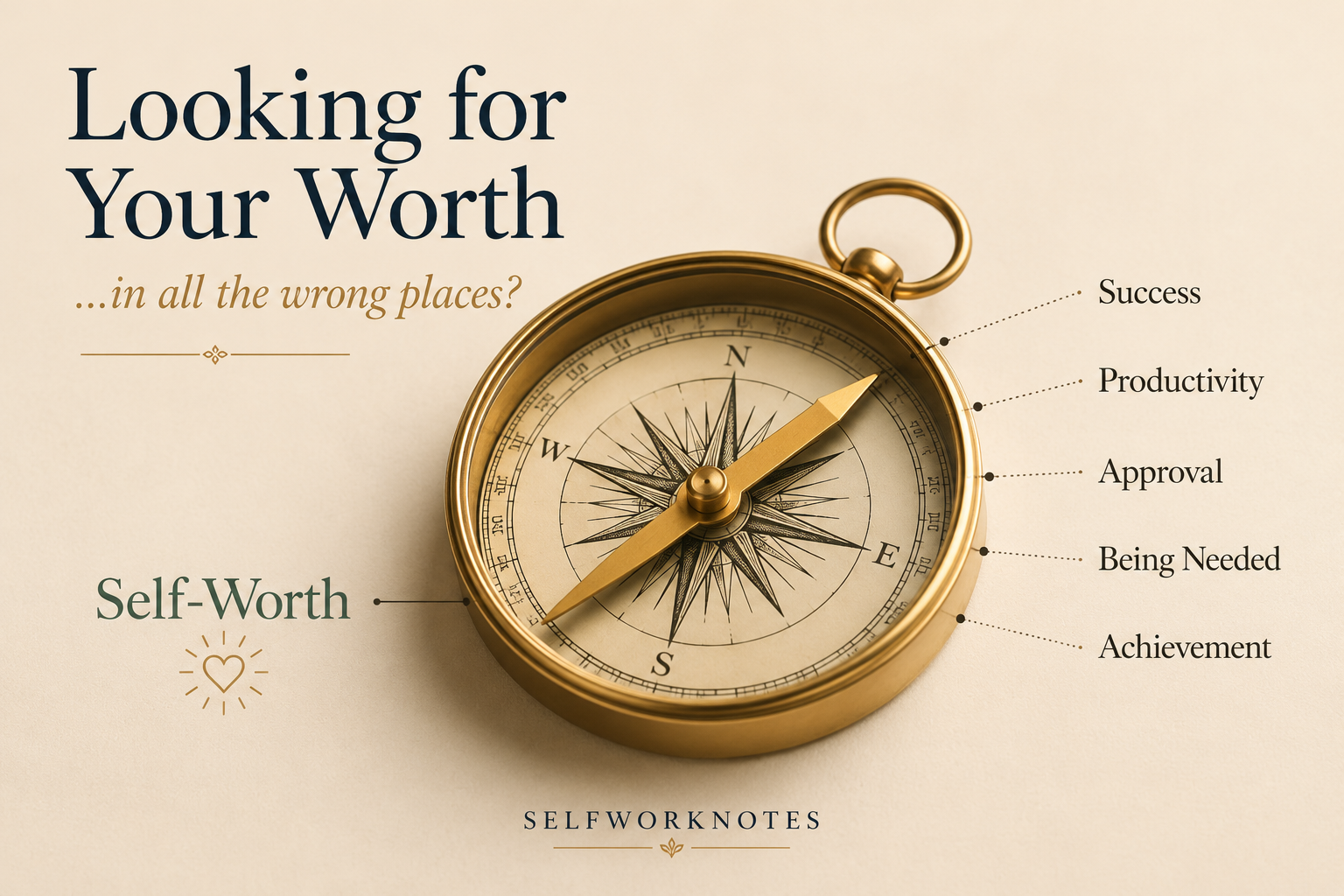
Perhaps because our brain naturally looks for evidence. That we are accepted, doing well, that we matter.
The problem is that the places we often look for this evidence are usually temporary by nature and they might change, often overnight.
Let’s look at a few of the most common ones.
Achievement
Reaching a goal, receiving recognition, or seeing your hard work pay off can bring satisfaction, pride, and confidence. Which is great.
The difficulty begins when achievement quietly becomes a foundation for feeling valuable. Because achievement has a characteristic that we often forget, that it’s temporary.
Every finished project is followed by another; your promotion eventually becomes your new normal and when you achieve a goal, you set a new one.
If your worth depends on achievement, your mind rarely allows you to rest.
It just moves the finish line.
Productivity
Many of us grow up believing that being busy means being responsible. Productive people are often admired. They’re organized, hard-working. Again, none of these qualities are the problem.
But have you ever noticed how uncomfortable doing nothing can sometimes feel? Not because you’re bored, but because resting can quietly feel undeserved.
Almost as if productivity has become permission to exist without guilt.
This is where it may be worth asking yourself:
Do I rest because my work is finished? Or only because I’ve finally convinced myself that I’ve done enough to deserve it?
Those are two very different experiences.
Being Needed
Helping other people can be one of the most meaningful parts of life. Supporting a friend, a colleague, being there for your family. These moments often strengthen relationships and create genuine connection.
But sometimes another pattern lies underneath support: when being needed becomes the place where you feel most valuable.
Perhaps you automatically offer help before anyone asks, trying to solve others’ problems when your help isn’t really needed. Perhaps someone else’s happiness begins feeling like your responsibility. Sometimes saying no feels uncomfortable.
From the outside, these behaviors can look exactly like kindness. The motivation underneath, however, can be very different. Sometimes we help because we genuinely want to. Sometimes we help because not helping would make us question our own worth.
Other People’s Approval
Being appreciated feels good. Us, humans are social creatures, we naturally want to belong. Receiving positive feedback, or recognition can strengthen relationships and increase confidence, as well.
The problem begins when approval quietly changes from doing something because we genuinely want to, to doing it to earn someone’s approval.
And over time, our attention slowly shifts away from our own values towards constantly trying to predict everyone else’s expectations. Ironically, the more we depend on approval, the less connected we often become to our own voice.
None of These Things Are the Problem
It’s important to pause here for a moment, because it’s important to make a distinction between the motivation why we help, want to achieve things or why we want to be productive.
Because the question isn’t whether these things exist. The question is what happens when they disappear?
If losing one of them makes you wonder whether you’re still enough, perhaps the issue isn’t the achievement/productivity, helping etc. itself.
Perhaps it’s where your worth has quietly been living.
Why External Proof Feels So Convincing
There may be another reason why our brain so easily ties our worth to things like achievement, productivity, or other people’s approval.
They leave visible evidence, like a completed project, a salary increase, promotion, a diploma, compliment, or sometimes just a thank you.
These are tangible things, we can see them and sometimes, we can even show them to other people. Compared to this, self-worth can feel difficult to grasp. It doesn’t leave a certificate behind or produce a visible result that proves it exists.
Perhaps that’s one reason why our brain is naturally drawn to external achievements. Because they feel tangible, measurable and easier to use as evidence that we’re doing well.
The challenge is that these things were never designed to carry something as important as our worth. They can change, disappear, or be taken away.
Achievements tell a story about what you did. But they don’t necessarily tell the whole story about who you are. And perhaps that’s where a much more interesting question begins:
If your achievements can disappear, what still remains?
A Small Thought Experiment
Let’s imagine something for a moment.
Suppose that tomorrow, one of the things you’ve quietly connected to your worth suddenly disappeared.
For example your productivity, or the ability to help people, or, as in the above example, your job.
Would your worth disappear with it? Most people immediately answer, especially if they read the above example: “Of course not.”
But if the answer is no, why does losing those things often hurt so deeply?
Perhaps because the pain isn’t only about losing the role. Sometimes it’s about losing the place where we’ve been looking for our worth all along.
One Small Shift
Perhaps the goal isn’t to stop achieving or being productive or helpful.
Maybe you only need a small focus shift.
Instead of asking: “How can I become valuable?” maybe it’s worth asking:
“What have I been using as proof that I’m valuable?”
The difference between those two questions is subtle, but it can completely change where your attention goes. Instead of chasing more evidence, you begin examining the equation itself.
What Healthy Self-Worth Actually Looks Like
When people hear the phrase healthy self-worth, they sometimes imagine someone who never doubts themselves.
Someone who is always confident and calm. Reality is usually much quieter than that.
Healthy self-worth doesn’t remove difficult emotions. It doesn’t mean criticism never hurts or you stop questioning yourself from time to time.
Instead, developing healthier self-worth often changes something much smaller. It changes what those experiences mean about you. You may still fail, but it won’t become “I’m a failure” or “There must be something fundamentally wrong with me.”
What Slowly Begins to Change
Rebuilding self-worth often isn’t about becoming a different person but noticing the invisible rules you’ve been living by.
Over time, you may notice small shifts.
Perhaps you begin saying no occasionally without feeling the need to explain yourself for twenty minutes. Perhaps resting feels slightly less uncomfortable. Or you stop apologizing automatically before you’ve even done anything wrong. Maybe when someone disagrees with you, instead of immediately questioning yourself, you simply become curious.
None of these moments seem dramatic. Yet they quietly add up and slowly can change the relationship you have with yourself.
A Practical Exercise
The next time you notice yourself working harder than necessary, helping even though you’re exhausted or simply not needed, pause for a moment and try asking a quite interesting question:
What would this mean about you if you stopped doing it?
Would it mean you were lazy? Selfish? Disappointing? Not needed? Not enough?
Very often, the answer has much less to do with the situation itself and much more to do with the meaning your mind has quietly attached to it. Awareness doesn’t immediately remove that pattern, but it often becomes the first moment where a different response becomes possible.
Self-Worth Is Rarely Rebuilt Through One Big Decision
We often imagine change as something dramatic, like you have to change your whole mindset and create a totally new version of yourself.
But more often, self-worth (and spoiler alert: your mindset and your current version of yourself, as well) changes through dozens of very ordinary moments.
The moment you allow yourself to rest without earning it first. When you ask for help or let someone be disappointed. The moment you stop trying to prove something.
The moment you realize that your value didn’t actually disappear even though your performance wasn’t perfect. Or, back to our above example: when you realize your worth did not depend on that job you’ve been fired from.
None of these moments feel particularly extraordinary, but together, they slowly teach your brain something new.
Final Reflection on What is Self-Worth
Before you leave this article, perhaps take a moment to ask yourself:
When do I feel most valuable?
What have I been using as proof that I’m valuable?
If just one of those things disappeared tomorrow, would my worth disappear with it?
Perhaps your answers won’t change overnight. Sometimes awareness begins with a single honest question. And perhaps that’s enough for today.
Final Thoughts
Many of us spend years searching for our worth at sources like promotions, productivity, being needed, or making sure everyone else is okay.
The search itself isn’t the problem.
The problem is that these places were never designed to hold something as important as your value. Because these can change and even disappear rapidly.
Your worth, however, was never meant to depend on things that could be taken away. Perhaps your worth was never missing, you might have just been looking for it somewhere it could never be found.
If this resonated with you, you might want to learn the difference between self-confidence, self-worth and self-respect, why your worth can become conditional, and why failure feels so scary.
AI Transparency : At SelfWorkNotes, we use generative AI as a collaborative tool during the research, writing and creative process. Every article is carefully reviewed, edited and finalized by the author, who remains fully responsible for the published content. Unless otherwise stated, illustrations are created using generative AI.
FAQ
What is Self-Worth?
Self-worth is your sense of value as a person. It means believing that your value doesn’t depend entirely on your achievements, productivity, mistakes, or other people’s opinions. While confidence, success, and circumstances may change, healthy self-worth remains much more stable.
Can self-worth be improved?
Yes. Self-worth can gradually become healthier over time. It usually doesn’t change overnight, but through greater self-awareness, questioning old patterns, and repeatedly choosing new ways of responding to yourself and life’s challenges.
What is the difference between self-worth and self-confidence?
Self-confidence is about believing you can do something. Self-worth is about believing you still have value even if you can’t. Confidence often changes with experience, while healthy self-worth is less dependent on success or failure.
Why do people tie their self-worth to achievement?
Many people gradually learn to connect their worth to achievement, productivity, approval, or being needed because these experiences often bring praise, acceptance, or a sense of belonging. Over time, the brain may begin treating these experiences as evidence of personal value, even though they are not the same thing.
Can you have low self-worth even if you’re successful?
Yes. Success and self-worth are not the same thing. Someone may achieve a great deal professionally while still feeling that they constantly need to prove themselves. When self-worth depends on achievement, success often brings only temporary relief before the pressure to achieve returns.
Gentle reminder: The content on SelfWorkNotes is provided for informational and educational purposes only. It does not constitute medical, psychological, legal or financial advice. Always consult a qualified professional regarding your personal situation.