Why You Feel Emotionally Drained After Social Interactions
“I’m so antisocial today, I absolutely don’t feel like going out.” We say this sentence so casually that it almost sounds like a mood, or simply part of adult life. What if it’s not because you are antisocial, but because you already feel emotionally drained?
There is absolutely nothing wrong with needing space, quiet, or time alone. Not everyone wants constant social interaction, and not every moment of withdrawal means something is wrong.
But when social interactions consistently feel emotionally exhausting, when you already feel tension before social gatherings, replying to messages, or when conversations leave you mentally drained, it might be worth looking deeper at the root cause.
Because sometimes the issue is not that you dislike people, but that you are emotionally overloaded.
You May Be Constantly Monitoring Yourself While Socializing
For many people, social exhaustion does not only come from interaction itself, but from what’s happening internally during the interaction. You may, for example, constantly:
- monitor moods, tension, facial expressions
- analyze people’s reactions,
- watch your tone (or their tone for change of emotions)
- think about what others will think about you,
- adjust your behavior,
- try not to disappoint anyone,
- avoid awkwardness,
- overthink your responses.
And all of this requires a lot of energy. This is why some people leave conversations exhausted, not because they talked too much, but because they stayed emotionally alert the entire time.
Why You Feel Emotionally Drained While Socializing
Social interactions can feel draining because your system is not simply connecting, it is scanning the environment. And the underlying pattern here is the same constant emotional awareness that also may lead to emotional drain, overexplaining, overthinking, and feeling unsafe when you are doing nothing.
Especially if emotional awareness became important very early in life. When a child learns that being manageable or emotionally easy made connection feel safer. Over time, this might lead to staying emotionally available, avoiding conflict, but most importantly to constantly monitoring your environment for potential mood changes.
This is why social interaction may stop feeling spontaneous in the long run, instead, it can start feeling like emotional management. And staying continuously “on” emotionally is exhausting for the body and mind.
You Might Be Absorbing More Emotion Than You Realize
Some people unconsciously absorb emotional tension around them very quickly.
You may for example:
- immediately feel responsible when someone becomes upset,
- struggle to emotionally disconnect from tension,
- replay conversations long after they ended,
- feel affected by other people’s moods, even might try to fix them
- or feel pressure to emotionally stabilize situations.
This can create a constant sense of emotional heaviness during social interaction.
Social Exhaustion Does Not Always Mean You Hate People
Needing solitude does not automatically mean you are cold, emotionally detached or dislike people. It is absolutely okay if you are introverted, naturally need more quiet moments than others or just simply need solitude sometimes to recharge.
But there is a big difference between peaceful solitude and emotional exhaustion.
Because emotional overload is more like:
“I feel mentally and emotionally depleted around people.”
While solitude sounds more like: “I enjoy being alone”
The difference matters.
Signs You May Be Emotionally Drained Socially
This pattern may look like:
- replaying conversations repeatedly afterward
- feeling tension before social gatherings
- mentally preparing before replying to messages (especially how they will react to your reply)
- difficulty relaxing around people
- feeling emotionally “on” all the time
- exhaustion after texting, calls, or social events
- constantly monitoring reactions
- trying to keep conversations emotionally smooth, avoid conflict
- feeling responsible for group atmosphere
- needing long recovery time after interaction
- overthinking how you were perceived
- feeling emotionally drained even after small interactions
Over time, this can create chronic emotional fatigue.
Don’t Confuse Healthy Fatigue with Emotional Overload
Let’s say you’ve had a busy week, maybe even did some overwork, or you even had some home projects maybe running at the same time. And then this invitation comes up for Friday night’s drink. You accept it, and at night you return home absolutely exhausted.
How do you know if what you feel is healthy tiredness or emotional drain?
The difference is not the measure of fatigue, but the quality of fatigue.
When you are “healthily” tired, you might feel:
it’s been a busy day / week, but in the meantime, maybe you, for example:
- were yourself
- could genuinely connect to others
- stayed present
- didn’t feel the need to monitor yourself, and / or your environment for mood changes
- felt that drink with your friends / colleagues even recharged you after a busy period.
However, when you are emotionally drained, you feel:
it’s been a busy day/week, and on top of that maybe you, for example:
- didn’t say no to that drink in the first place, despite it was the last thing you wanted at that moment
- prepared emotionally in advance: “I need to be chatting again”, “I hope I won’t be awkward”, “I will have to do well all along”
- were constantly monitoring your environment for their reaction
- rather masked yourself to avoid tension
- automatically think that the problem might be you, when tension / silence emerges. You immediately ask yourself: “did I say something wrong?”
- overthink (“what will we be talking about?” “if I say that, others will find me awkward”, “maybe I shouldn’t have said that”, “what if they take it as offensive?”)
- reply, analyze, feel self-criticism afterwards: “I shouldn’t have talked so much!” “why did I say that?”, etc.
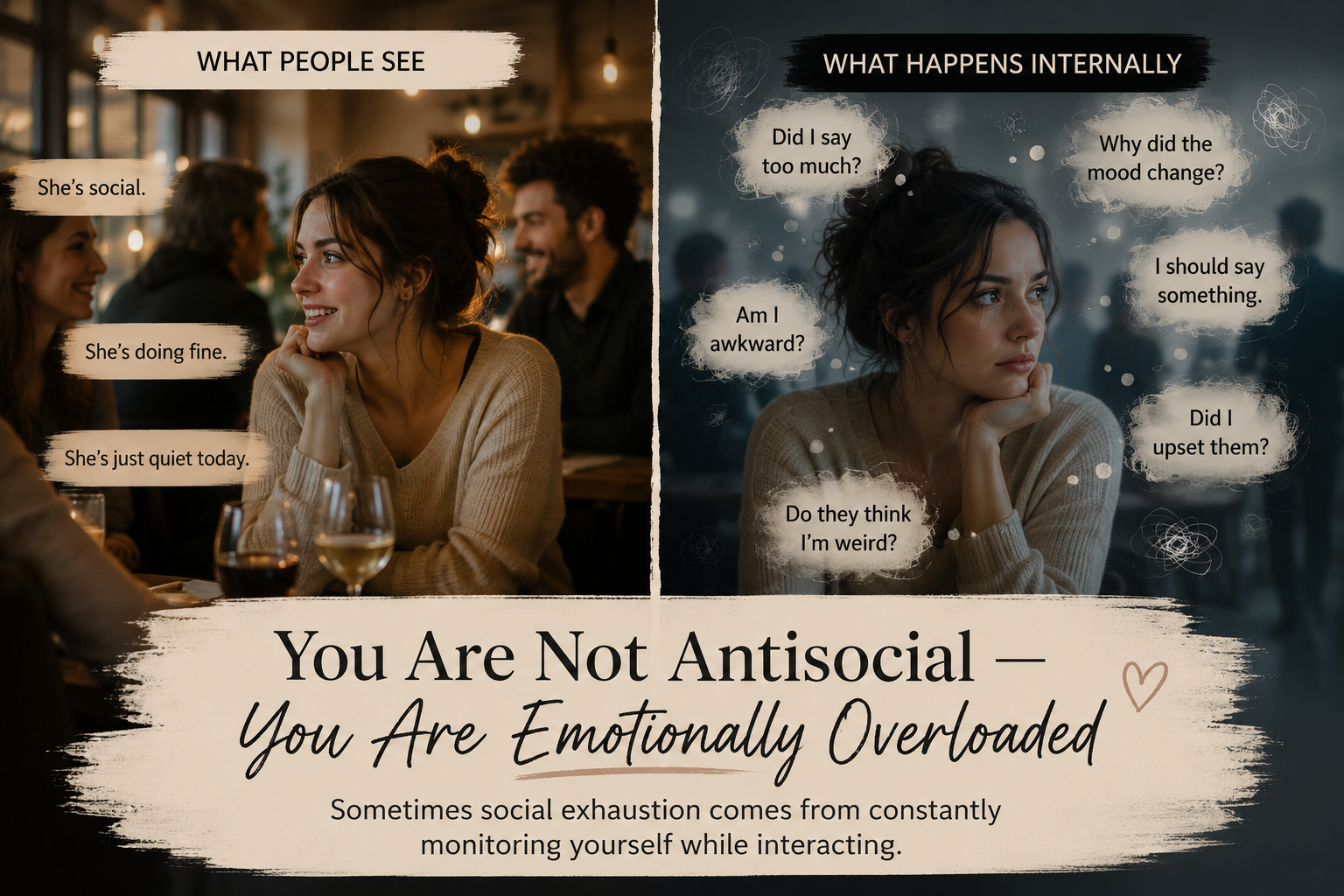
Sometimes social exhaustion does not come from talking to people — but from constantly monitoring yourself while doing it.
To find out if you are emotionally drained or just “simply” tired, ask yourself:
After social interaction, do I mostly feel:
- pleasantly tired,
- mentally stimulated,
- socially fulfilled,
- and able to recover naturally?
Or do I feel:
- emotionally tense,
- mentally overloaded,
- self-critical,
- socially “hungover,”
- and unable to fully relax even afterward?
Practical Shifts That Can Help to Avoid Feeling Emotionally Drained
1. Stop Treating Every Interaction Like Emotional Performance
Not every interaction requires perfect wording, emotional management, or constant self-monitoring. Sometimes conversations are allowed to be imperfect, include disagreement, or simply exist without overanalyzing every detail afterward.
Connection becomes exhausting when you feel responsible for managing the entire emotional atmosphere constantly.
2. Notice How Often You Monitor Other People’s Reactions
Pay attention to how quickly your focus moves outward during conversations.
Do you immediately:
- scan moods,
- analyze tone,
- monitor silence,
- adjust your behavior,
- or try to predict reactions?
Awareness alone may not instantly stop the pattern, but noticing it can slowly interrupt emotional autopilot.
3. Ask Yourself:
“Am I Connecting — Or Performing?”
This question can reveal a lot.
Sometimes social exhaustion comes from constantly trying to appear agreeable, avoid disappointing anyone, sound “correct,” or manage how you are perceived. And over time, this can create emotional disconnection from yourself. Because connection feels very different from performance.
4. You Do Not Need To Be Emotionally Available All the Time
You are allowed to
- need space,
- rest socially,
- reply later,
- leave conversations,
- say no to plans,
- or protect your emotional energy.
Constant emotional availability is not the same thing as emotional health.
And your worth is not measured by how emotionally accessible you remain to everyone all the time.
Reflection When You Feel Emotionally Drained
You can even journal about these questions:
- When did social interaction start feeling exhausting instead of connecting?
- Am I connecting with people — or constantly monitoring myself?
- Do I feel emotionally responsible for keeping interactions smooth?
- What would social interaction feel like if I stopped emotionally over-managing everything?
If this resonates with you, you may also want to explore emotional responsibility, overthinking, overexplaining, and why doing nothing feels unsafe.
AI Transparency : At SelfWorkNotes, we use generative AI as a collaborative tool during the research, writing and creative process. Every article is carefully reviewed, edited and finalized by the author, who remains fully responsible for the published content. Unless otherwise stated, illustrations are created using generative AI.
Gentle reminder: The content on SelfWorkNotes is provided for informational and educational purposes only. It does not constitute medical, psychological, legal or financial advice. Always consult a qualified professional regarding your personal situation.