

Why Do I Need Certainty? Why It Doesn’t Always Make Me Feel Safe
Have you ever wondered, why do I need certainty so much? Maybe you’re waiting for an email, trying to make sense of an unanswered message, or wondering what your manager wants to discuss. You tell yourself that you just need to know what’s going on.
Sometimes, getting an answer helps. Other times, the answer arrives, but you still don’t feel any better. If uncertainty was the problem, shouldn’t knowing the answer make everything easier?
The need for certainty is understandable. But sometimes, what we’re looking for goes beyond information. We may also be hoping that knowing will help us feel safer, calmer, or more in control.
Why Do I Need Certainty in the First Place?
When we don’t have enough information, it’s natural to try to make sense of the situation. We imagine possible outcomes, look for clues, and try to work out what might happen next. This can help us prepare for a decision or respond to something that genuinely needs our attention. The difficulty begins when we feel that we cannot relax, move forward, or trust ourselves until we know exactly how things will turn out.
Research on intolerance of uncertainty has explored how difficulty dealing with the unknown relates to anxiety and other emotional difficulties (Carleton, 2016).
In our previous article, we explored why uncertainty can feel so uncomfortable and why we sometimes rush to find answers before we have enough information. Here, we’re looking at a related but different question: what do we expect certainty to give us once we finally have it?
Sometimes, we simply need practical information. Knowing the time of a meeting helps us plan our day, and understanding what someone expects from us makes it easier to prepare. In other situations, however, we want more than information. We hope that knowing what is happening will make us feel calmer, more in control, or less vulnerable to whatever might come next.
We may not realize how much emotional relief we’re expecting from an answer until we finally get it and discover that the feeling we wanted to escape is still there.
What Do I Hope Certainty Will Give Me?
The need for certainty can be connected to several different needs. Understanding which one matters most in a particular situation can help us make sense of our reactions.
Sometimes, we’re looking for emotional safety. If a friend seems distant or someone important to us hasn’t replied, we may want to know whether something is wrong. Beneath that question, there may be a more personal concern: are we still okay with each other? Have I upset them? Is this relationship secure?
At other times, certainty promises a sense of control. When we know what is happening, we can decide what to do next. Not knowing can leave us feeling unprepared, especially when the outcome matters to us. We may keep searching for information because having a clear plan feels more comfortable than admitting that some things are outside our control.
Certainty can also become connected to self-worth. Imagine receiving criticism at work or making a mistake on a project. You might initially want to understand what went wrong, which is reasonable. But the question can become more personal: does this mean I’m not good enough? Have I disappointed everyone? What does this say about me?
Finally, we may be looking for predictability. Knowing what comes next can make everyday life easier to navigate, particularly when we’re already dealing with a lot. When several things feel uncertain at once, even a small unanswered question can become harder to leave alone.
These needs are not inherently problematic. It is perfectly understandable to want secure relationships, a healthy sense of self-worth, and some predictability. The difficulty arises when we begin to expect certainty to provide all of these things for us. An answer can clarify a situation, but it cannot guarantee that a relationship will remain secure, that a decision will work out, or that we will never make another mistake.
Research has explored intolerance of uncertainty as a factor associated with emotional difficulties, although important questions about the relationship remain (Shihata et al., 2016).
Why Getting an Answer Doesn’t Always Help
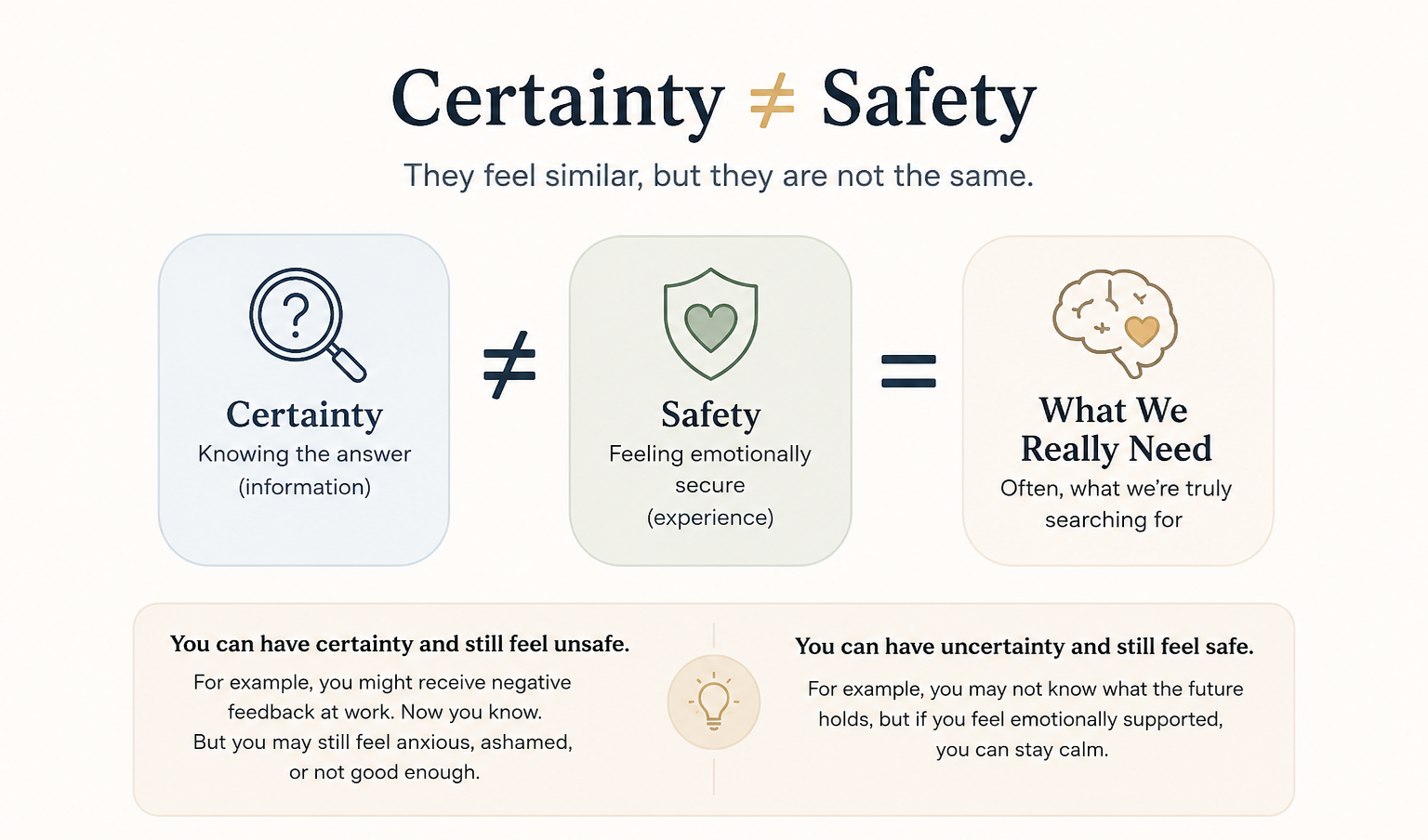
Imagine that you’ve been worried about a conversation with your manager. You’ve been trying to work out what the meeting is about, replaying recent interactions and wondering whether you’ve done something wrong. Eventually, the meeting takes place, and your manager gives you some constructive feedback.
You now know what the meeting was about. Yet instead of feeling relieved, you find yourself thinking about every comment your manager made. Was the feedback a sign that they were disappointed in you? Will this affect how they see you in the future?
The original question has been answered, but the worry hasn’t necessarily disappeared.
This doesn’t mean you were wrong to want an answer. The information may be useful, and the feedback may help you improve your work. The point is that knowing what happened and feeling okay about what happened are two different things.
If your worry was partly driven by a fear of criticism or a belief that making mistakes means you’re not good enough, receiving feedback may not resolve those concerns. You can understand the situation more clearly and still struggle with what it seems to say about you.
Something similar can happen in relationships. You may finally hear from someone who hasn’t replied to your message, only to start wondering whether their response sounds different from usual. You have the information you were waiting for, but now you’re searching for clues that will tell you whether everything is really okay.
When this happens, the search for certainty may be an attempt to manage a more difficult feeling. We might want reassurance that we’re valued, that we’ve done nothing wrong, or that we can handle whatever happens next. Because an answer cannot always provide that reassurance completely, the relief it brings may be temporary.
Sometimes, we simply need information, and getting it is enough. But when the same worry keeps returning even after we’ve received an answer, it may be worth looking beyond the question itself.
What to Ask Yourself When You Need an Answer
The next time you notice yourself urgently searching for certainty, try pausing for a moment before looking for more information. You don’t need to stop asking questions or pretend that uncertainty doesn’t bother you. Instead, give yourself a chance to understand what is making the situation so difficult.
Start by asking yourself: What do I actually know right now? Try to separate the information you have from the explanations your mind has added to it. Someone taking longer than usual to reply is something you’ve observed; the belief that they’re upset with you is an interpretation. It might turn out to be correct, but you don’t yet know that.
Then consider: What am I afraid this uncertainty might mean? Perhaps you’re worried about disappointing someone, making the wrong decision, or discovering that you haven’t met an expectation. Naming the fear won’t necessarily make it disappear, but it can help you understand why this particular question feels so important.
Finally, ask yourself: If I had the answer right now, what would I hope to feel? Would you expect to feel more secure in a relationship, more confident in your abilities, or more prepared for what comes next? Your answer may help you recognize whether you need practical information, emotional reassurance, or a way to cope with something that remains outside your control.
These questions aren’t a substitute for taking action when action is needed. Sometimes, the right response is to clarify an expectation, have an honest conversation, or gather the information you need to make a decision. The purpose is to recognize when you’re looking for information that can help you act and when you’re hoping it will remove a feeling that may not disappear through certainty alone.
How Curiosity Can Help You Sit With Uncertainty
When something feels unresolved, it’s tempting to settle on an explanation as quickly as possible. An unanswered message must mean something; a change in someone’s tone must have a reason. Sometimes, these interpretations are accurate. Other times, we’re filling in the gaps with assumptions because not knowing feels uncomfortable.
Curiosity gives us another option. Rather than immediately deciding what a situation means, we can allow ourselves to consider more than one explanation. A colleague who seems quiet might be having a difficult day. A delayed response might have very little to do with us. A mistake at work might be something to learn from rather than proof that we’re not capable.
This doesn’t mean ignoring warning signs or convincing ourselves that everything will turn out well. It means giving ourselves time to understand what is happening before treating our first interpretation as a fact.
We also don’t need to resolve every uncomfortable feeling before continuing with our day. You might still feel nervous before an important conversation, even after preparing for it. You might care deeply about the outcome of a decision while accepting that you cannot predict it perfectly. Feeling uncertain doesn’t automatically mean you’re unprepared, and feeling uncomfortable doesn’t necessarily mean something is wrong.
Over time, this can help you feel more comfortable with uncertainty and think more clearly about what to do next. Instead of immediately searching for another answer, you may become more able to decide whether you genuinely need more information or whether you can allow the situation to unfold.
Final Thoughts
Wanting certainty is not a flaw, and there is nothing wrong with looking for answers when they help you understand a situation or make a decision. The important question is what happens when getting an answer becomes the only way you believe you can feel okay.
Sometimes, the information we need really can resolve the problem. Other times, we discover that the uncertainty was connected to something else: a fear of rejection, a concern about our worth, or a desire to feel more in control of an unpredictable situation.
When that happens, searching for more certainty may not be enough. We may also need to address the underlying concern or accept that some outcomes cannot be known in advance.
So, the next time you catch yourself thinking, I just need to know, consider asking one more question: What am I hoping to gain from knowing?
The answer might help you understand not only what you’re looking for, but what may be driving that need.
Related Patterns
- Why Your Brain Fills in the Blanks (related article)
- Why We Crave Certainty (related article)
- Avoidance Isn’t Laziness (related article)
- Overthinking Isn’t the Real Problem (related article)
- Reassurance Seeking (related article)
- Fear of Failure (related article)
Further Reading
- Carleton, R. N. (2016). Into the unknown: A review and synthesis of contemporary models involving uncertainty. Journal of Anxiety Disorders, 39, 30–43. Read the article
- Shihata, S., McEvoy, P. M., Mullan, B. A., & Carleton, R. N. (2016). Intolerance of uncertainty in emotional disorders: What uncertainties remain? Journal of Anxiety Disorders, 41, 115–124. Read the article
AI Transparency : At SelfWorkNotes, we use generative AI as a collaborative tool during the research, writing and creative process. Every article is carefully reviewed, edited and finalized by the author, who remains fully responsible for the published content. Unless otherwise stated, illustrations are created using generative AI.
Gentle reminder: The content on SelfWorkNotes is provided for informational and educational purposes only. It does not constitute medical, psychological, legal or financial advice. Always consult a qualified professional regarding your personal situation.