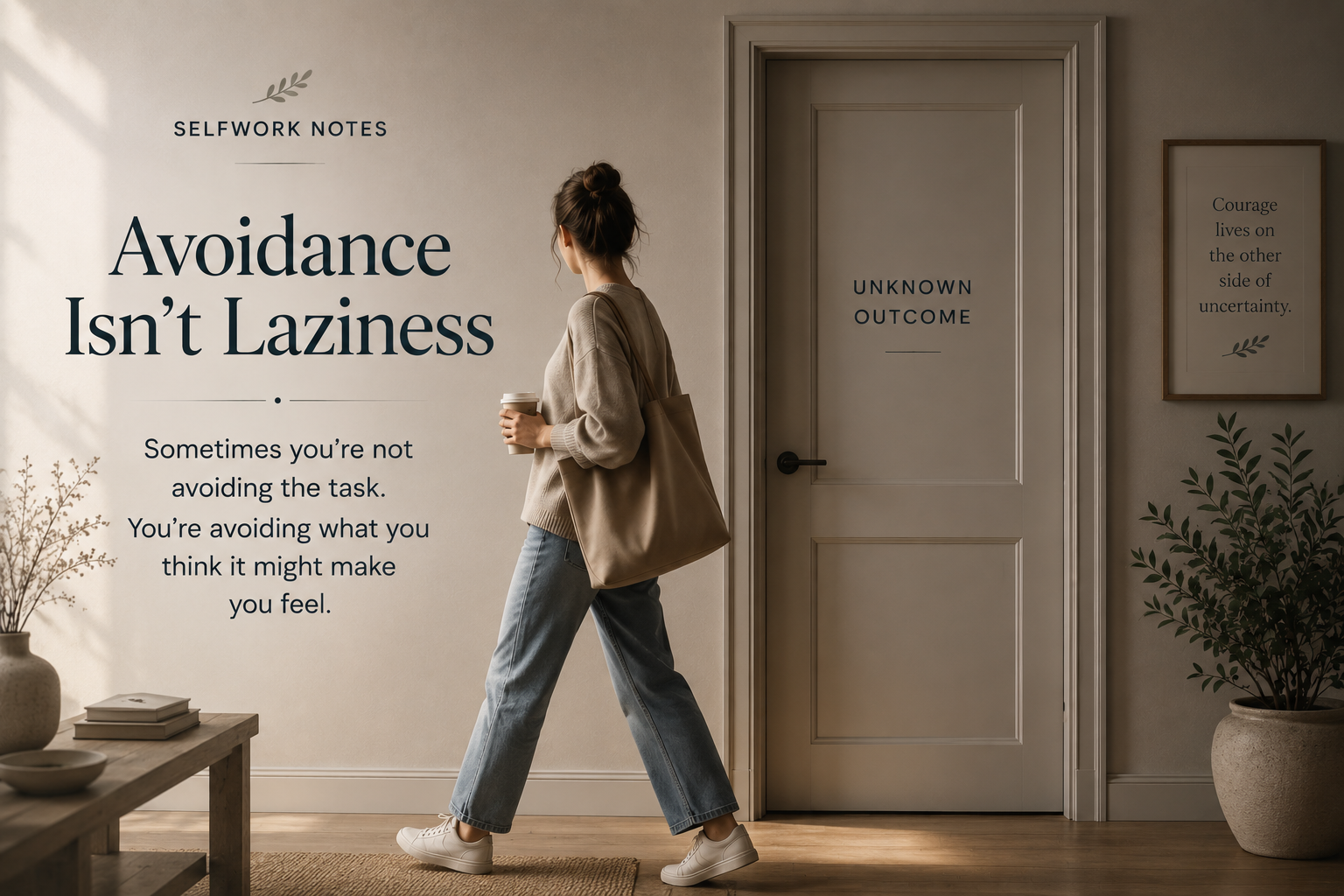
Avoidance Isn’t Laziness: Why We Avoid Things
Have you ever noticed yourself slipping into avoidance, even when you knew you should do something?
Maybe it was a task you kept postponing, a difficult conversation, an email you didn’t want to open, or medical test results you weren’t ready to read. Maybe you kept telling yourself: “I’ll deal with it tomorrow.”
From the outside, avoidance can easily look like laziness, procrastination, or a lack of motivation. But very often, avoidance isn’t about not caring. It’s about trying to protect yourself from something that feels emotionally difficult.
The question is: What exactly is your brain trying to protect you from?
If you’ve ever wondered why uncertainty sometimes leads to overthinking and other times to avoidance, you’re not alone.
What Is Avoidance?
Avoidance is more than simply not doing something.
In psychology, avoidance refers to postponing, escaping, or distancing yourself from situations that currently feel emotionally uncomfortable.
Sometimes we avoid external situations, our own thoughts, emotions, or decisions. And although avoidance often brings temporary relief, it rarely solves the original problem.
In many cases, it actually keeps the discomfort alive.
Why Does Avoidance Happen?
There isn’t one single answer. The same behavior can serve very different psychological purposes.
Two people may both avoid having a difficult conversation, but for completely different reasons.
One may fear rejection.
Another may fear conflict.
Someone else may feel overwhelmed.
Another person may simply feel uncertain about what will happen.
The behavior looks the same, the underlying pattern, however, is different.
For example:
Fear of Failure
“What if I can’t do it?”
Avoidance protects you from the possibility of failing.
Perfectionism
“If I can’t do it perfectly, maybe I shouldn’t start at all.”
Avoidance protects you from making mistakes.
Emotional Safety
“What if they’re upset with me?”
Avoidance protects you from emotionally difficult interactions.
Self-Worth
“What if this proves I’m not good enough?”
Avoidance protects your sense of self.
Overwhelm
“This feels like too much right now.”
Avoidance becomes an attempt to reduce emotional overload.
Need for Certainty
“What if I don’t know what’s going to happen?”
Avoidance delays facing uncertainty.
None of these explanations automatically applies to everyone, sometimes several of them work together.
In this article, we’ll focus on one particularly common pattern: our brain’s need for certainty.
It’s important to remember that human behavior is rarely explained by a single pattern. The examples in this article aren’t diagnoses or fixed categories, they’re possible lenses through which to better understand your own experience.
Avoidance vs. Procrastination
Although procrastination can be one form of avoidance, the two aren’t identical.
Avoidance is a broader emotion regulation strategy that helps us distance ourselves from situations, thoughts, emotions, or decisions that currently feel emotionally uncomfortable. Procrastination is one specific way this can happen: instead of facing a task now, we delay it until later.
In both cases, the immediate goal is similar: to reduce emotional discomfort. The difference is that procrastination usually involves postponing a task, while avoidance can involve distancing yourself from many kinds of emotionally difficult experiences, not just tasks.
How Avoidance Helps the Brain Feel More Certain
This may sound surprising at first, but avoidance doesn’t eliminate uncertainty.
It postpones it.
Imagine you have to do a task you don’t like. Not primarily because you simply don’t feel like working, but because it makes you anxious.
For example, you receive an email from your boss, that they want to meet you tomorrow.
You immediately feel anxious.
You could open your calendar, you could reply. Maybe you could ask what the meeting is about.
Or, you could spend the entire evening avoiding the thought altogether.
For a little while, avoidance creates the illusion that you don’t have to deal with the uncertainty yet.
The answer still exists.
You just postpone meeting it.
The Paradox of Avoidance
What’s really difficult about avoidance is that it often feels helpful in the short term, but in the long term, it usually keeps uncertainty alive.
The email still waits, the conversation still needs to happen, the test results are still there, the decision still has to be made.
Avoidance temporarily reduces emotional discomfort, but it often prolongs the uncertainty your brain wanted to eliminate in the first place.
Sometimes the fastest path toward relief isn’t avoiding uncertainty, it’s simply moving through it.
What Can You Do to Reduce Avoidance?
1. Emotional Shift
Avoidance often makes a task feel enormous. Sometimes so much, that it can totally drain you and lead to overthinking. To prevent catastrophic thoughts taking over, you could try to think about what the emotion is you are trying to prevent yourself from. Not just fear, it can be a surface problem, but emotion is rooted deeper.
Ask these questions: “What emotion am I trying to avoid? What do I think will happen? And if that happened, what would feel so difficult about it? What part of me would that threaten?
For example, maybe you don’t want to open that email, because you’re afraid that your boss will give you negative feedback? If so, then you could try to think over what criticism means to you. Maybe you feel you’re not good enough? If you notice this pattern repeatedly, it may be worth exploring whether self-worth plays a role.
2. Curiosity Creates More Space Than Control
Many of us respond to uncertainty with one simple goal: “I need to know.”
But sometimes, trying to force certainty too quickly only increases anxiety.
Instead of asking: “How can I make this uncertainty disappear?”
try asking:
“What happens if I simply allow myself to learn more?”
Curiosity doesn’t remove uncertainty; it simply shifts your attention from needing immediate answers to gathering more information before reaching a conclusion.
Instead of saying: “I have to know right now.”
try saying:
“I don’t know yet, but I’m curious to see what I’ll discover.”
Notice how different those two sentences feel.
One demands certainty, the other allows reality the chance to unfold before deciding what the story means.
3. Start with Smaller Steps
When you have some clarity about what to do next, and you feel you have to do something huge, one helpful approach is reducing the size of the first step.
Maybe you don’t have to solve everything today, maybe your first step is simply opening the email.
Or, instead of saying “I need to finish the whole project”, maybe you could try just working on it for ten minutes.
In this way, your brain will be less likely to interpret the task as you must do it all at once, which can sound impossible, but the task becomes more approachable.
Your brain often doesn’t need complete certainty, sometimes it simply needs evidence that the first step is safe enough to take.
Final Thoughts
Avoidance isn’t always a sign of laziness or weakness.
Very often, it’s your brain trying to reduce emotional discomfort in the best way it currently knows how.
The important question isn’t simply:
“Why am I avoiding this?”
A more helpful question might be:
“What is my avoidance trying to protect me from?”
Sometimes the answer is fear of failure, or perfectionism, sometimes emotional safety or uncertainty.
Understanding the need underneath the behavior often helps explain it. And when you understand what your brain is trying to protect, you can begin responding to the real need instead of only fighting the behavior.
Avoidance often disappears not when the task becomes smaller, but when the unknown becomes smaller.
If this resonated with you, you might want to read about why we need certainty, why we overthink, seek reassurance, why we often overexplain ourselves, and why our brain often fills in the blanks.
AI Transparency : At SelfWorkNotes, we use generative AI as a collaborative tool during the research, writing and creative process. Every article is carefully reviewed, edited and finalized by the author, who remains fully responsible for the published content. Unless otherwise stated, illustrations are created using generative AI.
Gentle reminder: The content on SelfWorkNotes is provided for informational and educational purposes only. It does not constitute medical, psychological, legal or financial advice. Always consult a qualified professional regarding your personal situation.