Why Doing Nothing Feels Unsafe
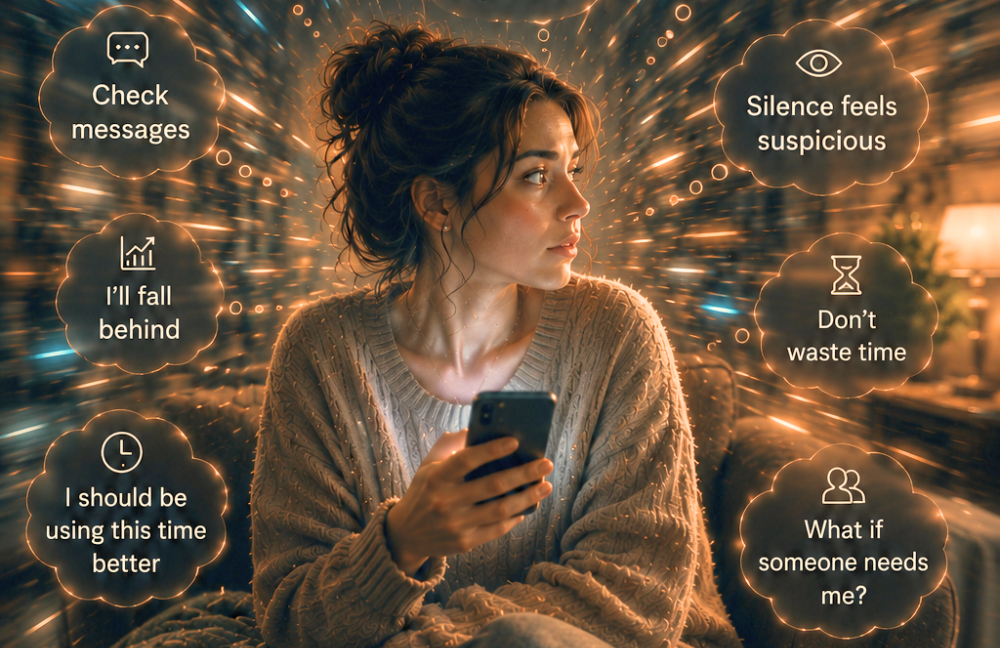
Sometimes the moment everything finally becomes quiet, your nervous system gets louder. You sit down to rest, but instead of relaxing, you suddenly feel restless. You reach for your phone automatically, start thinking about what you should be doing, or feel a strange tension in your body, because doing nothing feels unsafe.
And even when nothing is wrong, you feel uncomfortabe. Not because you are lazy, unproductive, or incapable of resting. But because your nervous system may have learned that staying mentally or emotionally active was the safest way to move through life.
Why Doing Nothing Can Feel Unsafe
For some people, slowing down feels unnatural because their mind and body rarely learned how safe slowing down could feel.
Instead, the nervous system became used to:
- monitoring the environment
- staying prepared
- anticipating problems
- paying attention to other people’s moods
- remaining productive or useful
Over time, this constant alertness can become automatic. So when activity stops, your nervous system doesn’t immediately interpret it as peace. It interprets it as uncertainty.
This is why doing nothing feels unsafe sometimes, instead of calming.
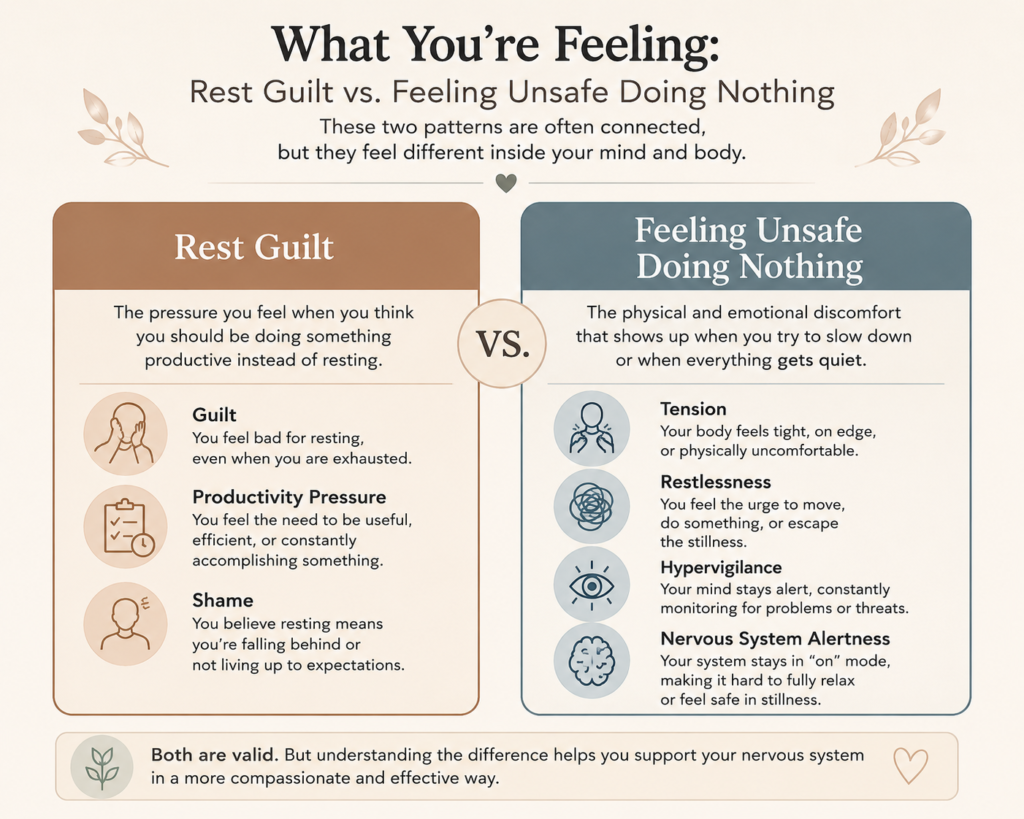
The Difference Between Rest Guilt and Feeling Unsafe Doing Nothing
These two patterns are closely connected, but they are not exactly the same.
Rest guilt usually sounds like:
“I should be doing something productive right now.”
The focus is often on self-worth, usefulness, or feeling undeserving of rest. But when you feel unsafe doing nothing, the experience goes deeper than guilt.
Your body may feel:
- tense
- restless
- uneasy
- overstimulated by silence
- unable to fully settle
Even if you consciously want to relax.
This is because the nervous system may still associate constant activity with emotional safety and control.
How This Pattern Often Starts
Many people who struggle to slow down learned early that staying alert helped them feel safer.
Maybe you grew up in an environment where you had to:
- pay attention to emotional changes quickly
- avoid conflict
- stay useful and productive
- anticipate other people’s reactions
- remain emotionally available
For a child, constant awareness can often become a survival strategy.
Your nervous system slowly learns:
“If I stay alert, prepared, helpful, or busy, things are less likely to go wrong.”
And while this pattern may once have protected you, later in life it can become exhausting. Because eventually, your nervous system stops feeling comfortable slowing down.
You can still be safe even when you don’t control everything around you.
Especially other people’s reactions are not your responsibility to carry.
Signs Your Nervous System Doesn’t Feel Safe Slowing Down
This pattern can look like:
- constantly checking your phone
- feeling uncomfortable in silence
- needing background noise all the time
- overthinking when things become quiet
- feeling guilty or anxious while resting
- automatically searching for something to do
- struggling to fully relax, even during time off
- feeling emotionally “on” all the time
Sometimes, people become so used to internal tension that calm starts to feel unfamiliar. And unfamiliar can feel unsafe.
And thus, what you may need first is to
teach your body that rest is safe.
Practical Shifts That Help Your Nervous System Feel Safer
1. Notice the Urge to Stay Busy
The goal is not to judge yourself for being productive.
Simply start noticing when silence feels uncomfortable, when you automatically reach for stimulation, or when your body struggles to slow down
Awareness helps interrupt autopilot patterns.
2. Stop Treating Rest Like Something You Need to Earn
One of the most powerful shifts is allowing your nervous system to experience small moments where:
- nothing is being solved or monitored
- nobody needs anything from you
and everything is still okay.
Because rest is not a reward for overexhaustion. Rest is a human need.
Your nervous system needs moments of safety before complete burnout happens — not only after.
Think of micro “nervous system pauses” like:
- not checking your phone immediately after waking up
- sitting in silence for two minutes before starting the next task
- taking a slow breath before answering a message
- looking out the window instead of filling every empty second
- drinking your coffee without multitasking
- letting yourself finish one thing before rushing into the next
Even small pauses matter. They give your nervous system the experience that nothing bad happened while you were resting.
3. Teach Your Body That Stillness Can Be Safe
Your nervous system often responds more to physical experiences than to thoughts alone.
This is why calming physical signals can help your body slowly step out of constant alertness.
Simple things like:
- slower breathing
- softer lighting
- grounding exercises
- warm blankets
- calming music
- or guided relaxation excersies
can help create small moments of safety for your nervous system.
Because your body gradually learns that slowing down does not automatically mean danger.
4. Build Safety Through Predictability
Your nervous system responds strongly to repetition and consistency.
Predictability = safety signal for your nervous system.
Therefore, simple routines can help create internal stability, such as:
- familiar evening rituals
- consistent sleep schedules
- warm drinks
- calming sensory experiences
- slowing your breathing intentionally
These are small signals of safety your body can recognize over time.
Reflection for When Doing Nothing Feels Unsafe
What happens inside you when everything becomes quiet?
And what if your difficulty with resting was never laziness — but a nervous system that learned to stay alert for too long?
If this resonates with you, you may also want to explore why you feel emotionally drained, why you feel guilty for resting, and the quiet signs of burnout.
AI Transparency : At SelfWorkNotes, we use generative AI as a collaborative tool during the research, writing and creative process. Every article is carefully reviewed, edited and finalized by the author, who remains fully responsible for the published content. Unless otherwise stated, illustrations are created using generative AI.
Gentle reminder: The content on SelfWorkNotes is provided for informational and educational purposes only. It does not constitute medical, psychological, legal or financial advice. Always consult a qualified professional regarding your personal situation.