Why You Feel Responsible for Other People’s Emotions
You notice immediately when someone’s mood changes. Emotional responsibility often starts before you even consciously realize it — your nervous system reacts automatically to tension, silence, or emotional shifts around you.
You immediately start thinking over what you did and how you can fix the situation. You ask yourself questions like: “Did I do something wrong?”, “Should I help?” “I need to address this heavy silence.”
And slowly, without even realizing it, you begin carrying emotional weight that was never fully yours.
For many people, emotional responsibility does not come from weakness or “being too sensitive.” It often comes from a nervous system that learned early that staying emotionally aware helped create safety.
You Learned to Stay Emotionally Alert
Some people grow up learning that emotional awareness is necessary. This is because maybe you had to, for example, notice emotional changes quickly, avoid conflict, or calm other people down.
For a child, this can become an adaptation strategy.
Your nervous system slowly learns:
“If I stay aware of other people’s emotions, things feel safer.”
And over time, emotional monitoring becomes automatic. Not because you consciously choose it. But because your body learned that staying emotionally alert helped you feel protected, accepted, or connected.
The pattern of emotional responsibility is closely connected to emotional hypervigilance and nervous system alertness. But while some people respond to internal anxiety by staying constantly busy or mentally active, others become highly focused on managing the emotional environment around them.
Emotional Responsibility vs Healthy Empathy
Caring about people is healthy. But emotional responsibility goes far beyond that.
Empathy says: “I care about how you feel.”
Emotional over-responsibility says: “Your emotions are now my responsibility to manage.”
In practice, this can look like:
- feeling guilty when someone is upset
- trying to prevent discomfort constantly
- overexplaining yourself
- feeling responsible for keeping peace
- struggling to say no
- absorbing other people’s stress
- feeling emotionally “on” all the time
Over time, this becomes exhausting for the nervous system, because you are constantly managing emotional pressure around you.
Signs of Emotional Responsibility Overload
Sometimes emotional overload becomes so familiar that you stop noticing how much tension you carry internally.
Signs can include:
- constantly monitoring people’s moods
- difficulty relaxing
- feeling guilty for disappointing others
- overthinking interactions repeatedly
- struggling to disconnect emotionally
- feeling tense even during rest
- emotional exhaustion
- people pleasing
- difficulty identifying your own needs
- feeling responsible for fixing situations immediately
- And eventually, the body may start signaling overload too.
How Your Body Signals Emotional Responsibility
Many people push through emotional stress for a very long time by minimizing their own needs. But the nervous system and body are deeply connected, and your body may sometimes signal when emotional overload has been building for too long.
Sometimes chronic emotional overload can show up as:
- muscle tension
- stomach discomfort
- shallow breathing
- headaches
- exhaustion
- difficulty sleeping
- constant internal alertness
Physical symptoms should never be self-diagnosed or ignored. Persistent symptoms should always be taken seriously and discussed with a healthcare professional when needed.
When your body is reacting, it’s not weakness, and it’s definitely not working against you. In fact, it works for you and it may be signaling a need for attention, rest, safety, or change.
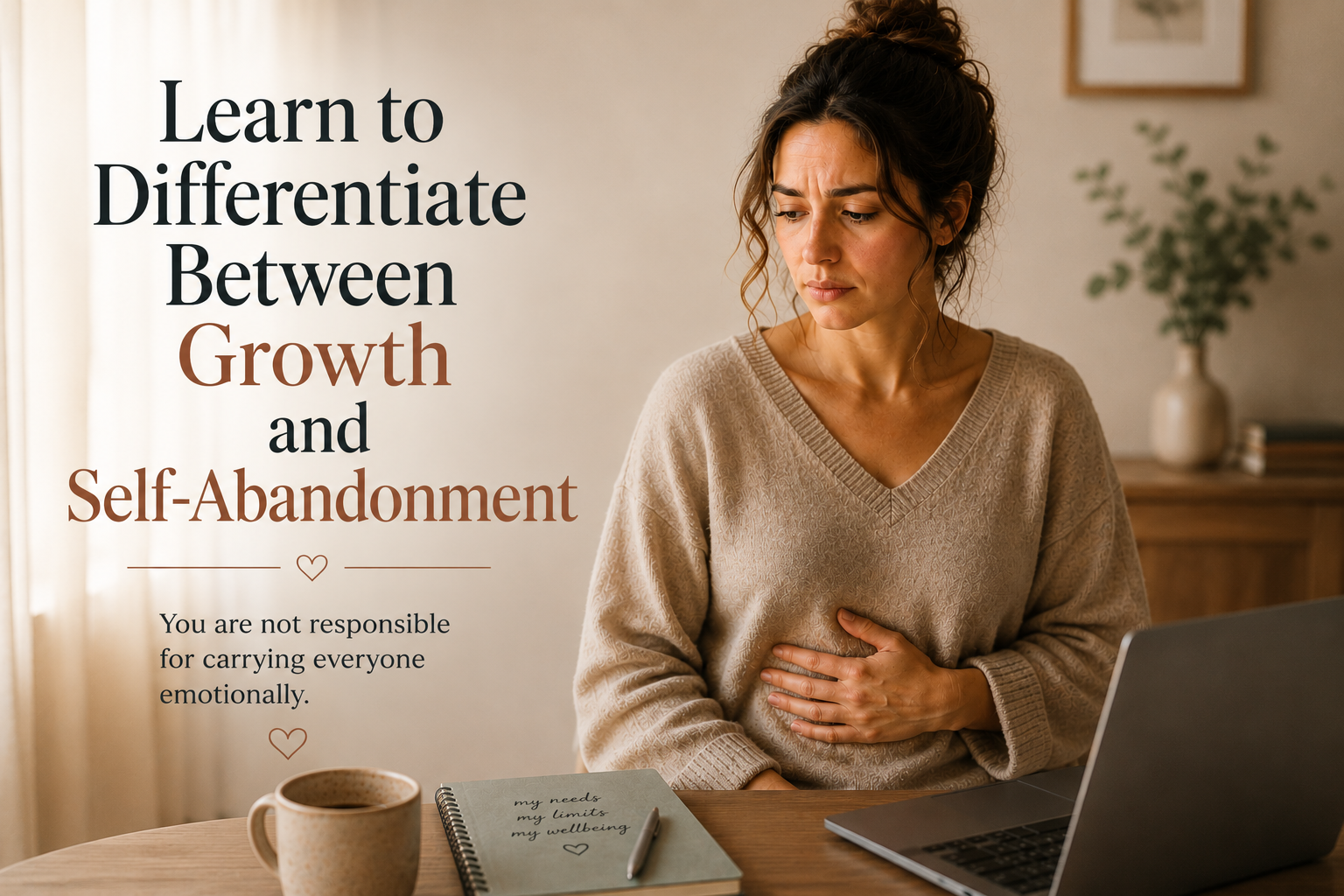
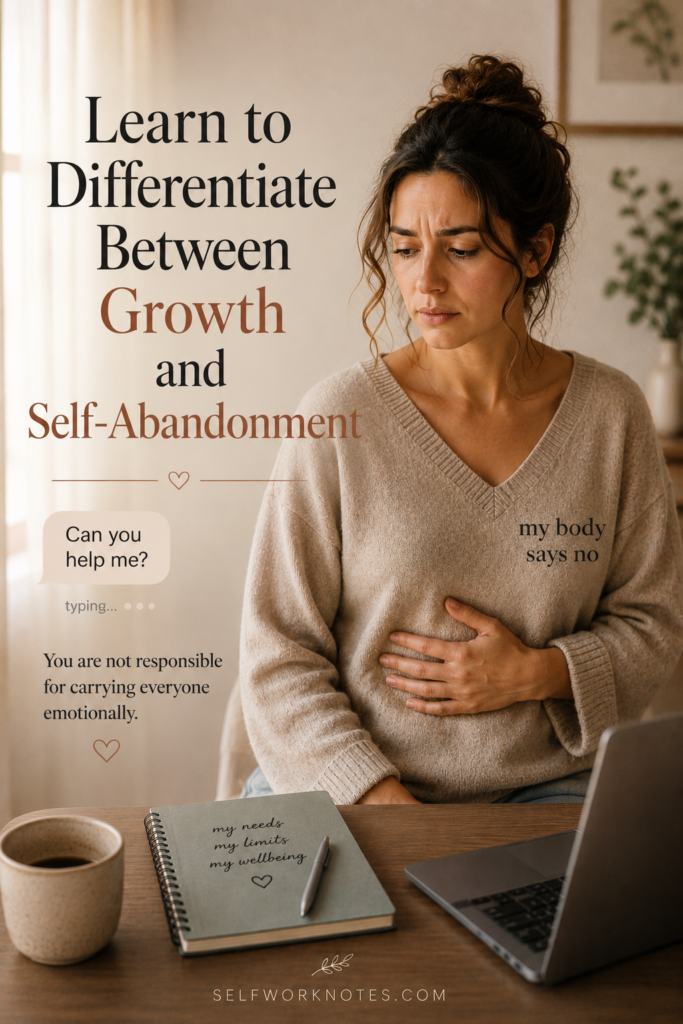
Learn to Differentiate Between Healthy Discomfort and Self-Abandonment
Not every uncomfortable feeling means something is wrong.
Sometimes discomfort simply means your nervous system is experiencing something unfamiliar:
- setting boundaries
- saying no
- disappointing someone
- not immediately fixing everything
- allowing other people to manage their own emotions
That kind of discomfort can be part of healing.
Chronic emotional overload, however, is different. If your body constantly feels exhausted, tense, emotionally depleted, overwhelmed, or unsafe, those signals should not be endlessly ignored or tolerated.
Because there is a difference between temporary discomfort that comes from growth, and ongoing self-abandonment that slowly drains your nervous system.
Your body is not asking you to become “better” at carrying everything. Sometimes it asks you to stop people pleasing and carrying what is harming you.
Practical Shifts for Emotional Responsibility
1. Ask Yourself: “Is This Actually Mine to Carry?”
Before automatically taking on emotional responsibility again, pause for a moment. Ask yourself:
“Am I supporting this person, or taking responsibility for emotions that are not mine to control?”
Not every uncomfortable situation needs your intervention.
2. Notice When Your Body Tightens
Your nervous system often reacts before your mind fully understands what is happening.
Pay attention to moments when, for example:
- your stomach tightens
- chest feels heavy
- the breathing becomes shallow
- your body immediately goes into tension
Sometimes these reactions are signals that you are moving into emotional over-responsibility again. Not every difficult feeling means danger. But your body deserves attention when it constantly feels overwhelmed.
When you feel signals of your body in a heavy situation, ask yourself:
“What do I actually want? What is my body trying to tell me right now? Where do I feel it in my body?”
These questions also may guide you in gaining clarity about your own needs and give yourself what you need at that moment.
For example: someone asks you a favor you have no capacity or simply energy to do, because you are already overloaded with work, you have family responsibilities, and ongoing projects in your life, you name it. And when you are about to say yes, you may feel that slight tension in your stomach. If you answer the above questions, you may say that all you really want is a good rest right now, because you already feel overwhelmed. And you may realize that instead of automatic people pleasing to avoid others feeling hurt, saying no could be a healthier choice at that moment.
And no, you won’t be selfish setting boundaries to protect your energy and prevent burnout. You still can help once your own needs are met, the two don’t have to be mutually exclusive.
Besides, you are not responsible for other people’s reactions, either.
3. Stop Monitoring Every Emotional Shift
Emotionally exhausted people often scan the environment automatically to check tones constantly, analyze reactions or to avoid potential conflict or discomfort.
Instead of immediately focusing outward, gently bring attention back inward: “What am I feeling right now?” This helps rebuild connection with your own emotional state.
4. Allow Small Moments Where Nothing Needs Fixing
Your nervous system may need experiences where nothing is being solved, and still, everything is okay.
Even small moments matter:
- sitting quietly for a few minutes
- breathing slowly and focusing on your breathing, while you relax your body
- listening to calming music
- taking a slow walk
- letting a message wait
- resting without multitasking
These moments help your nervous system learn that safety does not always require constant emotional vigilance.
5. Your Worth Is Not Measured by Emotional Self-Sacrifice
Many emotionally over-responsible people unconsciously learned:
“If I stop helping, I disappoint people.”
But your value does not come from carrying everyone else emotionally.
You are allowed to:
- have limits
- protect your energy
- say no
- prioritize your wellbeing
- step back from emotional overload
Supporting people should not require abandoning yourself.
Reflection
You can even journal about these:
What emotional weight are you carrying right now that was never fully yours?
What would change if you no longer believed you had to keep everyone emotionally okay in order to feel safe, valuable, or loved?
If this resonates with you, you may also want to explore why you feel emotionally drained, why doing nothing feels unsafe, and why overthinking keeps your mind stuck in constant alertness.
AI Transparency : At SelfWorkNotes, we use generative AI as a collaborative tool during the research, writing and creative process. Every article is carefully reviewed, edited and finalized by the author, who remains fully responsible for the published content. Unless otherwise stated, illustrations are created using generative AI.
Gentle reminder: The content on SelfWorkNotes is provided for informational and educational purposes only. It does not constitute medical, psychological, legal or financial advice. Always consult a qualified professional regarding your personal situation.