Why You Can’t Fully Relax: The Hidden Pattern Behind Overthinking, Overexplaining, People Pleasing, and Emotional Exhaustion
Most people think their struggles are separate problems. Maybe you overthink, while you are also prone to failing to say no. Maybe social interactions leave you emotionally exhausted and you even tend to constantly replay conversations afterward. At the end of the day, you might feel drained, but might not really understand why you can’t fully relax.
At first glance, these may seem random, rather unpleasant traits, but what if they have something in common? What if they are different expressions of the same underlying pattern? A pattern that quietly teaches you that feeling safe depends on keeping people happy, preventing problems, managing others’ emotions, avoiding disappointment, and staying emotionally alert. And if it is running in the background, true relaxation becomes difficult, because you are constantly monitoring your environment for any changes.
The Hidden Rule Running in the Background
In many cases, these behaviors may be connected to a need for emotional safety.
In practice, feeling responsible for keeping everyone okay
It may show up such as avoiding conflicts, staying available even when exhausted, suppressing your own needs, or softening your boundaries.
This pattern can sometimes begin early in life, when a child feels acceptable or loveable if they are “good”, easy to manage, agreeable, and don’t cause any disappointments. In such cases, the nervous system may learn to pay attention to people, watch for mood changes and prevent problems before they happen.
This can become so automatic that it feels less like a strategy and more like reality itself and slowly, you simply feel responsible for it.
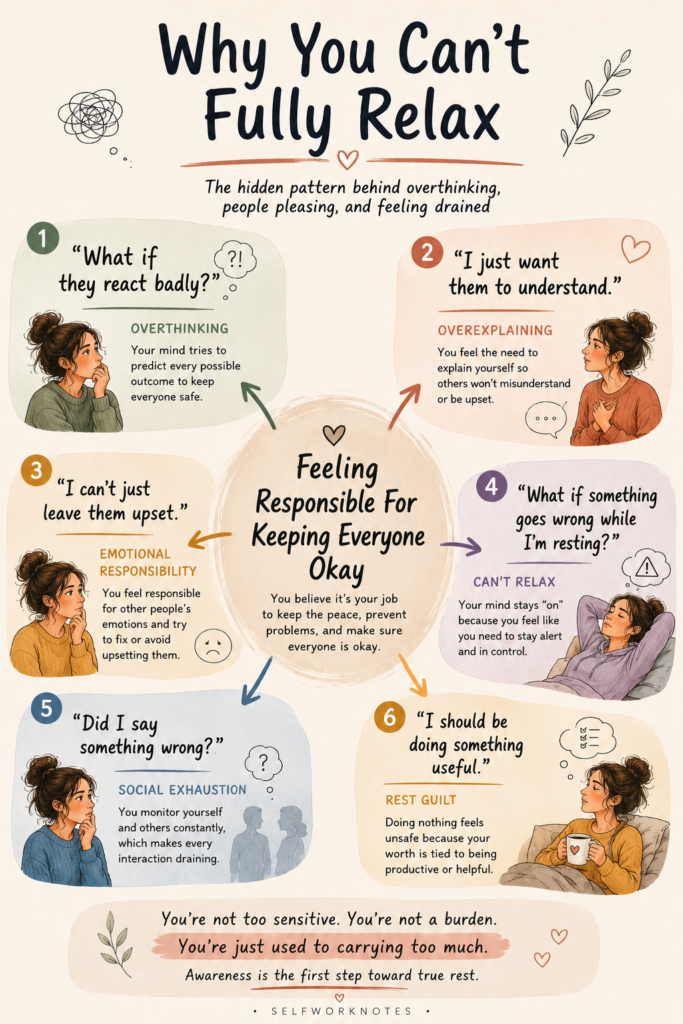
How The Same Pattern Shows Up in Everyday Life
The pattern often appears as completely different problems, such as:
Overthinking
How it sounds: “I must prepare for all the possible outcomes.” “What if they get upset?” “What if I make things worse?” Or:
Sometimes overthinking sounds surprisingly reasonable: ‘I just want to make sure I didn’t miss anything.’ And before you know it, you have checked the same thing ten times.
What’s happening: Overthinking often looks like problem solving. Your conscious mind says you have to stay in control. But sometimes it is an attempt to predict and prevent emotional discomfort before it happens, because you need to be emotionally safe.
Overexplaining
How it sounds: “I just want them to understand my point.”
What’s happening: Many people overexplain because they want clarity, and sometimes that is true. But overexplaining can also become an attempt to manage reactions. If you explain enough, maybe nobody will be disappointed, nobody will misunderstand or judge you.
The problem is that no amount of explanation can fully control how another person feels.
Emotional Responsibility
How it sounds: “I just care about them” “I can’t just leave them upset“
What’s happening: This pattern often creates the belief that other people’s emotions are somehow your responsibility. This is why you may want to reduce discomfort, solve tension, prevent conflict, i.e.: manage your environment’s reactions.
But caring about someone’s feelings is not the same thing as being responsible for them. Those are two very different things.
Social Exhaustion
How it sounds: “Did I say something wrong?” “Why did everyone go silent?” “I need to be the one who entertains them all night long”
What’s happening: Social interaction becomes exhausting when connection turns into monitoring. Because instead of simply being present, you may find yourself
constantly evaluating facial expressions, tone changes, group dynamics, i.e. the emotional reaction of your environment. And this can take a lot of effort which exhausts you.
Difficulty Resting
How it sounds: “I should be doing something useful.”
What’s happening: Rest requires safety. And if you stay focused on potential problems, slowing down can feel surprisingly uncomfortable. You may assume you struggle with productivity. But sometimes the deeper issue is that being busy feels safer than letting go.
Because when you stop moving, the mind finally has room to notice everything it has been trying to manage.
People Pleasing
How it sounds: “It’s easier if I just go along with it.” “I’m a flexible person.”
What’s happening: People pleasing is often misunderstood as kindness. But in reality, the underlying pattern is that you might be trying to avoid emotional consequences, like disappointment, conflict or rejection and try to stay acceptable to others.
The behavior may look helpful from the outside. But internally, may be driven partly by generosity and partly by fear of rejection.
Why These Patterns Are So Hard to Recognize
If you look at the above example sentences, they rarely look harmful. In fact, many of them appear sensible, responsible, logical choices that you make from thoughtfulness. And that’s the “trap”. Because this is one of the reasons this pattern can run without you noticing it.
Overthinking may look like preparation. Overexplaining may look like clear communication. Emotional responsibility may look like empathy. People pleasing may look like kindness. And often these behaviors genuinely come from positive intentions.
The problem is not the behavior itself, but what is the underlying pattern that drives it. In other words:
The question is whether you are still inside your own boundaries while doing it.
Two people may do exactly the same thing on the surface and for completely different reasons underneath. Both may help others and prepare carefully.
Both may explain their decisions and care deeply about people’s feelings.
The difference often appears only when their own needs, limits, or boundaries come into conflict with someone else’s expectations.
One person may still feel free to say no.The other may feel unable to.
One person helps because they genuinely want to. The other helps because they fear what might happen if they don’t.
From the outside, the behavior can look almost identical. From the inside, the experience can be completely different.
Note the difference between the “Healthy” and the “Trapped” motifs:
“Do I want to help?” vs. “What will happen if I don’t?”
“Am I really providing necessary information?” vs. “Am I trying to control how they see me / react?”
“I care for how they feel” vs. “I feel responsible to solve it.”
“I can do this without abandoning my own needs” vs. “I need to do this so they won’t be upset”
“I want to make sure nobody is disappointed” vs. “I feel responsible for making sure nobody is disappointed”
What changes is whether it comes from choice or fear, self-respect or self abandonment, genuine care or the need to keep everyone comfortable.
Why You Can’t Fully Relax Even When Nothing Is Wrong
This pattern makes an important promise:
“If I manage everything well enough, I will finally feel safe.”
It sounds convincing. Unfortunately, though, it rarely works. Because what you may try to keep in your hands is the reaction of your external environment. Something that comes from outside of you and therefore remains outside your control.
Practical Shifts
Understanding why you can’t fully relax is often the first step toward changing the pattern.
1. Notice When You Are Managing Emotions Instead of Experiencing Them
When you notice overthinking, overexplaining, or people pleasing, ask yourself:
“Am I present in this situation, or am I trying to manage it?”
“What am I trying to prevent right now?”
Awareness alone can reveal patterns that usually operate automatically.
2. Practice Letting Small Disappointments Exist
Not every uncomfortable feeling requires your intervention.
Allow someone to disagree. Allow someone to feel disappointed.
Allow yourself not to fix it.
3. Question The Rule
When you feel pressure to manage everything, ask:
“Am I really the only responsible one for the outcome of the situation?”
The answer can be surprisingly revealing. Because don’t forget: the reaction of others is not something you can fully control, and you don’t even have to: it is simply not your responsibility.
4. Recognizing Your Worth Could Be Your First Boundary
When you feel you are starting to abandon yourself to make others feel okay, please remember:
Your worth does not depend on remaining constantly available or agreeable.
You are not responsible for others’ reaction. What you are responsible for is protecting your own mental health and energy.
And trust yourself: if others react “badly”, just remember you are able to handle those situations as well, just remember similar ones that you successfully handled in the past. (Maybe those past examples reveal some interesting patterns, as well.)
One of the hardest parts of changing this pattern is accepting that some people may not like it. A new boundary may disappoint someone and may even lead to conflict. Expressing your needs may trigger reactions. And sometimes those reactions are real.
But the goal is not to create a life where nobody is ever upset. The goal is to stop organizing your entire life around preventing that possibility.
Because making sure everyone is okay is not what finally allows you to relax.
Peace of mind comes from trusting that you have the ability and strength to handle it when they are not.
And from realizing that discomfort, disappointment, and conflict are not always signs that something went wrong. Sometimes they are signs that you finally stopped abandoning yourself.
Reflection
You may want to journal about these questions:
- Which branch of this pattern shows up most often in my life?
- What am I usually trying to prevent?
- What would change if I trusted myself to handle discomfort instead of preventing it?
If you’ve spent years wondering why you can’t fully relax, even during quiet moments, this underlying pattern may be worth exploring. Because while overthinking, overexplaining, people pleasing, social exhaustion, and difficulty resting may look like different problems on the surface, they often grow from the same root:
Feeling responsible for keeping everyone okay.
AI Transparency : At SelfWorkNotes, we use generative AI as a collaborative tool during the research, writing and creative process. Every article is carefully reviewed, edited and finalized by the author, who remains fully responsible for the published content. Unless otherwise stated, illustrations are created using generative AI.
Gentle reminder: The content on SelfWorkNotes is provided for informational and educational purposes only. It does not constitute medical, psychological, legal or financial advice. Always consult a qualified professional regarding your personal situation.