
Need for Certainty: Why We Crave Answers So Quickly
The human brain has a natural need for certainty, especially when information is incomplete.
Have you ever noticed how uncomfortable it feels not knowing?
For example: a friend hasn’t replied to your message. Your boss asks if you can meet tomorrow. Your partner seems quieter than usual.
Nothing has actually happened yet and maybe nothing is wrong. Yet your mind immediately starts searching for answers: “Did I do something wrong?”
“Are they upset with me?”
“Something must have happened.”
Interestingly, many people would rather have an explanation, even a negative one, than no explanation at all.
But why?
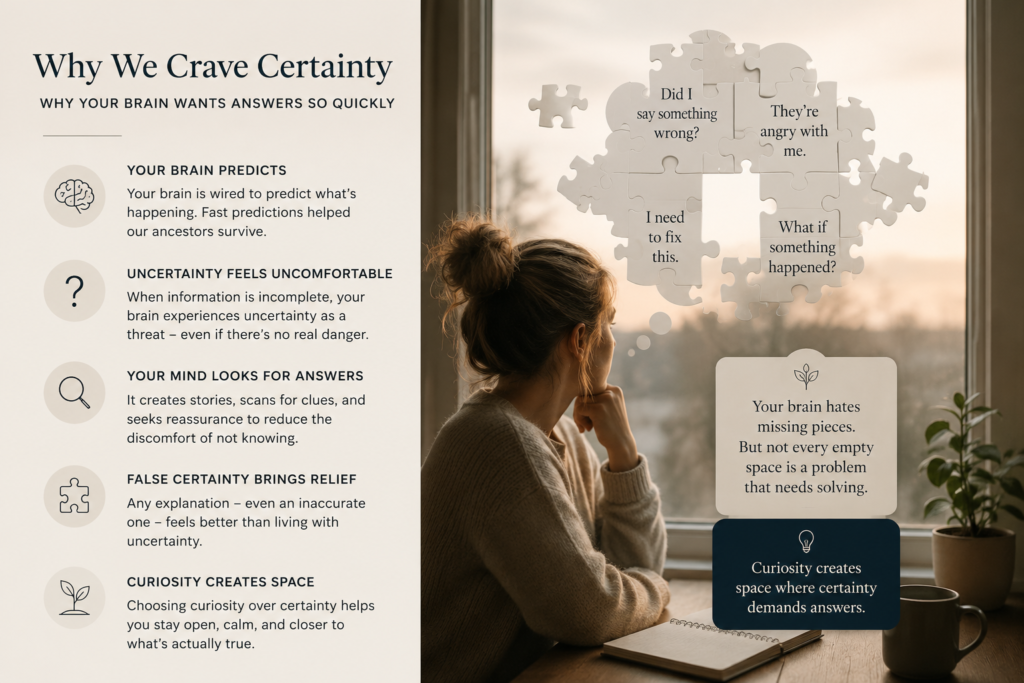
The answer is not simply overthinking or anxiety. It begins with something much more fundamental: the human brain naturally prefers certainty over uncertainty, because predicting the environment is one of its fundamental survival functions. That doesn’t mean uncertainty is always dangerous. It simply means that our brains are wired to look for patterns, predictions, and explanations whenever information is incomplete.
Why Your Brain Has a Need for Certainty
One of the brain’s primary jobs is not simply to react to the world, but to predict it.
From an evolutionary perspective, this ability helped humans survive.
Imagine hearing movement in the bushes thousands of years ago. Waiting until you had complete information might have been dangerous. Your brain had to make a quick prediction whether that was a threat or not.
Most of the time, making a fast prediction was far more useful than waiting for perfect certainty.
That same prediction system still exists today. The difference is that modern uncertainty often isn’t about physical danger anymore. It rather appears in everyday situations, which most of the time are not about survival. It may appear sometimes as unanswered messages, or unclear conversations, sometimes simply waiting for results, uncertain relationships, or unexpected changes.
Your brain still tries to predict what is happening, even when there isn’t enough information yet.
Why Uncertainty Feels So Difficult
Psychologists have studied our relationship with uncertainty for decades. One well-researched concept is Intolerance of Uncertainty (IU), which describes why some people find uncertain situations particularly difficult to tolerate. In everyday language, you could think of this as the brain’s natural desire for certainty when information is incomplete.
But if every human brain has the need for certainty, why do some people seem comfortable with uncertainty while others find it almost unbearable?
There isn’t one single explanation.
Every human brain prefers certainty. What differs from person to person is what uncertainty comes to mean. For some people, uncertainty is simply inconvenient.
For others, it may activate deeper concerns about rejection, criticism, failure, loss of control, or emotional safety.
In other words, uncertainty itself is not the same as danger. But for some people, the brain may have learned to associate the two.
Several different factors may influence how difficult uncertainty feels.
For example:
- your current stress level
- emotional exhaustion or burnout
- previous life experiences
- personality differences
- attachment experiences
- a strong need for control
- fear of rejection or failure
For some people, uncertainty simply feels unpleasant. For others, it can temporarily feel emotionally unsafe.
When uncertainty feels threatening, the brain naturally becomes even more motivated to eliminate it as quickly as possible.
Not because something is wrong with you. Because uncertainty itself can feel uncomfortable.
How the Need for Certainty Shapes Your Thoughts
When uncertainty becomes uncomfortable, the brain often starts searching for ways to reduce it.
Sometimes that search is helpful. Other times, it leads us toward conclusions that feel certain without necessarily being accurate. This can show up in many different ways. Some people start overthinking every possible scenario.
Others repeatedly ask for reassurance.
Some overexplain themselves, hoping to prevent misunderstanding.
Others mentally rehearse conversations before they happen.
Some avoid making decisions altogether because choosing one option means giving up certainty about the others.
Different behaviors, but the same immediate goal:
Reduce uncertainty.
But underneath that, the deeper need may be different.
For one person, it may be a need for predictability. For another, reassurance, for someone else, emotional safety, connection, or a sense of control.
The behaviour may look the same. The underlying need may not.
This doesn’t necessarily mean these behaviors are always unhealthy. The important question is whether they move you closer to reality or simply help your brain feel certain for a moment.
The Hidden Cost of False Certainty
The brain often experiences certainty as relief. The problem is that relief and accuracy are not the same thing.
Imagine receiving a message from your boss asking to meet tomorrow afternoon. You immediately conclude:
“They will fire me.”
In that moment, your uncertainty disappears. You now have an explanation.
The problem? Nothing actually confirmed it.
Your brain simply replaced uncertainty with a story. Stories feel better than question marks. And sometimes that story turns out to be true. Many times, it doesn’t.
Sometimes the first explanation doesn’t feel convincing because it is true. It feels convincing because it removes uncertainty.
How to Build More Tolerance for Uncertainty
The goal is not to become someone who enjoys uncertainty, but to simply become a little more comfortable saying “I don’t know yet.” and allowing the situation to unfold before deciding what it means.
Here are a few ways to practice that.
1. Curiosity Shift: A Healthier Response to the Need for Certainty
Many people try to eliminate uncertainty by saying: “I need to know.” “I need to find an answer.”
But instead of rushing to assign meaning to the situation, you could try approaching the situation with curiosity.
Compare these two energies:
“I need to know”, “What does this mean?”, “I need an answer”, “I need certainty”
vs.
“I don’t know yet”, “I’m curious”, “I will see what happens”, “I will respond when I know more”.
The latter doesn’t try to fight the basic instinct of the brain to seek certainty. It doesn’t say you should not want certainty.
Curiosity just simply changes how you relate to uncertainty, and shifts your attention to giving more space to reality before you decide what the situation is actually about.
I don’t know yet. I’m allowing more information to emerge.
In my own experience this has been one of the most difficult mindset shifts to practice, especially when it comes to major milestones in your life that you have no control over.
But does overthinking and stressing yourself do any better for you?
2. Ask Yourself What You Actually Know
Separate observable facts from assumptions.
Ask yourself:
What do I know for certain?
What am I assuming?
What information might still be missing?
Sometimes this exercise alone reduces unnecessary overthinking.
3. Communicate Before Concluding
This might sound a hilariously obvious solution, but for many people, it’s not. For many reasons. For example: they might be afraid of harsh replies, or might be afraid of being judged for asking.
Yet, the missing information cannot always be found inside your own thoughts. It can only come from another person. Instead of trying to solve uncertainty alone, consider asking. A calm conversation often provides information your brain simply could not have guessed.
If they react harshly or judge you for asking, it’s their reaction, which, please don’t forget, is not your responsibility. But whether you get clarity immediately or spend the whole night worrying and overthinking, is more of your responsibility.
And what if they don’t react harshly in the first place?
Final Thoughts on Why You Need Certainty
Your brain is not trying to make your life difficult, it is trying to make your world more predictable.
For thousands of years, that ability helped humans survive. Today, however, not every unanswered question signals danger. Sometimes it simply means that you don’t have all the information yet.
Learning to tolerate uncertainty doesn’t mean eliminating your need for certainty, especially when information is incomplete. It means becoming more comfortable waiting for enough information before deciding which story to believe.
And the goal is not to diminish this need, but to give space to reality before reacting.
Curiosity creates space where certainty demands answers.
If this resonated with you, you might want to read about why we often overthink, or seek reassurance before making a decision, why we often overexplain ourselves, and why our brain often fills in the blanks.
Want to Explore the Science?
If you’d like to explore the research behind this topic:
• Einstein, D. A. (2014). Extension of the Transdiagnostic Model to Focus on Intolerance of Uncertainty.
• Carleton, R. N. (2016). Fear of the Unknown: One Fear to Rule Them All.
AI Transparency : At SelfWorkNotes, we use generative AI as a collaborative tool during the research, writing and creative process. Every article is carefully reviewed, edited and finalized by the author, who remains fully responsible for the published content. Unless otherwise stated, illustrations are created using generative AI.
Gentle reminder: The content on SelfWorkNotes is provided for informational and educational purposes only. It does not constitute medical, psychological, legal or financial advice. Always consult a qualified professional regarding your personal situation.