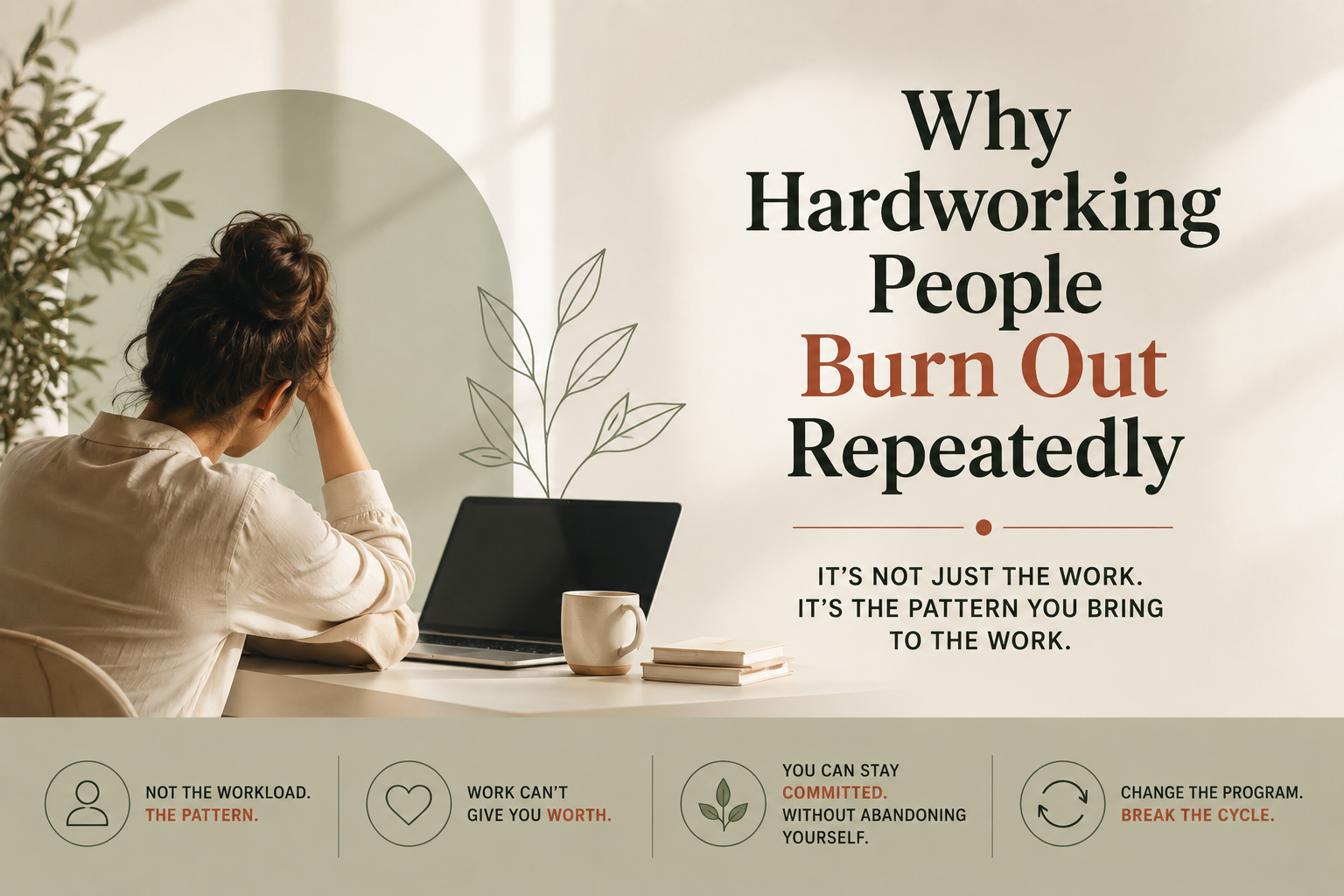
Why Hardworking People Burn Out Repeatedly
Most people assume burnout happens because they work too hard or they must deal with too much stress. And many tend to simply say, these are among the primary factors why hardworking people burn out repeatedly. And sometimes it can be true. But if you’ve burned out more than once throughout your career, a different question may also be worth asking:
What if the problem isn’t the amount of work, but the pattern you bring to the work?
Because many hardworking people don’t burn out from effort and stress alone. Many hardworking people burn out from carrying something that work was never meant to carry: their self-worth.
There is nothing wrong with being hardworking, proactive or reliable. The problem begins when your value starts feeling tied to your usefulness.
Burnout Is Not the Problem, It’s a Sign
One of the reasons burnout is so confusing is that the pattern is often rewarded for years before it becomes painful. Working harder gets recognition, taking ownership gets praise. Solving impossible problems gets admiration, and being available gets appreciation.
From the outside, everything seems to be working: you put in effort, and in a way, you get rewarded. Which is why many people might never even recognize the pattern. Until exhaustion finally forces them to.
But burnout is often not the first problem. It may be the first sign that a pattern you’ve relied on for years is no longer sustainable.
And you can still love your job, your team, maybe even the creative or challenging tasks and feel frustrated because of the burnout.
You might even be asking: “If I love my job, why do I feel so exhausted?” Not because of the workload, stress or tight deadlines. Sometimes the deeper issue is not only the workload, stress, tight deadlines, or compensation.
It’s not the effort in itself that you put into your work.
Rather, you put too much identity into your work.
This leads us to the next point.
The Question Is Not Why You Work So Hard
Most burnout advice focuses on behavior:
- Work less.
- Rest more.
- Take time off.
- Delegate.
While these ideas indeed can be helpful, they often miss a deeper question:
What are you hoping hard work will give you?
Because the answer matters. Because it’s not the behavior you might need to change in the first place, but the pattern. So, if your answer is:
- growth
- mastery
- creativity
- contribution
- professional pride
there is usually nothing unhealthy about that.
But if the answer is somewhere beneath the surface:
- worth
- acceptance
- importance
- validation
- self-esteem
then work begins carrying a responsibility it may not need to.
Why Hardworking People Burn Out Repeatedly Even When They Love Their Work
Many people who repeatedly burn out are not chasing success; they are chasing permission to feel valuable.
The hidden belief often sounds something like:
“I matter because I am useful.”
“If I stop performing, people will stop appreciating me.”
“If I am not needed, what value do I have?”
This is why boundaries can feel so uncomfortable. Because boundaries do not simply limit workload. Sometimes they challenge identity.
If your value depends on being the person who always makes things work, saying “no” can feel much bigger than declining a task. It can feel like becoming less important.
The next time you find yourself pushing beyond your limits, pause for a moment and ask:
If nobody praised me for this, would I still feel valuable?
Not productive, not successful, valuable.
The answer may reveal more than any productivity strategy ever could.
Reliable Doesn’t Mean Endlessly Available
One of the most damaging assumptions behind burnout is the belief that reliable people must always be available. They don’t.
Reliable people keep their commitments, communicate honestly and take responsibility for their work. But reliability does not require sacrificing your health, your boundaries, your recovery, or your peace of mind.
Being reliable and being endlessly available are not the same thing.
One creates trust. The other often creates burnout.
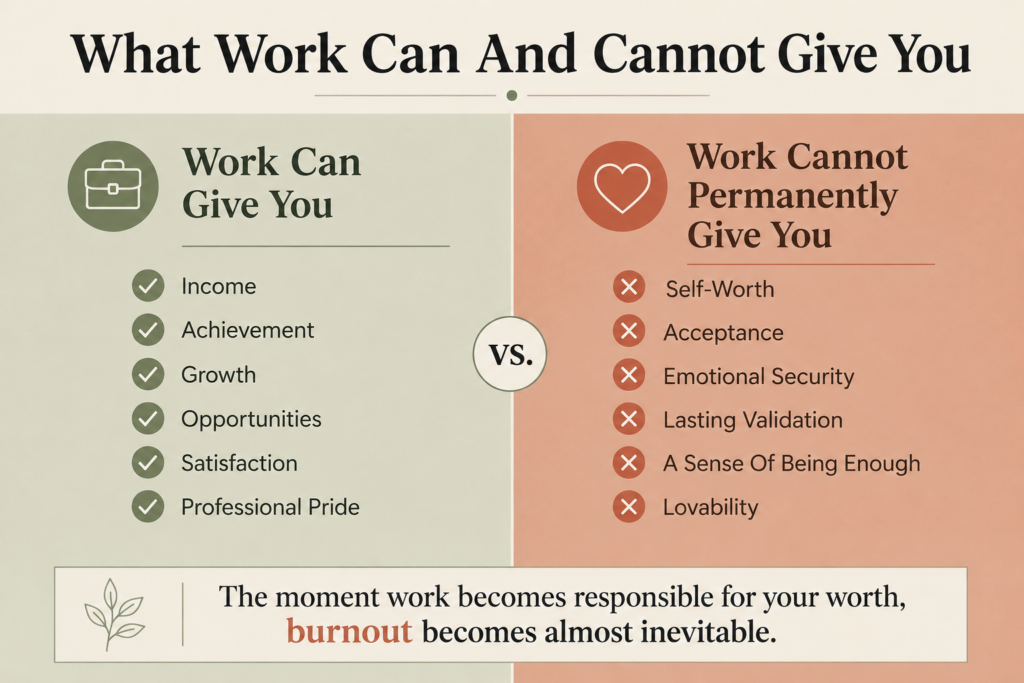
What Work Can and Cannot Give You
Work can provide:
- income
- achievement
- growth
- opportunities
- satisfaction
Work cannot permanently provide:
- self-worth
- acceptance
- lovability
- emotional security
- lasting validation
This distinction is easy to overlook.
Because achievement can feel like self-worth, recognition can feel like acceptance, and success can feel like security. But temporary and permanent are not the same thing.
And this is where many people get trapped.
Because if you are trying to build or assure your self-worth through performance, there will always be another project. Another promotion, another target, another quarter to win.
Another achievement to prove that you are enough. And the finish line keeps moving.
You Can Stay Committed Without Abandoning Yourself
This is where the difference becomes important. The goal is not to stop caring or to stop working hard.
The goal is to recognize when commitment quietly becomes self-abandonment.
Just think about the interpretations of the same sentences when they arrive from a healthy or a self-abandoned place:
“I care about doing good work” vs. “I need good work to prove my value”.
“I help when I can” vs. “I feel guilty when I can’t”.
“I take ownership” vs. “I carry everything”.
“I am reliable” vs. “I must always be available”.
Same Pattern, Different Company?
When exhausted, many people say, “Maybe I need a different company, there I might even get higher salary as well”, or “I will push for a higher salary increase, I deserve it after so much effort I put into my work”.
While you might be right, and the financial side of the situation may vary individually, you could ask yourself before you decide: even if you got 30% higher salary, would that resolve why you are feeling exhausted and fed up?
If the answer is no, probably it’s just not about the money, and therefore, a new workplace or higher salary may not solve it permanently, only mask it for a while, even if you change to a new workplace.
It can be a new environment, a new manager, a new role, but the same pattern running in you.
What is more, coming back from burnout is not only about getting your energy back. It is about discovering when you stop proving your worth through performance.
And the goal here is not just simply to get back from burnout, but to overwrite the program that leads you back to it again and again.
To change the old program: “I am valuable because I perform”
into a new one:
“I perform because I am valuable”.
Final Thoughts
There is nothing wrong with being hardworking and caring about your work. The problem begins when work becomes responsible for proving your worth. Because no achievement can permanently satisfy an identity that depends on constantly earning its value.
The good news is that you are not broken. The pattern was learned, which means it can also be changed.
The burnout may not disappear from one day to another. But you might want to build a new self who not only survives until the next holiday, but who knows, you can stay committed without carrying everything.
And perhaps most importantly:
Your worth does not increase when you overwork. And it does not decrease when you rest.
If this resonated with you, you might also be interested in the quiet signs of burnout, and the hidden pattern behind overthinking and overexplaining, as well as why it can feel soometimes hard to say no.
AI Transparency : At SelfWorkNotes, we use generative AI as a collaborative tool during the research, writing and creative process. Every article is carefully reviewed, edited and finalized by the author, who remains fully responsible for the published content. Unless otherwise stated, illustrations are created using generative AI.
Gentle reminder: The content on SelfWorkNotes is provided for informational and educational purposes only. It does not constitute medical, psychological, legal or financial advice. Always consult a qualified professional regarding your personal situation.