Why Your Brain Fills in the Blanks
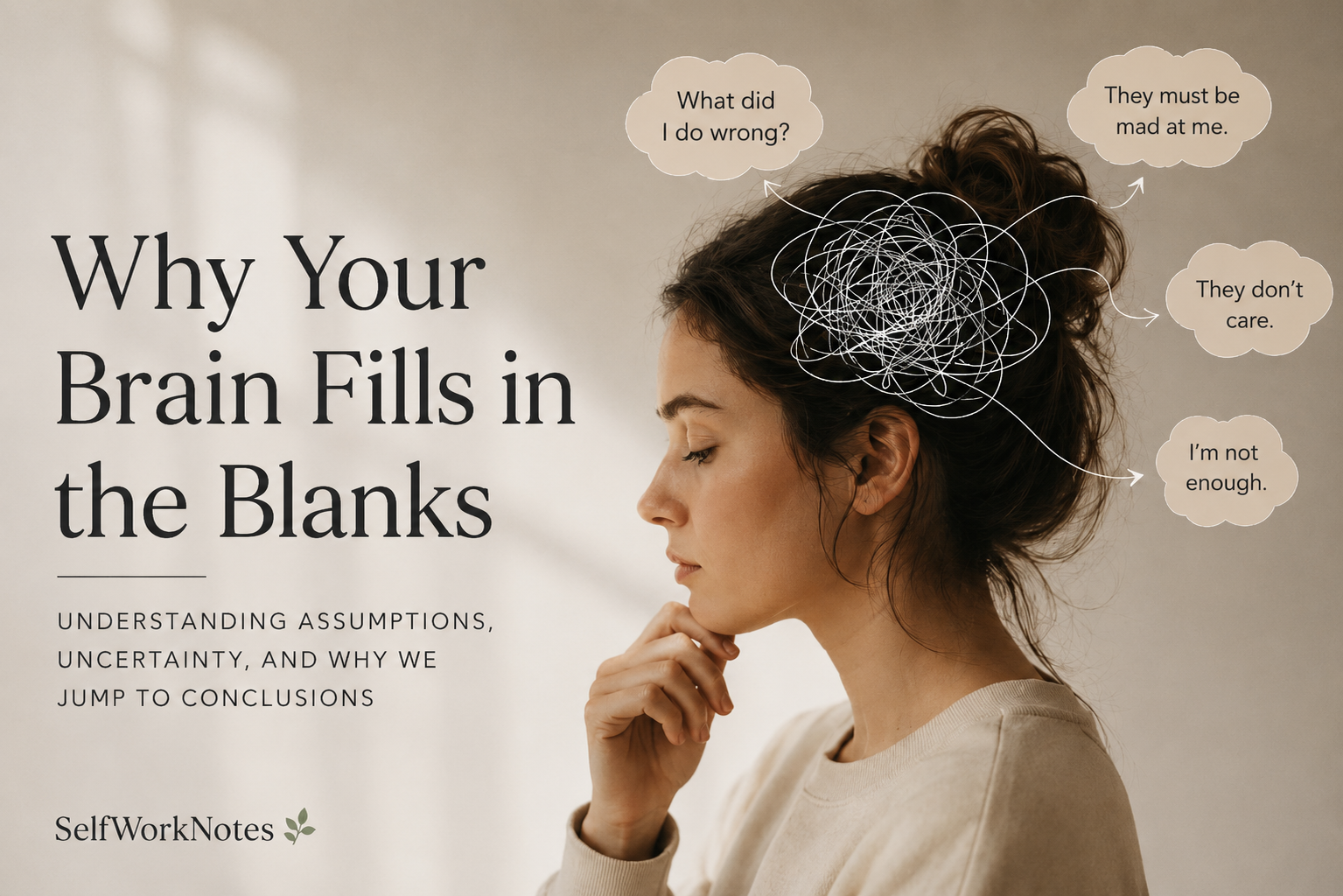
Have you ever noticed how quickly your mind comes up with an explanation, even when you don’t actually know what happened?
A friend doesn’t reply to your message.
Your boss says, “Can we talk tomorrow?”
Your partner has been quieter than usual.
None of these situations tells the whole story, yet you may already have an explanation within seconds.
“They must be upset with me.”
“I probably did something wrong.”
“They’re losing interest.”
Most of the time, these thoughts appear because the human brain naturally dislikes unanswered questions. When information is missing, it tries to fill in the blanks. The problem is not that your brain looks for explanations, but that the first explanation it offers can sometimes feel like a fact before you’ve had a chance to think about it.
Why Your Brain Fills in the Blanks
One of the brain’s most important jobs is to make sense of the world. Rather than waiting until every piece of information is available, your brain constantly tries to predict what is most likely happening. This helps you react quickly, recognize patterns, and navigate everyday life. Most of the time, this ability serves you well.
But when information is incomplete, your brain still prefers having an explanation over having none at all. Uncertainty can feel uncomfortable. An unanswered question leaves the brain searching for closure.
So instead of saying, “I don’t know yet,” it often begins asking:
“What is the most likely explanation?”
This process is completely normal. In fact, every human brain does it.
The challenge is that predictions are not always accurate. Sometimes they simply reflect what feels most plausible at that moment.
Why Different People Tell Different Stories
If this process is universal, an interesting question follows: why do two people often create completely different explanations for exactly the same situation?
Imagine that someone’s partner has called less frequently than usual.
One person thinks:
“They’re probably just busy.”
Another immediately worries:
“They don’t love me anymore.”
A third concludes:
“I must have done something wrong.”
This happens because although every brain tries to reduce uncertainty, the explanation it chooses is influenced by much more than the situation itself.
What Shapes the Story Your Brain Creates?
There isn’t one single answer. Several different factors may influence which explanation feels most believable.
1. Your Brain Naturally Seeks Certainty
As humans, we are naturally uncomfortable with uncertainty. When information is missing, the brain tries to complete the picture. Not because something is wrong with you, but because that’s how the brain is designed to work.
2. Your Current Emotional State
Stress, exhaustion, anxiety, burnout, lack of sleep can all influence how you interpret the same situation.
When you’re emotionally overwhelmed, your brain is often more likely to expect negative outcomes than when you feel calm and rested.
3. Your Previous Experiences and Beliefs
This is where personal patterns may begin to matter. Your brain doesn’t fill in the blanks randomly. It fills them with what it has learned to expect.
If, throughout your life, you repeatedly experienced criticism, rejection, inconsistency, or conditional approval, certain explanations may begin to feel more believable than others.
For example:
If you often think: “I must have done something wrong.”
This may reflect difficulties with self-confidence.
If your first thought is: “I’m probably not good enough.”
This may reflect difficulties with self-worth.
If your mind says: “I can’t trust my own judgment.”
This may relate to self-trust.
Or perhaps your first assumption is: “People always leave.”
That story may reflect earlier relationship experiences that taught your brain to expect abandonment or inconsistency.
None of these conclusions necessarily describe reality. They often describe what your mind has learned to expect.
The encouraging part is that learned expectations are not permanent. Once you become aware of them, you can begin questioning whether they still fit your current reality.
The Hidden Cost of Filling in the Blanks
The story itself is often only the beginning. Once your brain accepts a conclusion as true, your behavior may start changing accordingly.
You may withdraw, become defensive, seek reassurance, overexplain yourself, or avoid difficult conversations.
Or, make important decisions before gathering enough information.
How to Leave the Blank Blank
Instead of immediately completing the story, try creating a little more space.
1. Notice the Context and What You Actually Know
Separate facts from assumptions.
Ask yourself:
“What do I know for certain and what am I adding?”
“Did I also take the context into account?”
2. Generate More Than One Explanation
Instead of stopping at the first story your brain offers, challenge yourself to come up with at least three possible explanations. Not just worst-case scenarios, but also best-case scenarios and realistic ones, as well.
You don’t have to believe them. The goal is simply to remind yourself that your first interpretation is not the only possible one.
3. Ask: What Would the Camera See?
Imagine the situation had been recorded by a camera.
What observable facts would the recording show? What conclusions have you added afterward?
4. Communicate Instead of Making Assumptions
Sometimes the missing information can only come from the other person. Instead of assuming, ask.
A conversation often reveals information that your mind simply could not have known.
Final Thoughts
Your brain is not trying to deceive you, it is trying to reduce uncertainty. But sometimes, the stories that once helped you make sense of the world continue running long after the situation has changed.
The good news is that stories can be questioned. Not by arguing with yourself, but by becoming curious.
Because sometimes the healthiest answer is not: “I know what this means.”
Sometimes it’s simply curiosity:
“I don’t know yet, but let’s find out.”
And leaving the blank blank for a little longer may give reality the chance to fill it in instead.
If this resopnated with you, you might be interested in what’s the difference between self-confidence, self-trust, self-worth and self-respect, why it is so hard to trust your emotions or why you make assumptions based on your emotions which don’t always tell the full story. If you often find yourself explaining yourself after a decision, or you rather often seek reassurance before making decisions, these links also can be helpful.
AI Transparency : At SelfWorkNotes, we use generative AI as a collaborative tool during the research, writing and creative process. Every article is carefully reviewed, edited and finalized by the author, who remains fully responsible for the published content. Unless otherwise stated, illustrations are created using generative AI.
Gentle reminder: The content on SelfWorkNotes is provided for informational and educational purposes only. It does not constitute medical, psychological, legal or financial advice. Always consult a qualified professional regarding your personal situation.