
Why Does Rejection Feel So Personal? Understanding Why It Hurts
Why does rejection feel so personal, even when you know it shouldn’t? In our previous article, How to Deal with Rejection, we looked at what rejection is and explored some ways to handle it when it happens. But knowing what to do after rejection doesn’t necessarily explain why it can affect us so deeply in the first place.
A rejection is an event that happened in a particular context. But our minds don’t always leave it there. We may start looking for an explanation, comparing ourselves with the person who was chosen, or turning one outcome into a broader question about our worth: “What does this say about me?”
So, why does rejection feel so personal?
There isn’t one answer. Rejection can touch our need to belong, our sense of self-worth, our expectations, and sometimes insecurities that were already there. The experience can also vary greatly depending on who rejected us, what we were hoping for, and how much the outcome mattered to our sense of self.
Understanding what happens between the rejection itself and the meaning we give it can make the experience easier to understand, and sometimes easier to carry.
Why Does Rejection Hurt So Much?
Humans have a fundamental need for social connection and acceptance. Feeling included, valued, and connected to other people is not a trivial part of our lives. Research on social rejection has consistently linked rejection with negative emotional reactions, which helps explain why being excluded or turned down can feel genuinely distressing rather than simply disappointing.
This doesn’t mean that every rejection affects us equally. Some barely register. Others stay with us for days or even longer. The difference often lies in what the rejection represents.
Imagine that you apply for a job you were only mildly interested in and receive a rejection email. It might be disappointing, but you move on. Now imagine applying for a position you’ve wanted for months, one that seemed to confirm that you were finally moving in the direction you wanted. The same word, rejected, can carry a very different emotional weight. The outcome hasn’t changed. What was at stake, however, was very different.
This is one reason it can be misleading to tell yourself that you are “overreacting” simply because the event seems small from the outside. Your reaction isn’t determined only by what happened. It is also influenced by what the situation meant to you.
Rejection Can Feel Like More Than a “No”
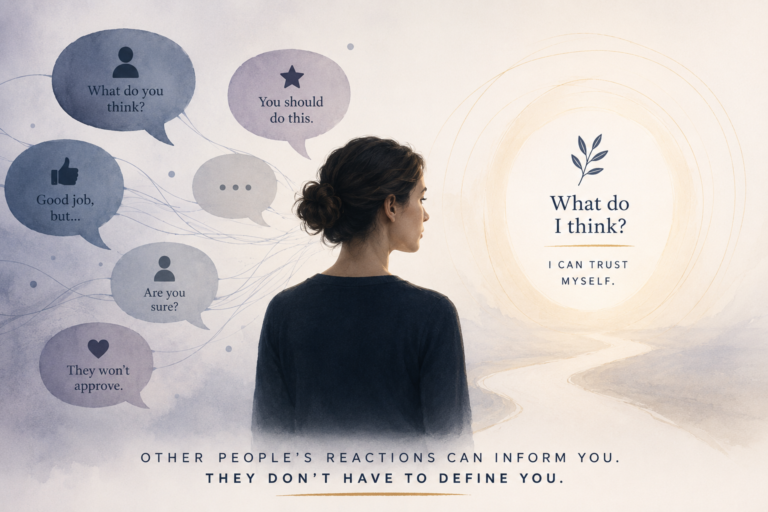
There is a difference between an event and the meaning we attach to it. This distinction matters because rejection can provide information without giving a complete explanation of who you are. Perhaps another candidate had more experience. Perhaps the role wasn’t the right fit. Perhaps the other person wanted something different. Sometimes you may never know the reason.
Our minds don’t always like that uncertainty. When an outcome matters to us, it can be hard to leave it unexplained. We may start looking for a reason, especially when the other person doesn’t give us one. And when the explanation isn’t available, it can be tempting to fill in the blank ourselves. Unfortunately, however, the explanation that feels most convincing isn’t necessarily the most accurate one.
Why Rejection Can Affect Your Sense of Self-Worth
Rejection can become especially painful when the area in which you’re rejected is closely connected to how you evaluate yourself.
Psychologists have studied the idea of contingent self-worth, the tendency to base part of our sense of worth on particular areas of life, such as academic competence, physical appearance, competition, or the approval of others. When our self-worth is closely tied to a particular domain, successes and failures in that area can have a stronger effect on how we feel about ourselves. In other words, a setback can feel more significant when it happens in an area that matters deeply to our sense of self.
You might notice this in everyday life without ever having thought about it in those terms.
If being competent is an important part of how you see yourself, a professional rejection may feel like more than losing an opportunity. Or, if being attractive or desirable is closely tied to your confidence, romantic rejection may land particularly hard. Also, if being liked is central to your sense of belonging, being left out of a social situation can feel like evidence that you don’t matter.
The rejection hasn’t necessarily become more significant objectively. It has become more significant to your sense of self.
This is also why telling someone “don’t take it personally” can be easier said than done. If the rejection touches something you care deeply about, your mind may experience it as relevant to you even when the situation doesn’t justify the larger conclusion.
Why Some Rejections Hurt More Than Others
Not all rejection feels equally painful. The person involved matters. The context matters. What you expected matters. And your own vulnerabilities matter.
A stranger declining an invitation may sting for a moment. Someone you’ve been hoping to impress for months can leave you replaying the interaction in your head. A job rejection can feel particularly painful when you’ve already started imagining your future in that role. A friendship ending may hurt differently when it confirms a fear you’ve carried for a long time.
This is one reason it can be difficult to compare your reaction with someone else’s. You might think, why can they just move on? It was only one rejection. But you don’t know what that rejection represented to them.
Research also suggests that people differ in their sensitivity to rejection. For example, lower self-esteem has been associated with stronger emotional and physiological responses to rejection, and some people show greater attentional sensitivity to rejection-related cues, particularly in areas where they already feel vulnerable.
That doesn’t mean that being deeply affected by rejection automatically indicates low self-esteem or a psychological problem. It simply means that the same external event can affect different people in different ways, depending on their internal experiences.
Sometimes the Present Rejection Isn’t the Whole Story
There is another reason a rejection can feel unusually intense: it may remind you of something you’ve experienced before. Not necessarily an identical memory. It can simply evoke a familiar feeling.
Maybe you’ve often felt like the person who wasn’t chosen. Maybe you’ve spent years wondering whether you’re good enough. Maybe you’ve experienced repeated criticism, exclusion, or disappointment in a particular area of your life.
When something in the present resembles that old emotional pattern, the reaction can feel bigger than the current situation alone would explain.
This doesn’t mean that every painful reaction has some hidden childhood explanation. Previous experiences can shape how sensitive we become to rejection, influencing how we interpret ambiguous situations and how strongly we expect or react to being rejected.
Sometimes, then, you’re not only responding to this rejection. You’re also responding to what it seems to confirm. And that can make a single “no” feel like a much larger statement.
Why Your Mind Wants an Explanation
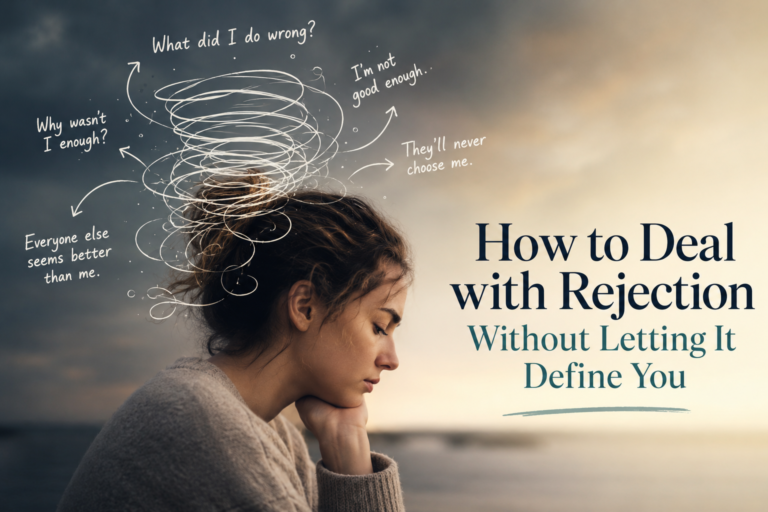
One of the hardest parts of rejection is uncertainty. If someone tells you exactly why they didn’t choose you, you may not like the answer, but at least you have one. But when there is no explanation, the mind can keep returning to the same questions: “What did I do wrong?”, “What did they see that I didn’t?”, “Was I not good enough?”, “What does everyone else have that I don’t?”
This is where rejection can easily turn into rumination. Instead of processing what happened, you keep searching for the missing piece that will finally make the situation make sense. The problem is that your mind may eventually accept an explanation simply because it is available, not because it is true.
And self-blame can be strangely compelling. “I’m not good enough” is painful, but it creates a sense of certainty. It gives the rejection a clear cause and makes an unpredictable situation feel more understandable.
The alternative can be much harder to tolerate: “I don’t know exactly why they chose differently.” That answer may feel unsatisfying, but sometimes it is also the more accurate one.
Rejection Is Information, not a Verdict
There is a temptation to respond to rejection with the opposite extreme: “It has nothing to do with me.” But that isn’t necessarily true either.
Sometimes rejection does contain useful information. You may have been missing a skill for a particular job. A relationship may not have worked because of something you need to understand about your communication or expectations. Someone may have decided that your personalities weren’t compatible. You don’t have to deny those possibilities to protect your self-worth.
The more useful distinction is between specific information and global judgment.
“I wasn’t chosen for this job” is specific. “I’m not capable” is global. “This relationship didn’t work” is specific. “No one will ever want me” is global. “They didn’t want to continue the friendship” is specific. “I’m someone people eventually leave” is global.
The first statements describe particular situations. The second statements turn them into definitions of the self.
That jump is where rejection can become much more painful than it needs to be.
What to Remember When Rejection Feels Personal
Because rejection can touch things that matter deeply to us: belonging, connection, competence, desirability, approval, and self-worth. And when an outcome matters to our sense of self, it can be difficult to experience it as just one isolated event.
But feeling that something is personal doesn’t necessarily mean that it is a complete or accurate evaluation of you.
A rejection can tell you that someone made a different choice. It can tell you that an opportunity didn’t work out. It can even give you information worth learning from. What it cannot automatically tell you is what you are worth as a person.
The pain of rejection is real. You don’t have to talk yourself out of feeling it or pretend that you don’t care. But you can become more careful about the conclusions you draw from it.
Because there is a meaningful difference between “This happened to me” and “This happened because of who I am.”
And sometimes, understanding that difference is where the sting of rejection begins to lose some of its power.
Further Reading
- Blackhart, G. C., Nelson, B. C., Knowles, M. L., & Baumeister, R. F. (2009). Rejection Elicits Emotional Reactions but Neither Causes Immediate Distress nor Lowers Self-Esteem: A Meta-Analytic Review of 192 Studies on Social Exclusion. Personality and Social Psychology Review, 13(4), 269–309. Read the study
- Crocker, J., & Wolfe, C. T. (2001). Contingencies of Self-Worth. Psychological Review, 108(3), 593–623. Read the study
- Gyurak, A., Hooker, C. I., & Ayduk, Ö. (2012). Individual Differences in Neural Responses to Social Rejection: The Joint Effect of Self-Esteem and Attentional Control. Social Cognitive and Affective Neuroscience, 7(3), 322–331. Read the study
- Downey, G., & Feldman, S. I. (1996). Implications of Rejection Sensitivity for Intimate Relationships. Journal of Personality and Social Psychology, 70(6), 1327–1343. Read the study
AI Transparency
At SelfWorkNotes, we use generative AI as a collaborative tool during the research, writing and creative process. Every article is carefully reviewed, edited and finalized by the author, who remains fully responsible for the published content. Unless otherwise stated, illustrations are created using generative AI.
Gentle reminder: The content on SelfWorkNotes is provided for informational and educational purposes only. It does not constitute medical, psychological, legal or financial advice. Always consult a qualified professional regarding your personal situation.