
How to Deal with Rejection Without Letting It Define You
Learning how to deal with rejection can be difficult, especially when a simple “no” starts sounding like a statement about who you are.
Someone doesn’t choose you for a job. Someone you like doesn’t feel the same way. A friendship changes. You don’t get invited. An application is turned down. The reasons can be completely different, but the reaction can feel strangely familiar: What does this say about me?
Learning how to deal with rejection isn’t about becoming someone who never feels hurt by it. Rejection can genuinely affect our emotions and our sense of belonging. Research has found that experiences of rejection can frustrate basic psychological needs, particularly belonging and control, and can lower mood and self-esteem.
So, instead of asking what rejection might say about your worth, a more useful question may be how you can experience rejection without turning it into a verdict about who you are.
If you remember only one thing: don’t rush to decide what rejection means about you. First, feel it. Then separate the facts from the story. Finally, decide whether there is something to learn, repair, or let go.
How to Deal with Rejection: Separate the Event from the Story
One of the easiest ways to get caught in rejection is to treat the event and our interpretation of it as if they were the same thing.
Imagine you apply for a position and don’t get it. The fact might simply be that you weren’t selected for the role. Your mind, however, may easily turn this into a verdict about yourself and you may find yourself saying: I wasn’t good enough.
And from there: I’m falling behind. Other people are better than me. I’ll probably never get where I want to be.
The first statement is information. The others are interpretations.
That doesn’t mean your interpretation is necessarily wrong. Perhaps there really was something you could have done differently. Perhaps you weren’t the strongest candidate. Perhaps there is useful feedback in the experience.
The point is simply that an interpretation isn’t automatically a fact.
This distinction matters because research on rejection has found that the meaning people make from a rejection can be connected to how strongly they react to it. In one study examining responses to imagined interpersonal rejection and failure, more negative meaning-making around self-worth and interpersonal relatedness was associated with stronger negative emotional responses.
So rather than immediately asking, “What is wrong with me?”, it can help to ask a smaller, more grounded question: What actually happened?
Why Rejection Can Feel So Personal
There is a reason rejection doesn’t always feel like neutral information.
Humans have a strong need for social connection and belonging. When acceptance is threatened, the experience can affect much more than our plans for the afternoon. Research suggests that rejection can lower mood and self-esteem and can threaten basic psychological needs such as belonging and control.
This doesn’t mean every rejection will damage your self-esteem. Research findings aren’t quite that simple. Another study found that rejection reliably produces emotional reactions, while its effects on self-esteem varied depending on the circumstances and comparison conditions.
What matters for everyday life is that rejection can feel like information about your social value, even when it isn’t a complete assessment of it.
And that is where self-worth can become involved.
If being chosen, successful, attractive, useful, or liked has become an important source of feeling valuable, rejection in that area can feel much bigger than the event itself. Research on contingencies of self-worth suggests that when self-worth is strongly tied to a particular domain, experiences in that domain can have a stronger effect on how people evaluate themselves.
This is one reason a rejection can sometimes feel like more than: “This didn’t work out.” It can feel like: “This tells me something about who I am.”
Learning how to stop taking rejection personally doesn’t mean pretending that rejection isn’t painful. It means becoming more careful about what you assume the rejection says about you.
How to Recognize the Rejection Spiral
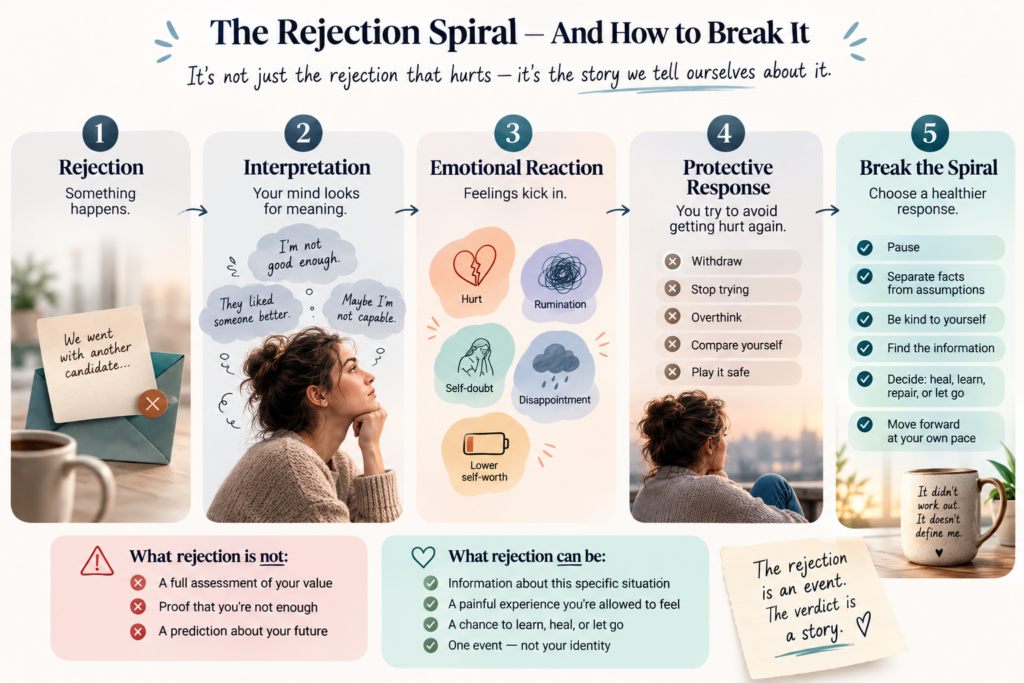
After a painful rejection, the mind can move through several stages surprisingly quickly.
First comes the event: something didn’t happen the way you wanted.
Then comes the interpretation: you decide what the event means.
Then comes self-judgment: the interpretation becomes a statement about you.
Then comes replay: you go back over the conversation, application, date, message, or mistake, searching for an explanation.
Finally, you may start to protect yourself. You stop trying. You withdraw. You compare yourself with the person who was chosen. You avoid situations where you could be rejected again.
The original rejection may have taken a relatively short time. The reaction to it, however, can last much longer.
This doesn’t mean you are doing something irrational. Rumination often feels like problem-solving: “If I can just figure out why this happened, maybe I can make sense of it.” But sometimes the search for an explanation simply gives the inner critic more material to work with.
This is particularly important when rejection activates an existing sensitivity around self-worth. Recent research suggests that rejection sensitivity may shape how strongly social exclusion affects self-esteem.
You don’t have to prevent yourself from feeling the rejection. But you might want to notice when processing the event starts turning into judging yourself.
How to Deal with Rejection Without Ignoring Your Feelings
When you’re still emotionally affected, try separating the situation into two columns. For example:
What happened:
They decided not to continue the relationship.
How you interpret it:
I’m not lovable.
Or:
What happened:
I wasn’t offered the position.
How you interpret it:
I’m not competent enough to succeed.
This can feel almost too simple, but that’s the point.
You aren’t trying to convince yourself that everything is fine. You’re giving yourself enough distance to examine the thought before believing it.
Ask:
What do I know? What am I assuming? What don’t I actually know?
Maybe you received clear feedback that you need more experience. That’s useful information.
Maybe there were many qualified applicants and you don’t know why another person was selected. That’s uncertainty.
Maybe someone ended a relationship because they didn’t feel the connection they were looking for. That’s painful, but it isn’t necessarily a statement about your overall worth.
Rejection can contain information without containing a complete definition of you.
Self-compassion can also be useful here, but it doesn’t mean telling yourself that you’re perfect or pretending the rejection doesn’t matter. Psychologist Kristin Neff defines self-compassion as being supportive toward yourself when experiencing suffering, mistakes, inadequacy, or difficult circumstances. Unlike self-esteem, self-compassion does not require you to evaluate yourself as successful, worthy, or better than others in order to respond to yourself with care.
In practical terms, self-compassion might sound more like: “This hurts because I cared. I don’t have to make myself feel worse for being disappointed.”
That is a very different way of responding to yourself.
How to Decide What Rejection Actually Tells You
Once the initial emotion has settled, you can become more curious about the rejection.
Not: “What does this prove about me?”
But: “What information is actually here?”
Sometimes the answer is something about you. Perhaps there is a skill you need to develop, a communication pattern you could improve, or feedback worth taking seriously.
Sometimes the answer is something about the other person or the situation. Preferences, timing, compatibility, circumstances, priorities, and other people’s needs all influence decisions.
And sometimes the answer is simply unknown.
That last category can be uncomfortable. We often prefer a painful explanation to no explanation at all. “They rejected me because I’m not good enough” at least feels definite. But certainty isn’t the same thing as truth.
You don’t have to fill every gap in the story.
What You Can Do After Rejection: Heal, Learn, Repair, or Let Go
Not every rejection requires the same response.
Sometimes you need to heal. A breakup or the loss of an important friendship may not have a useful lesson waiting to be extracted immediately. You may simply need time, support, and space to adjust.
Sometimes you need to learn. If you receive specific feedback after an interview, project, or application, there may be something practical you can take forward.
Sometimes you need to repair. Perhaps you misunderstood someone, communicated poorly, or contributed to a conflict.
And sometimes you need to let go.
There may be nothing to fix. You and another person may simply want different things. You may not have been the right candidate for a particular role. A situation may have ended without anyone being wrong.
This is why “learn from every rejection” might not always be a helpful rule. Sometimes there is a lesson. Sometimes there is information. Sometimes there is grief. And sometimes the healthiest next step is simply accepting that not everything that doesn’t work out needs to become a personal growth project.
How to Deal with Rejection Without Turning It into a Judgment About Yourself
After rejection, it can be tempting to collect evidence. This is where the inner critic can become particularly convincing.
Your inner critic might say things like: “See? This always happens.” or “You should have known.” or “You’re just not good enough.”
But one event cannot tell you everything about your future, your relationships, your abilities, or your value. Try changing the scale of the statement.
Instead of: “I’m bad at this.” try: “This attempt didn’t go the way I hoped.”
Instead of: “Nobody wants me.” try: “This person didn’t choose a relationship with me.”
Instead of: “I’m a failure.” try: “I experienced a failure.”
The difference isn’t about positive thinking but keeping the statement proportionate to the evidence.
A Simple Rejection Reset
If you notice yourself spiraling after a rejection, try writing down five things:
1. What happened?
Describe the event in factual terms.
2. What am I telling myself it means?
Write down the judgment or story your mind has created.
3. What am I actually feeling?
Disappointed, embarrassed, angry, lonely, ashamed, confused, or something else?
4. What do I need right now?
Comfort? Connection? More information? Space? A practical next step?
5. Is there something I can do, or is this something I need to release?
Choose one: repair, learn, or let go.
You don’t have to answer these questions perfectly. The point is to create a little space between what happened and what you decide it means about you.
How to Deal with Rejection and Move Forward
You may not be able to control who chooses you, who changes their mind, which opportunities work out, or when something you want comes to an end.
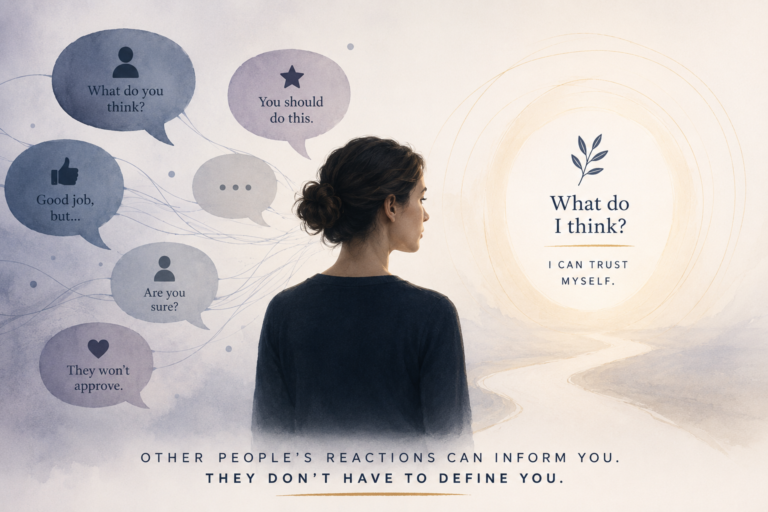
You can, however, become more careful about what you allow those experiences to say about you.
Rejection can tell you that something didn’t work. It can give you useful information. It can hurt and disappoint you. It can even show you something you want to understand about yourself. But it doesn’t automatically tell you that you are unworthy, unlovable, incapable, or destined to be rejected again.
The rejection is an event. The verdict is a story. You don’t have to turn one into the other.
Further Reading
- Gerber & Wheeler, On Being Rejected: A Meta-Analysis of Experimental Research on Rejection. PubMed
- Neff, Self-Compassion: Theory, Method, Research, and Intervention. Annual Review of Psychology
- Dependency, self-criticism and negative affective responses following imaginary rejection and failure threats. PubMed
AI Transparency
At SelfWorkNotes, we use generative AI as a collaborative tool during the research, writing and creative process. Every article is carefully reviewed, edited and finalized by the author, who remains fully responsible for the published content. Unless otherwise stated, illustrations are created using generative AI.
Gentle reminder: The content on SelfWorkNotes is provided for informational and educational purposes only. It does not constitute medical, psychological, legal or financial advice. Always consult a qualified professional regarding your personal situation.