How to Accept Yourself Without Giving Up on Growth
There is a particular idea about self-acceptance that can feel surprisingly difficult to believe: you can accept yourself as you are and still want to change.
At first, these two things can seem contradictory. If you accept yourself, shouldn’t you stop worrying about what needs to be improved? And if you are constantly trying to become a better version of yourself, doesn’t that mean you are not satisfied with who you are now?
Maybe you’ve felt this tension in your own life. You want to become healthier, more confident, more successful, less reactive, better at your work, or simply more comfortable in your own skin. But sometimes the desire to improve comes with another message underneath it: I shouldn’t be like this. I need to fix myself. I will finally feel good enough when I become different.
That is where self-improvement can become something very different from personal growth.
Learning how to accept yourself does not mean convincing yourself that you have nothing to work on. It means learning to separate the desire to grow from the belief that your current self is somehow unacceptable.
What Does It Actually Mean to Accept Yourself?
Self-acceptance is sometimes confused with approval. But accepting something about yourself does not necessarily mean that you like it, agree with it, or intend to leave it unchanged.
It is closer to being able to see yourself as you are – including qualities you like and those you struggle with – without turning that observation into a judgment about your worth. (Ryff, 2023)
You can recognize that you procrastinate more than you’d like without deciding that you are a lazy person. You can acknowledge that you made a mistake without deciding that you are a failure. You can dislike certain aspects of your appearance without making your body the enemy. And you can recognize that you want to develop a particular skill without treating your current abilities as evidence that you are not good enough.
Self-Acceptance and Self-Improvement Are Not Opposites
Imagine two people who have exactly the same goal: both want to become more confident at work.
One thinks, I would like to become more comfortable speaking up because I have ideas I want to share.
The other thinks, I have to become confident because everyone else seems better than me, and I can’t keep being this inadequate.
Their actions might look almost identical from the outside. Both might read books, practice presentations, take on new challenges, or ask for feedback. But internally, they are working from very different starting points.
This is why the question is not simply whether you want to improve yourself. Wanting to improve is not inherently a rejection of yourself. Research on self-compassion has similarly found that responding to personal shortcomings with greater acceptance can, in some circumstances, support rather than reduce motivation for self-improvement. (Breines & Chen, 2012)
A more useful question might be:
What do I believe about myself if I don’t improve?
If the answer is something like I won’t be worthy, successful, attractive, lovable, or good enough, then the goal may have become tied to your sense of worth.
If the answer is I’d like to see what I’m capable of, the same goal can have a completely different meaning.
You can want more for yourself without deciding that what you have now is not enough.
You Don’t Have to Become a Different Person to Deserve Acceptance
One reason self-acceptance can be difficult is that we often treat our future selves as more deserving than our present selves.
When I lose weight. When I become more successful. When I stop overthinking. When I become more confident. When I finally get my life together.
There can always be another version of ourselves waiting somewhere in the future who seems more acceptable than the person we are today.
The problem is that the finish line tends to move. You achieve one goal, and another one takes its place. You become more successful, but now you compare yourself with people who are even further ahead. You become fitter, but suddenly you notice something else you want to change. You receive recognition, but instead of feeling secure, you start wondering whether you can maintain it.
Improvement can become an endless negotiation with yourself.
Self-acceptance can interrupt that negotiation by challenging the idea that you must first become someone else before you are allowed to feel okay about being yourself.
That does not make ambition disappear. It simply means that ambition no longer has to be a condition to prove your own worth.
How Comparison Can Get in the Way of Self-Acceptance
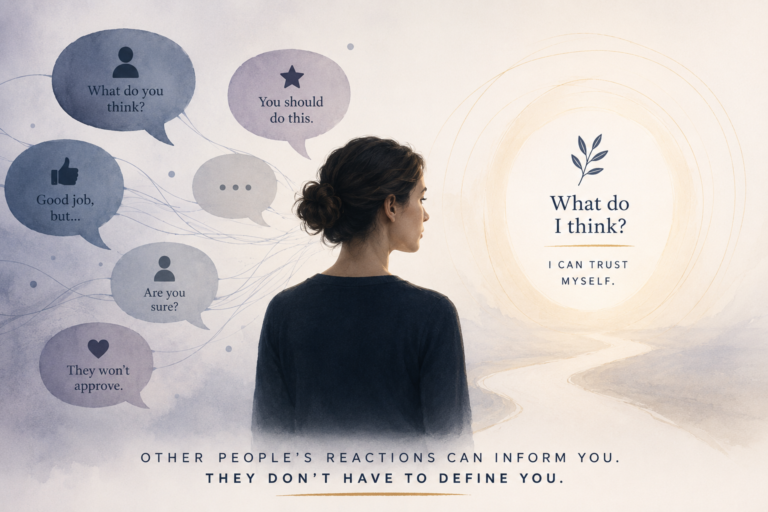
This becomes particularly noticeable when we compare ourselves with other people.
Someone else’s success can suddenly make our own achievements feel smaller. Someone else’s appearance can make us question our own. Someone else’s relationship, career, home, lifestyle, or confidence can become an unexpected measuring stick.
The comparison may begin with a simple observation: They are further ahead than I am in this area. But the mind can quickly add another conclusion: So I must be behind. And then another: Maybe I’m not good enough.
This is where comparison stops providing information and starts becoming a judgment.
Learning how to accept yourself does not require pretending that other people are not more successful, attractive, experienced, confident, or accomplished in particular areas. It simply means that their position does not have to become a verdict about yours.
Someone else can be further ahead without you being a failure. That is an important distinction.
Self-Acceptance Doesn’t Mean You Stop Holding Yourself Accountable
There is another misconception worth clearing up. Sometimes self-acceptance sounds like an excuse: If I accept myself, why would I ever push myself to do better?
But acceptance and accountability can exist together. You can say, I handled that badly, without saying, I am a bad person. You can admit that you have been avoiding something without deciding that you are incapable of changing.
You can recognize a pattern that is hurting you and still treat yourself with enough understanding to actually do something about it.
In fact, constant self-criticism can make mistakes feel like threats to your sense of self, rather than information you can learn from. And If every mistake feels like a threat to your sense of worth, it may become harder to look at it objectively.
Acceptance creates a little more room between what you did and who you believe you are. That space can make change feel less like punishment and more like a choice.
So How Do You Accept Yourself While Still Growing?
It may help to change the questions you ask yourself.
Instead of: What’s wrong with me? you could try: What is happening here?
You could also change the question of Why can’t I be more like them? to: What is it about their situation that I genuinely want for myself?
Or, instead of asking: How do I fix this part of me? try: Is this something I actually want to change, or something I believe I should change?
And instead of: When will I finally be good enough? try: What would I choose to work on if I already believed I was enough?
That last question can be particularly revealing. If you already knew that your worth was not at stake, what would you still want to improve?
The goal of self-acceptance is not to remove your desire for growth. It is to remove the idea that growth is the price you have to pay for being acceptable.
How to Tell Growth From Conditional Self-Worth
1. “What is underneath the goal?”
When you realize you want to change something about yourself, don’t immediately ask how you’re going to change it. First, stop for a moment and write down the following questions.
1. What do I want to change?
For example: I want to become more confident at work.
2. Why do I want this?
For example: I want to be able to speak up more easily and share my ideas.
3. What do I believe would happen if I didn’t change?
For example: I would probably feel like I’m less capable than my colleagues.
4. What would this change mean about me?
For example: That I’m finally good enough at what I do.
If your answers suggest that achieving the goal has become a condition for feeling worthy, lovable, acceptable, or “good enough,” that may be worth noticing. It doesn’t mean you have to give up your goal. It might however mean that it’s worth contemplating if reaching your goal serves as proof for yourself that you are enough.
And here comes the most important question:
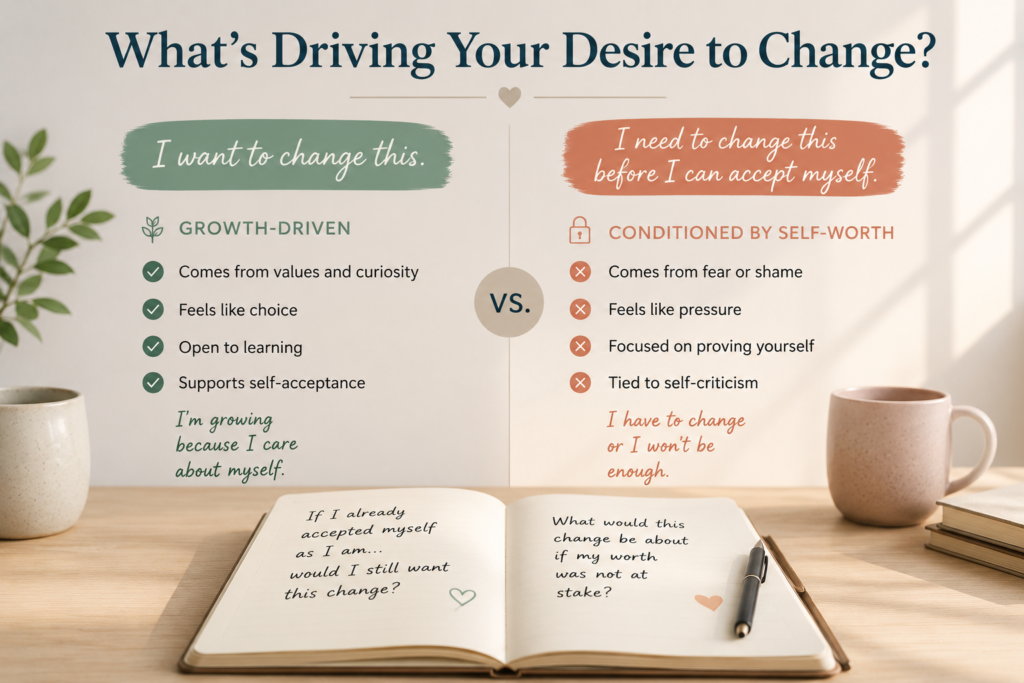
If I already accepted myself as I am, would I still want this change?
If the answer is yes, that’s a useful sign: you may not need to choose between self-acceptance and self-growth. If the answer is probably not, it’s also okay. Maybe this is the moment you discover that you sometimes pursue goals because they represent an image of what you should be like and not what you genuinely desire to achieve.
2. The One-sentence Probe
When you realize you want to change something about yourself, complete the following two sentences:
“I want to change this because…”
and
“I need to change this because…”
Notice the difference between the two. The first can reflect choice, curiosity, or personal values. The second may reveal an underlying condition; although “I need to change this” is not automatically a sign that something is wrong. Context matters.
These exercises are not meant to diagnose anything. They are simply ways to notice the stories we attach to our desire to change.
Growth Can Come From Acceptance, Not Rejection
There is an important difference between trying to escape yourself and trying to develop yourself.
When improvement is driven by rejection, every step forward can feel like evidence that the previous version of you was inadequate.
When improvement comes from acceptance, change can become an expression of curiosity, care, values, or simply the desire to see what is possible. Research on self-compassion and self-improvement motivation suggests that a more accepting response to personal shortcomings does not necessarily reduce the desire to grow. (Breines & Chen, 2012)
You don’t have to believe that your current life is inadequate to want to build a different one. And you don’t have to wait until you become the desired version of yourself before you allow yourself to feel at ease with your current version, as well.
How to Accept Yourself Without Giving Up on Yourself
Perhaps the most useful way to think about self-acceptance is not I am perfect exactly as I am. That statement may not even feel believable. A more realistic version might be: I can see where I am without turning it into a reason to reject myself.
You can acknowledge your limitations, recognize your mistakes, and still believe that you are capable of growth. You can want to change your circumstances without treating your current circumstances as proof that you have failed.
Self-acceptance is not a promise that you will never change. It is the decision to stop making change a requirement for your own acceptance.
And perhaps that is the part that gets overlooked when we talk about personal growth. You don’t have to choose between accepting yourself and becoming a different version of yourself.
Because there is a difference between saying: “I want to become more.” and: “I have to become more before I can believe I am enough.”
The first can be growth. The second can become a life spent trying to earn your own acceptance. And acceptance is not something you have to earn.
If this article resonates with you, you might also want to explore why we can become so critical of ourselves – especially when we feel we aren’t where we think we should be. If you want to read more on self-acceptance, you might find this article interesting, as well.
Further Reading
- Ryff, C. D. (2014). Psychological Well-Being Revisited: Advances in the Science and Practice of Eudaimonia. Psychotherapy and Psychosomatics, 83(1), 10–28. Read the full article
- Breines, J. G., & Chen, S. (2012). Self-Compassion Increases Self-Improvement Motivation. Personality and Social Psychology Bulletin, 38(9), 1133–1143. Read the abstract
AI Transparency
At SelfWorkNotes, we use generative AI as a collaborative tool during the research, writing and creative process. Every article is carefully reviewed, edited and finalized by the author, who remains fully responsible for the published content. Unless otherwise stated, illustrations are created using generative AI.
Gentle reminder: The content on SelfWorkNotes is provided for informational and educational purposes only. It does not constitute medical, psychological, legal or financial advice. Always consult a qualified professional regarding your personal situation.