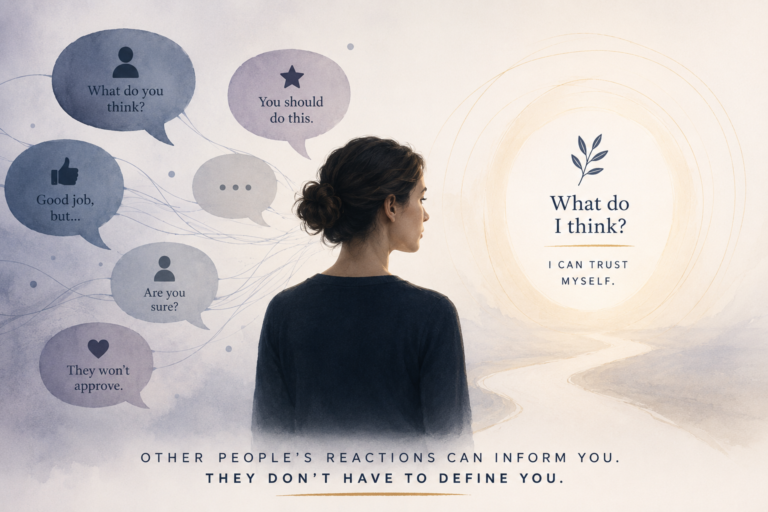
Why Do I Compare Myself to Others? Understanding the Need to Measure Up
Why do I compare myself to others, even when I know it usually doesn’t make me feel better? You might ask yourself this question after scrolling through social media and suddenly feeling behind in your career, relationships, appearance, or life in general. You might compare yourself to a colleague who seems more successful, a friend who seems happier, or someone you don’t even know whose life looks remarkably put together online.
And sometimes the comparison seems almost automatic. You weren’t trying to compete with anyone. You were simply looking. Yet somehow, you ended up feeling like you weren’t doing enough.
It is tempting to conclude that comparing yourself to others is simply a bad habit you need to stop. But comparison is not always about jealousy, insecurity, or wanting what someone else has. Sometimes, we look at other people because we’re trying to understand where we stand.
The more interesting question, then, may not be how you stop comparing yourself to others, but what you are trying to find out about yourself when you do.
Why Do I Compare Myself to Others?
Comparing ourselves with other people is not a new phenomenon, and it isn’t necessarily a sign that something is wrong with us. In the 1950s, psychologist Leon Festinger proposed social comparison theory, suggesting that people use others as a reference point when they don’t have an objective way to evaluate themselves. (Festinger, 1954).
Think about something as simple as starting a new job. How do you know whether you’re doing well? You might look at your colleagues. How quickly do they complete their work? How confident do they seem in meetings? What kind of feedback do they receive?
The same thing can happen in less obvious ways. You might look at someone else’s relationship when you’re wondering whether yours is going well. You might notice another person’s career when you’re questioning your own progress. You might compare your appearance with someone else’s when you’re trying to decide how you feel about yourself.
So if you’ve ever wondered, “Why do I compare myself to others when I know it makes me feel worse?”, the answer may not be as simple as “I need to stop comparing.” It can help us ask questions such as: Am I doing okay? Is this normal? Could I be doing something differently? What would I like to improve?
There is nothing inherently unhealthy about those questions. The problem can begin when comparison stops being a way of gathering information and becomes a way of judging yourself.
Comparison Doesn’t Always Mean You Want What Someone Else Has
We often assume that when we compare ourselves to someone, we must want their life. Sometimes that’s true. You may genuinely want their job, their relationship, their appearance, or the opportunities they have.
But comparison can also happen when you don’t actually want to be that person.
You might see a friend’s carefully renovated home and suddenly feel that your own home isn’t good enough, even though you never wanted their style. You might see someone’s promotion and feel behind, even though their career path isn’t one you would choose for yourself. You might look at a stranger’s holiday photos and feel dissatisfied with your own life, even though you have no desire to live theirs.
This is worth noticing because it changes the question. Instead of asking why you want what they have, you might ask what are you using their life to measure about your own?
Sometimes the answer is not about them at all. It might be about whether you feel successful enough, attractive enough, interesting enough, or simply where you think you should be by now.
The Comparison Can Turn into a Judgment About You
This is where social comparison can become uncomfortable.
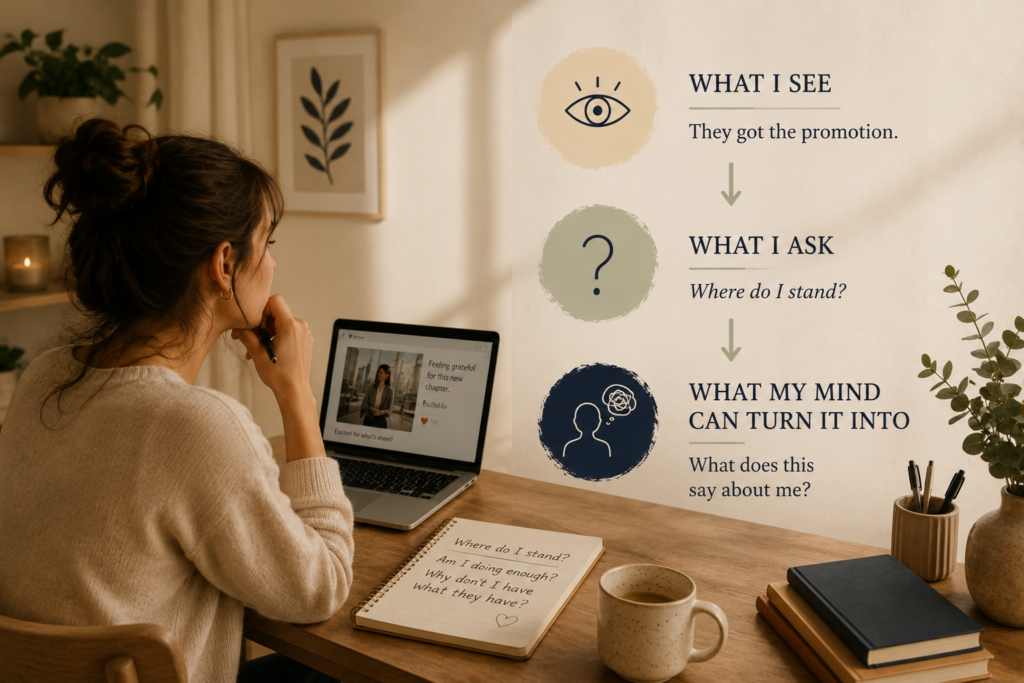
Imagine you see someone who has achieved something you haven’t. The initial observation is neutral: they got the promotion. Then comparison adds a second layer: “I’m not there yet”. And from there, it can become something much more personal: “I’m falling behind”. Or: “I’m not as capable as they are”.
The original comparison was about a difference between two situations. The conclusion, however, can easily be about your value or ability. That distinction matters.
There is a significant difference between “They are ahead of me in this particular area” and “They are better than me.” The first is an observation of one specific difference. The second turns that difference into a much broader judgment.
And once comparison becomes a judgment, it can be difficult to feel satisfied with anything you have. There will almost always be someone who is further ahead in one area, more attractive in another, more experienced somewhere else, or seemingly more successful according to whatever standard you’re using.
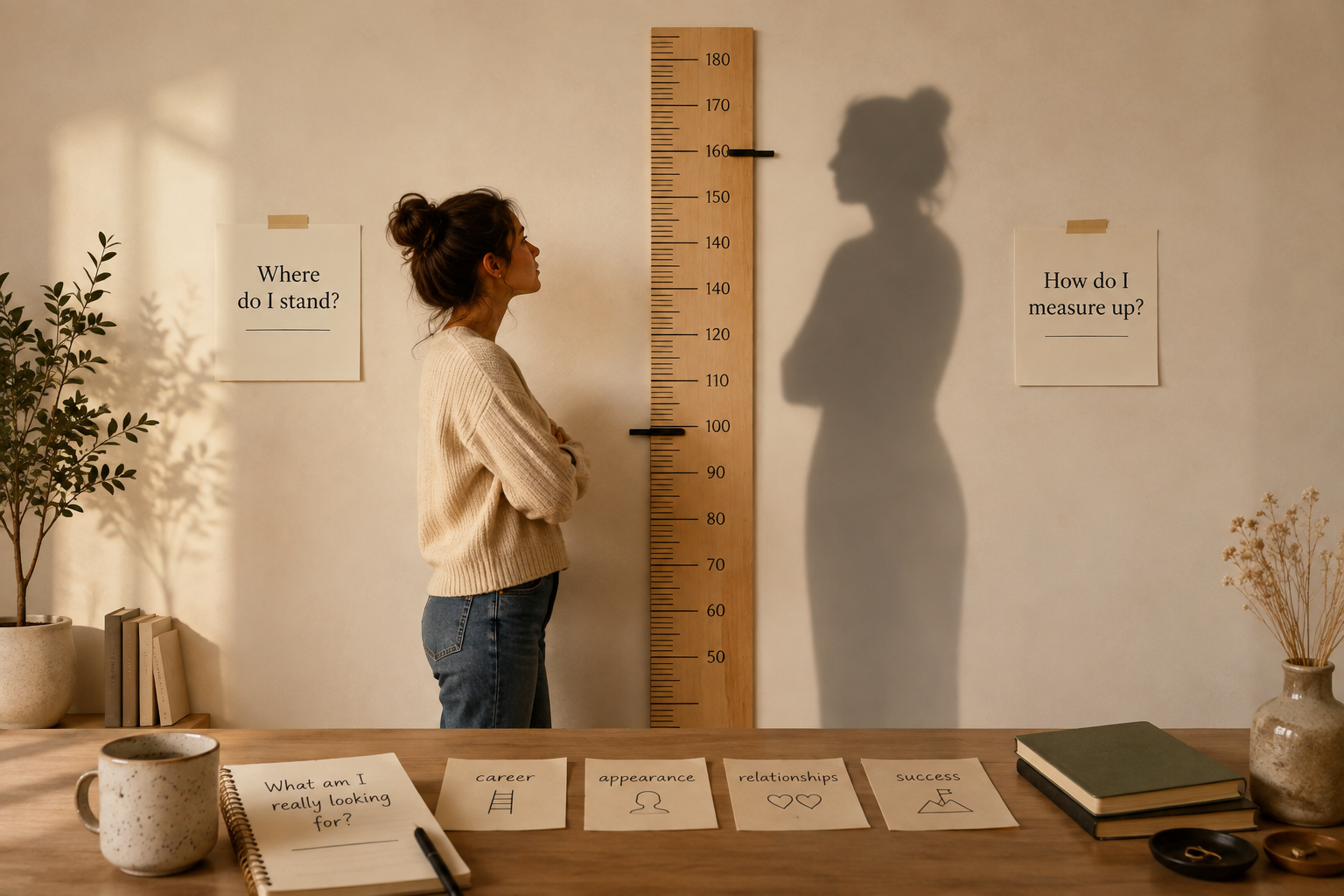
The comparison has stopped answering “Where do I stand?” and started answering “How do I measure up?” Those are not quite the same questions.
Why Do I Compare Myself to Others? When Comparison Starts to Hurt
One reason comparison can leave us feeling worse is that we often focus on people who seem to be doing particularly well in the area we’re already thinking about.
This is sometimes called upward social comparison: comparing yourself with someone you perceive as doing better than you in a particular domain.
Upward comparison isn’t automatically harmful. Seeing someone further along can provide inspiration or show you what might be possible. It can give you ideas, motivation, or a useful reference point.
But it can also create what researchers call a contrast effect. Instead of thinking, “That’s something I could work toward,” you may become more focused on the distance between their situation and yours (Buunk et al., 2005).
They got the promotion. They seem more confident than you. They’re in a relationship while you’re single. And suddenly, it feels as though they’re ahead of you in life.
The difference becomes the most noticeable part of the comparison. Research on social media has found that upward comparisons can be associated with more negative self-evaluations and emotions. A 2023 meta-analysis of 48 studies found a small but significant negative effect of upward social comparison on people’s self-evaluations and emotions in social media contexts, with contrast appearing to be the dominant response (McComb et al., 2023).
That doesn’t mean every comparison makes you feel worse, or that social media automatically damages your self-esteem. It means that the direction and context of a comparison can matter.
The Problem With Comparing Your Whole Life to Someone Else’s Highlight Reel
Social media adds another complication: we rarely see the whole picture. You see the holiday, not the argument they had before leaving. You see the promotion announcement, not the years of uncertainty that came before it. You see the finished renovation, not the financial stress or months of work behind it.
This isn’t to say that everyone online is pretending to have a perfect life. People simply tend to share particular parts of their lives, and social media gives us access to those selected moments far more often than we see the ordinary ones.
That creates an awkward comparison.
You might be comparing your everyday experience, including the things that aren’t working, with someone else’s selected moments.
And because you’re inside your own life, you have access to all the details that make it complicated. You know about your doubts, mistakes, unfinished projects, difficult days, and things you haven’t figured out yet. You don’t have the same information about the other person.
When Comparison Becomes Connected to Self-Worth
Comparison can become particularly painful when the thing you’re comparing is closely connected to how you feel about your own worth. This is closely related to what can happen after rejection, when an external event can start to feel like a judgment about your worth.
If professional success is important to your sense of self, someone else’s career achievement may feel like a reflection on you. If appearance plays a major role in how you evaluate yourself, seeing someone you consider more attractive can affect how you feel about your own body. If being in a relationship feels like evidence that you’re desirable or lovable, seeing other couples can become emotionally loaded.
This doesn’t mean that everyone who compares themselves has low self-esteem. Comparison is much more complicated than that. But it can be useful to notice which comparisons hurt the most.
You might compare yourself with dozens of people every day without caring. Then one particular person or situation makes you feel unexpectedly inadequate.
That reaction can tell you something.
Perhaps the comparison is touching an area where you’re already uncertain. Perhaps you’ve attached a lot of meaning to achieving a particular outcome. Or perhaps you’re using someone else’s situation to answer a question about yourself that doesn’t actually have a simple external answer.
What Are You Actually Trying to Find Out?
This may be the most useful question to ask when you catch yourself comparing. Instead of immediately trying to stop the comparison, pause and ask:
What am I trying to find out right now?
Maybe you’re wondering whether you’re doing okay, whether you’re falling behind, whether you’re good enough, or why you don’t have what they have. Sometimes the need to know whether we’re doing okay can also show up as reassurance-seeking.
“Could I do that too?” can lead to curiosity or motivation. “Why am I not as good as them?” is much more likely to turn the comparison into a judgment.
Comparison Isn’t the Problem. What You Do with It Matters.
Comparing yourself to others is not something you necessarily need to eliminate from your life. Sometimes comparison can show you something you genuinely want. It can introduce you to a possibility you hadn’t considered. It can help you recognize an area you’d like to develop. It can even remind you that someone else’s achievement is evidence that a particular path exists.
But comparison becomes much less useful when someone else’s life becomes the measuring stick for your worth.
You don’t need to pretend that you never notice differences between yourself and other people. You don’t need to convince yourself that you are just as successful, attractive, or accomplished as everyone else.
Instead, you can become more curious about the conclusion you’re drawing from the difference.
Someone being ahead of you in one area doesn’t automatically mean you’re behind in life. Someone having something you don’t doesn’t automatically mean you’re missing something essential. And someone else’s success doesn’t automatically make your own life smaller.
So, Why Do I Compare Myself to Others?
Because comparison can help us understand ourselves. When there is no clear external measure for how we’re doing, other people can become reference points. We look at them to figure out where we stand, what is possible, and sometimes what we might want for ourselves.
The difficulty begins when that reference point becomes a judgment. “They are further ahead than me” can quietly become “I am not good enough.” “They have something I don’t” can become “My life isn’t enough.” And “I don’t know where I stand” can become “I must be falling behind.”
The comparison itself may be only the beginning. What matters is what you decide the comparison means.
So the next time you catch yourself looking at someone else’s life and feeling that familiar sense of inadequacy, you don’t necessarily have to tell yourself to stop.
Try asking a different question:
What am I using this comparison to measure about myself?
The answer may tell you more about what you need, value, or worry about than it does about the person you’re comparing yourself to.
Further Reading
- McComb, C. A., Vanman, E. J., & Tobin, S. J. (2023). A meta-analysis of the effects of social media exposure to upward comparison targets on self-evaluations and emotions. Media Psychology, 26(5), 612–635. [Read the full study →]
- Festinger, L. (1954). A theory of social comparison processes. Human Relations, 7(2), 117–140.[Read the full study ]
- Buunk, B. P., Collins, R. L., Taylor, S. E., VanYperen, N. W., & Dakof, G. A. (2005). The affective consequences of social comparison: Either direction has its ups and downs. Journal of Personality and Social Psychology, 59(6), 1238–1249.[Read the study]
AI Transparency
At SelfWorkNotes, we use generative AI as a collaborative tool during the research, writing and creative process. Every article is carefully reviewed, edited and finalized by the author, who remains fully responsible for the published content. Unless otherwise stated, illustrations are created using generative AI.
Gentle reminder: The content on SelfWorkNotes is provided for informational and educational purposes only. It does not constitute medical, psychological, legal or financial advice. Always consult a qualified professional regarding your personal situation.