

Inner Critic: What Happened Between the Mistake and “I’m the Problem”?
You make a mistake at work, forget something important, miss a deadline, or handle a conversation badly. Your first thought might be straightforward: I handled that badly. Then the thought changes: “I always do this”, “Why am I like this?”, “I’m just not good at these things”. Before you realize it, something you did has become a statement about who you are. That jump is where your inner critic can become much more powerful than useful.
The problem isn’t necessarily that everything your inner critic says is false. Sometimes it starts with something that really happened. You may genuinely have made a poor decision, behaved badly, or fallen short of your own expectations. The more useful question is what happens next: how does a specific event become a much larger story about you?
Learning to notice that process doesn’t mean silencing your inner critic or convincing yourself that everything you do is fine. It means learning to separate useful information from the part that turns a mistake into a judgment about your entire self.
What Is an Inner Critic?
Your inner critic is a term for the harsh, judgmental side of your internal dialogue. It may point out mistakes, focus on shortcomings, anticipate failure, compare you with other people, or tell you that you should have done better. Simply Psychology – How to Manage Your Inner Critic.
Sometimes it shows up in direct statements such as: “You’re not good enough”. “You always mess things up”. “You should have known better”.
Other times, it is much quieter: “Everyone else seems to manage this more easily”. “Maybe you’re just not cut out for this”.
The important thing is that the inner critic often doesn’t stop at describing what happened; it also adds meaning.
Your Inner Critic Doesn’t Always Start with Something False
Imagine that you missed an important deadline. Your inner critic says: “You’re so unreliable”.
There may be something real underneath that statement. You did miss the deadline. Perhaps you underestimated how long the work would take, procrastinated, or failed to communicate early enough that you were falling behind. None of that needs to be denied.
But notice how quickly the statement can change:
“I missed a deadline” becomes “I’m unreliable”, then: “I always do this”, and eventually: “People can’t depend on me”.
These aren’t interchangeable statements. The first describes an event. The second turns that event into a judgment about who you are. The third turns it into a pattern, and the fourth extends that conclusion to what other people supposedly think or can expect from you.
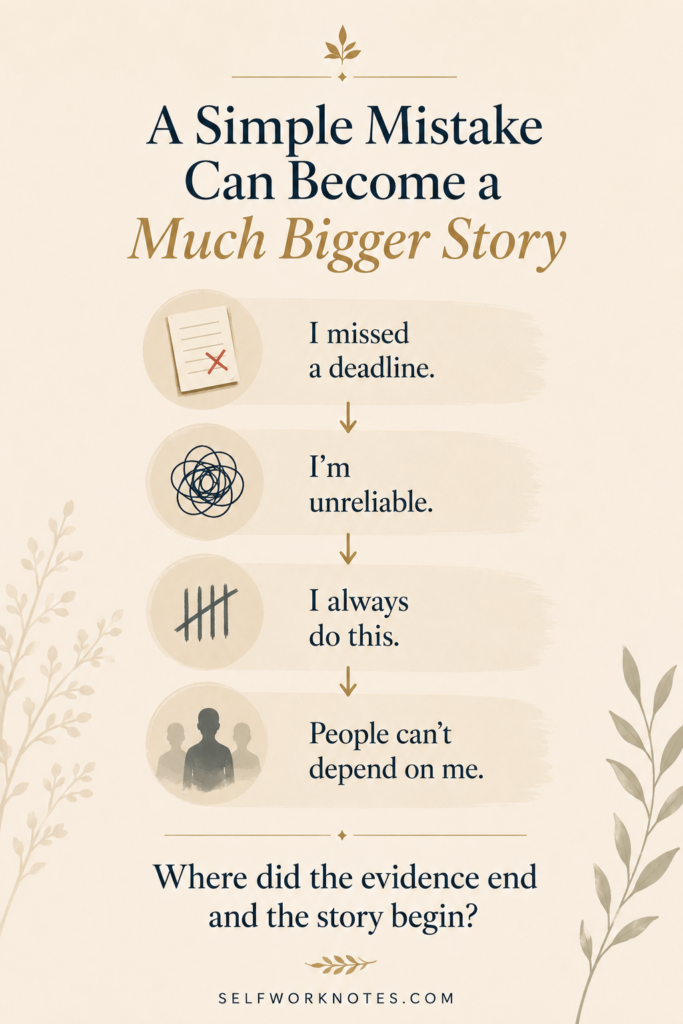
This is why asking whether your inner critic is right or wrong isn’t always enough. It may contain a piece of useful information while still drawing a much larger conclusion than the evidence supports.
You can make a mistake without it telling the whole story. You can have a pattern you genuinely need to work on without it becoming a complete definition of you. And you can take responsibility for something without turning responsibility into self-attack.
What Happens Between the Mistake and “I’m the Problem”?
Consider a presentation that didn’t go well.
The event: You gave a poor presentation.
The evaluation: You weren’t prepared enough.
The interpretation: You clearly aren’t good at presenting.
The prediction: Your manager is going to lose confidence in you.
The identity claim: You’re incompetent.
By the end, several different kinds of statements have been compressed into one conclusion about you.
The first may be easy to verify. The second may be useful feedback. The third is already an interpretation. The fourth is a prediction about someone else’s thoughts. The fifth turns the whole experience into an identity label. The inner critic can make this progression feel like one obvious chain of reasoning. But they aren’t necessarily as logically connected as they feel.
A useful question is:
Where did the evidence end and the story begin?
That question doesn’t require you to dismiss the original problem. It asks you to become more precise about what you actually know.
Maybe the presentation was poor. Maybe you need more preparation or more practice. Those things can be true without proving that you are fundamentally incompetent. Clarity matters because a precise problem can give you something to work with. A general judgment often doesn’t.
Feedback and Self-Attack Are Not the Same Thing
Self-criticism and honest self-assessment can look similar at first because both involve noticing something you want to improve. The difference often becomes clearer when you look at what happens after the observation.
You might think: “I interrupted her several times during that conversation”.
That’s uncomfortable, but it is specific. You can reflect on why you did it and decide to listen more carefully next time.
The inner critic may turn it into: “I’m selfish” or “I always make everything about me”.
Again, perhaps there is something worth examining. Maybe you really did dominate the conversation. But the identity statement doesn’t necessarily give you better information about what to do next.
The same thing happens with mistakes at work: “I missed the deadline” can become “I need to get better at estimating how long this kind of work takes”. That’s feedback.
Or it can become “I’m unreliable”, “I can’t get anything right”. That’s self-attack.
You don’t have to turn useful criticism into praise. If you made a mistake or behaved badly, you can acknowledge it. If there is something you need to learn, you still can learn it.
This is also where the idea of an “inner coach” can be useful, as long as it isn’t just a nicer voice replacing the critic. The real difference is whether the internal dialogue helps you identify what needs attention or turns the problem into a judgment about who you are.
Self-acceptance doesn’t require pretending that every choice was a good one. It means being able to see what happened without automatically turning it into a complete definition of yourself.
How to Deal With Your Inner Critic Without Silencing It
When your inner critic gets loud, it can be tempting to argue with it: “That’s not true, I’m actually good at this. I shouldn’t think this way”.
Sometimes that helps. But you can also ask more useful questions.
The next time your inner critic starts talking, write down its exact words rather than summarizing them as “I’m being negative again.” The wording matters.
What actually happened?
Start with the event, without adding a judgment. Separate what you know from what you’re assuming.
For example: “I sent out the report two days late. My manager hasn’t said that they think I’m incompetent”.
What am I adding to the event?
Look for words such as always, never, everyone, nobody, terrible, stupid, or hopeless. These often signal that the statement has moved beyond the specific situation.
What am I predicting?
Your inner critic may present a prediction as though it were already a fact. Something like “They’ll never trust me again”.
That’s a possibility you’re imagining, not evidence of what another person thinks.
What do I believe it means about myself?
This is where a specific event often becomes an identity claim.
“I made a mistake” becomes “I’m a failure”.
What needs attention?
For example: “I need to build more realistic timelines and communicate earlier when something is going off track”.
The fact of the mistake and the useful information stayed, but the unnecessary attack didn’t have to.
Once you can see that transition, you have more room to decide whether the conclusion actually deserves your trust.
What Is Your Inner Critic Trying to Protect?
Sometimes a harsh thought is connected to a fear of failure, rejection, embarrassment, or repeating a past mistake. Understanding where it comes from can be useful, but it doesn’t make the thought accurate. You can understand why a thought is there without handing it authority.
Confidence Doesn’t Make a Thought More Accurate
The inner critic rarely sounds uncertain.
It doesn’t usually say “There is a possibility that you may not be very good at this”.
Instead it says: “You’re terrible at this”.
It can sound immediate and convincing, but confidence is not evidence. A thought can be emotionally powerful without being accurate. And you might even repeat it so many times that it feels more like a fact than a thought.
This matters when your inner critic uses old information to make predictions about your future. You may have failed at some things before, but those facts don’t automatically tell you what happens next.
The useful question isn’t whether your past should be ignored. It’s whether you’re using it as information or treating it as a fixed forecast.
You Don’t Have to Silence Your Inner Critic
The goal isn’t to become someone who never criticizes themselves. Some self-reflection is useful, because you need to be able to notice when something didn’t work, when you hurt someone, identify a pattern you want to change, and take responsibility for your choices. The goal is to become better at sorting those thoughts.
When your inner critic speaks, you can ask:
- What happened?
- What is actually true?
- What am I assuming?
- What am I predicting?
- What am I making this mean about myself?
- What, if anything, needs to change?
You don’t have to believe everything your inner critic says simply because it is talking about something that feels true. And you don’t have to reject everything it says simply because the delivery is harsh. You can take the information seriously without taking the attack personally or letting it dictate what you predict about your future. The goal isn’t to become less accountable. It’s to become more precise.
You made the mistake, but you can learn from it and change what needs changing. And you can still refuse to turn one event or a pattern into a complete description of who you are.
Further Reading
- McLeod, S. (2026). How to manage your Inner Critic. Simply Psychology. Read the article
- Golden, B. (2019). How Self-Criticism Threatens You in Mind and Body. Psychology Today. Read the article
- American Psychological Association. (2018). Self-criticism. APA Dictionary of Psychology. Read the entry
AI Transparency
At SelfWorkNotes, we use generative AI as a collaborative tool during the research, writing and creative process. Every article is carefully reviewed, edited and finalized by the author, who remains fully responsible for the published content. Unless otherwise stated, illustrations are created using generative AI.
Gentle reminder: The content on SelfWorkNotes is provided for informational and educational purposes only. It does not constitute medical, psychological, legal or financial advice. Always consult a qualified professional regarding your personal situation.