
How to Stop Being So Hard on Yourself Without Losing Your Drive
What if learning how to stop being so hard on yourself didn’t mean losing the drive that gets things done? Maybe you recognize the pattern. You miss a deadline, make a mistake, procrastinate, or fall short of a goal, and the voice in your head immediately gets louder: You should have done better. Why are you like this? You need to get it together. And somehow, it works. At least sometimes.
The criticism creates urgency. The pressure gets you moving. You push yourself a little harder, finish the task, and tell yourself that if you had been kinder, you probably would have let yourself off the hook.
That can make the idea of learning how to stop being so hard on yourself surprisingly uncomfortable.
If I’m not hard on myself, won’t I lose my drive? you might wonder.
Not necessarily. There is a difference between something that gets you moving and something that helps you move well.
You don’t have to become less ambitious, lower your standards, or stop holding yourself accountable. You may simply need to stop using self-criticism as the thing that keeps you ambitious.
Why Being Hard on Yourself Can Feel Like Motivation
Self-criticism can create a powerful sense of pressure. When you tell yourself that you should be further ahead, should work harder, or can’t afford to make another mistake, there is very little room to relax. That pressure can feel productive because it often creates an immediate reason to act. And sometimes, pressure really does get results.
The problem is that getting yourself to do something and having a healthy reason for doing it are not necessarily the same thing.
You can finish a project because you’re genuinely committed to doing good work. You can also finish it because you’re terrified of what you’ll think about yourself if you don’t.
From the outside, those two situations may look identical. Inside, they can feel completely different. One says, this matters to me. The other says, I need to prove something.
If you’ve spent years relying on the second one, reducing self-criticism can feel less like becoming kinder to yourself and more like taking your foot off the accelerator.
But perhaps the better question is: what is your accelerator actually running on?
The Problem Isn’t Wanting More
There is nothing inherently wrong with wanting to improve. You might want to become more confident, get better at your work, become healthier, learn something new, earn more money, or simply become someone you feel proud of.
You can have high standards and still accept yourself. You can be ambitious and still be kind to yourself. And you can make a mistake and still expect yourself to learn from it. These things are not opposites.
Research on goal pursuit suggests an interesting distinction here. In a series of five studies, Powers and colleagues found a consistent negative association between self-criticism and goal progress. At the same time, self-oriented perfectionism — essentially, striving for high personal standards — showed a positive association with goal progress when self-criticism was taken into account. In other words, the desire to do well and the tendency to attack yourself for not doing well are not the same thing. (Powers et al., 2011)
That distinction matters.
High standards ask, “What am I capable of?”
Self-criticism asks, “What’s wrong with me if I don’t get there?”
You can keep the first question without carrying the second.
Self-Criticism Is Not the Same as Accountability
One of the easiest ways to confuse self-criticism with healthy motivation is to confuse it with accountability.
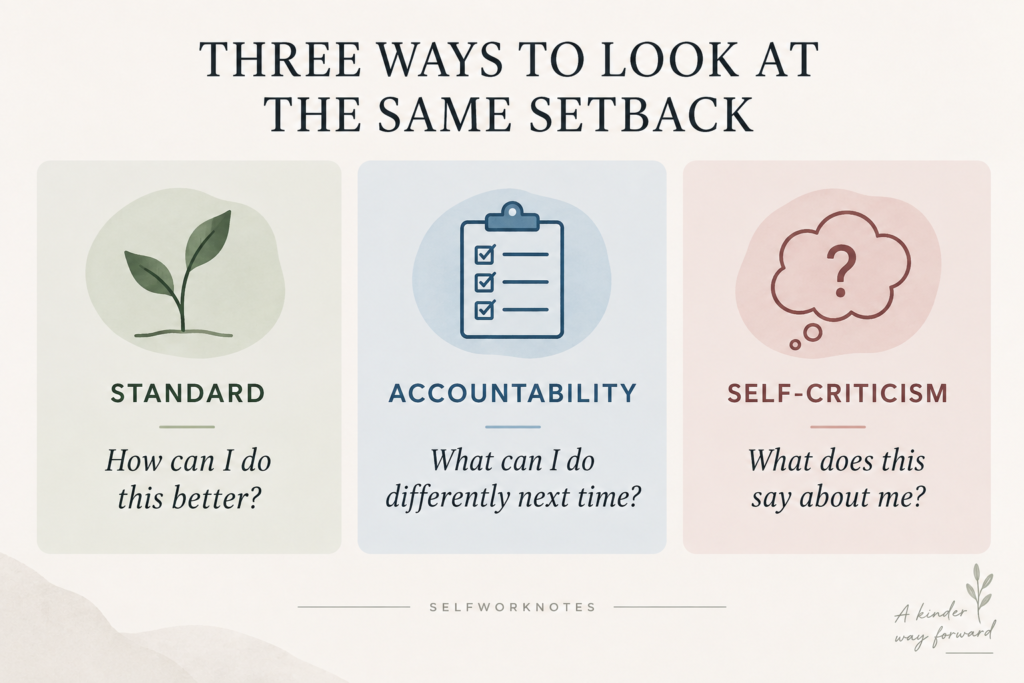
Imagine that you submit work that isn’t as good as you wanted it to be. Self-criticism might sound like: I always do this. I’m so careless. I should have known better.
Accountability sounds different. It can be uncomfortable, because it asks you to look honestly at what happened and decide what to do differently. For example: yI didn’t give myself enough time to do this properly. What can I change next time?
Both acknowledge that something went wrong. But only one requires you to turn the mistake into a judgment about yourself.
Accountability is about what happened and what you can do about it. Self-criticism often turns the same event into a statement about who you are.
That difference becomes especially important when you make mistakes repeatedly. If every setback becomes evidence that you’re lazy, incapable, undisciplined, or not good enough, you have much less room to look at the situation objectively.
You don’t need to excuse your behavior to stop attacking yourself for it. You can say, I didn’t handle that well, without having to add, and that proves something terrible about me.
What Happens When Self-Criticism Becomes Your Fuel?
The trouble with using self-criticism as fuel is that you can eventually become dependent on the pressure.
You may notice that relaxing makes you uncomfortable. A free afternoon can feel like wasted time. Rest can trigger guilt. Completing one goal barely gives you a moment to enjoy it before your attention moves to the next thing you haven’t done.
And when you do fall behind, the response isn’t necessarily to make a better plan. Sometimes you simply become harsher with yourself.
Research by Powers, Koestner, and Zuroff suggests that self-criticism was negatively associated with goal progress and was associated with rumination and procrastination in their studies. The findings don’t mean that every instance of self-criticism causes procrastination, but they do challenge the assumption that being harder on yourself is automatically a more effective way to pursue goals. (Powers et al., 2007)
There is an uncomfortable possibility here: the voice you think is keeping you on track may sometimes be making it harder to stay on track.
If you only know how to move by pushing yourself, calm can start to feel like stagnation. You might even start believing that pressure is proof that you care. But caring and suffering are not the same thing.
How to Stop Being So Hard on Yourself Without Losing Your Motivation
This is probably the hardest question to answer if self-criticism has been part of your motivation for a long time. If you stopped telling yourself that you’re behind, disappointing, lazy, or not good enough, why would you still work toward your goals?
There are plenty of possible answers. You might, for example, genuinely care about the result, enjoy getting better at something, want to find out what you’re capable of, or feel responsible for something that matters to you. You might even take pride in your work or simply avoid repeating the same mistake.
The goal might simply reflect your values. Or perhaps the person you’re becoming matters to you – not because the person you are now is unacceptable.
These are forms of motivation that don’t require you to dislike yourself first.
And research supports the idea that self-compassion does not necessarily undermine the desire to improve. In four experiments, Breines and Chen found that participants encouraged to take a self-compassionate approach after personal shortcomings showed greater motivation in several forms of self-improvement, including studying after failure, making amends, and changing a personal weakness. (Breines & Chen, 2012)
That doesn’t mean that self-compassion automatically makes everyone more productive. It means being kinder to yourself does not require giving up on improvement.
How to Stop Being So Hard on Yourself Without Lowering Your Standards
Learning how to stop being so hard on yourself doesn’t mean replacing ambition with passivity. Start by changing what happens after you fall short.
1. Separate your behavior from your identity
Instead of telling yourself, “I’m so lazy,” ask what actually happened. Why didn’t you do what you intended to do? For example: I avoided this because I felt overwhelmed.
Instead of “I’m terrible at this,” ask yourself what the difficulty actually is. Maybe it’s simply something you haven’t learned well enough yet.
The second versions aren’t excuses. They give you specific information you can actually work with.
2. Replace judgment with information
When something goes wrong, ask:
What happened? What contributed to it? What was within my control and what would I do differently next time?
These questions don’t make the standard disappear. They simply turn a mistake into information and not a verdict.
3. Keep the standard, change the voice
You can still tell yourself: I want to do better than this. You don’t need to follow it with what’s wrong with me?
You can expect more from yourself without making your worth dependent on whether you reach the expectation.
4. Give yourself a next step, not a verdict
Self-criticism can keep you stuck in the evaluation of what already happened. Accountability asks what happens next.
If you missed the workout, decide when you’ll move tomorrow. If you procrastinated, figure out what made starting difficult and make the first step smaller.
A next step can move you forward. A verdict about yourself usually can’t.
A Simple Exercise: What Is Actually Driving You?
Think about one goal you’re currently pursuing. It could be professional, financial, personal, physical, or creative.
Then complete these sentences honestly:
I want to achieve this because…
I’m afraid I won’t achieve it because…
If I don’t achieve it, I will tell myself…
If I knew my worth wasn’t at stake, would I still want this goal?
And finally:
What part of this goal would remain if I removed fear, shame, and the need to prove myself from the formula?
You may discover that the goal itself hasn’t changed. What changes is the reason you’re pursuing it. That distinction is worth paying attention to.
You Don’t Have to Choose Between Kindness and Drive
Being kinder to yourself doesn’t mean becoming someone who never pushes themselves. It doesn’t mean accepting poor performance when you know you can do better. It doesn’t mean abandoning discipline or pretending that mistakes don’t matter.
It means learning to respond to yourself in a way that allows you to keep moving.
There is a difference between “I expect more from myself because this matters to me” and “I have to expect more from myself because otherwise I won’t be good enough.”
The first can give your ambition somewhere to go. The second can make achievement feel like something you have to keep earning.
And if your motivation depends on constantly proving that you’re good enough, there may never be a point at which you feel finished.
There will always be another goal. Another weakness to fix. Another person to compare yourself with. Another version of yourself who seems to be just slightly ahead.
You Don’t Have to Become Less Ambitious
Learning how to stop being so hard on yourself isn’t about becoming less ambitious. You may simply need to stop treating self-criticism as the thing that keeps your ambition alive.
But you don’t have to be less ambitious to become less self-critical. You may simply need to stop treating self-criticism as the thing that keeps your ambition alive.
You can hold yourself accountable without humiliating yourself. The goal isn’t to lose your drive. It’s to stop needing fear to keep it alive.
Maybe the question isn’t “If I’m not hard on myself, won’t I become lazy?” It’s:
“What if I could stay driven without having to be at war with myself?”
Further Reading
- Powers, T. A., Koestner, R., Zuroff, D. C., Milyavskaya, M., & Gorin, A. A. (2011). The Effects of Self-Criticism and Self-Oriented Perfectionism on Goal Pursuit. Personality and Social Psychology Bulletin, 37(7), 964–975. Read the research
- Powers, T. A., Koestner, R., & Zuroff, D. C. (2007). Self-Criticism, Goal Motivation, and Goal Progress. Journal of Social and Clinical Psychology, 26(7), 826–840. Read the full text
- Breines, J. G., & Chen, S. (2012). Self-Compassion Increases Self-Improvement Motivation. Personality and Social Psychology Bulletin, 38(9), 1133–1143. Read the research
AI Transparency : At SelfWorkNotes, we use generative AI as a collaborative tool during the research, writing and creative process. Every article is carefully reviewed, edited and finalized by the author, who remains fully responsible for the published content. Unless otherwise stated, illustrations are created using generative AI.
Gentle reminder: The content on SelfWorkNotes is provided for informational and educational purposes only. It does not constitute medical, psychological, legal or financial advice. Always consult a qualified professional regarding your personal situation.