
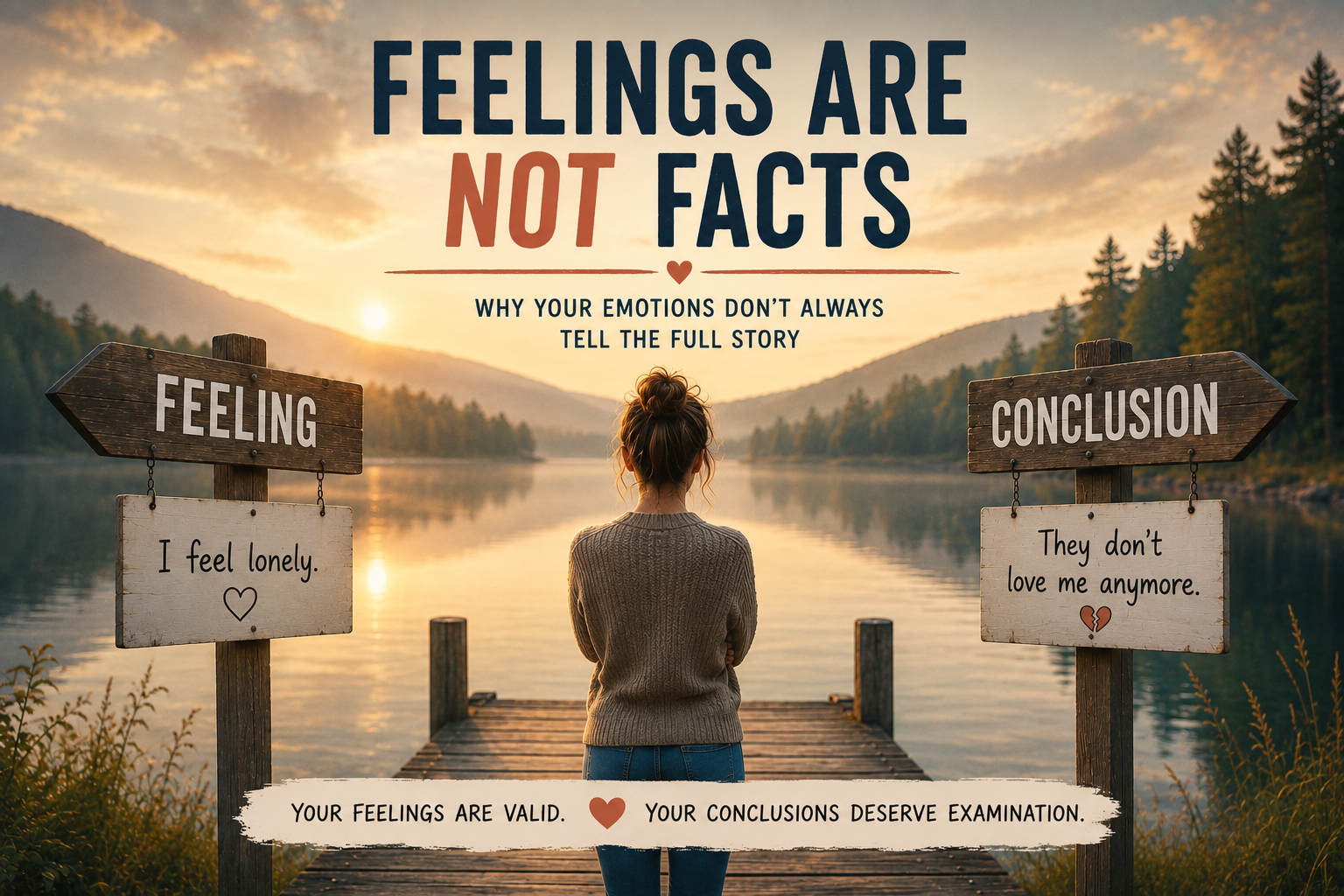
Feelings Are Not Facts: Why Your Emotions Don’t Always Tell the Full Story
Feelings are not facts, but many of us treat them as if they were. Have you ever noticed how quickly a feeling can turn into a conclusion?
Your partner takes longer than usual to reply to a message. You feel disappointed. Then worried. Then rejected.
Before long, you might find yourself wondering whether something is wrong with the relationship.
The feeling, the disappointment and the worry are real. The conclusion, however, may not be.
This is one of the most common mental shortcuts people make, often without realizing it. We experience an emotion, and before we know it, our mind starts building a story and conclusions around it.
In a previous article, we explored why it can be difficult to trust your emotions. We discussed how many people learn to question their feelings and invalidate their emotional experiences.
But there is another side to emotional self-awareness that is equally important:
Trusting your emotions does not mean treating them as facts. Your emotions deserve attention. Your conclusions deserve examination.
Feelings Are Not Facts, Even If They Are Real
One of the biggest misconceptions about emotions is the belief that if something feels true, it must be true.
Consider these examples:
“I feel anxious.” This is a feeling.
“Something bad is going to happen.” This is a conclusion.
Or:
“I feel rejected.” This is a feeling.
“They want to break up.” This is a conclusion.
The emotion itself is valid, but the interpretation may not be accurate.
Many people tend to treat emotions as evidence. The moment they feel something, they assume it reflects reality exactly as it is.
This is why the phrase “feelings are not facts” can be so important. Emotions may contain valuable information, but they do not automatically reflect reality exactly as it is.
This distinction between emotions and facts is important, not just because we might easily draw conclusions that may not fully reflect reality, but also because we tend to make serious decisions based on those which can influence our future, too. (E.g. break-up / divorce, ending friendships, quitting a job, etc.)
When Feelings Start Writing the Story
Imagine someone whose partner has been calling less frequently than usual. Not because they are not in love anymore, but because they have taken on two extra projects for some extra income, so they are working until late in the evening and their focus is on their job.
The feeling however might sound like:
“I miss them.” “I feel lonely.”
“I feel disappointed.”
All these feelings are completely valid.
But sometimes the mind quickly adds another layer:
“They don’t love me anymore.” Or, “They are losing interest.” Or, “They will probably leave me.”
Notice what happened. The feeling itself was not the problem. The conclusion appeared automatically afterward.
The challenge is that these conclusions often feel convincing because they arrive attached to genuine emotions. The stronger the emotion, the more believable the story can become.
Yet there may be many alternative explanations, and if someone struggles with drawing conclusions based on their emotions, they might miss taking the context into consideration: perhaps the partner is simply overwhelmed at work.
The feeling is real. The story remains a hypothesis.

Feelings Are Not Facts. So, What’s the Difference?
In psychology, this pattern is often referred to as emotional reasoning.
Emotional reasoning can feel very convincing because emotions are powerful and immediate, which is exactly why many people mistake feelings for facts.
The logic usually sounds like this:
“I feel it, therefore, it must be true.”
For example:
“I feel like a failure.” Therefore: “I am a failure.”
Or:
“I feel unsafe, which means I am in danger.”
Or:
“I feel rejected, therefore they are rejecting me.”
This pattern is extremely common because emotions are powerful. They grab our attention and influence our thinking. And sometimes they make certain interpretations feel more convincing than they actually are.
The goal is not to stop feeling emotions, but to recognize when an emotion has quietly transformed into a conclusion.
Why It Matters That Feelings Are Not Facts
At first glance, emotional reasoning may seem harmless. After all, everyone jumps to conclusions sometimes.
The problem is that we rarely stop at the conclusion itself. Once a conclusion feels true, we often start making decisions based on it.
Imagine someone who feels rejected and concludes:
“They don’t care about me anymore.”
If that conclusion is accepted as a fact, it may influence how they behave next. Perhaps they become distant or start an argument. Perhaps they just stop communicating openly.
Or in more extreme cases, they may even end a relationship, leave a job, cut off people, or make other important decisions based on an interpretation rather than the actual situation.
The risk is not the feeling itself but treating the conclusion as established reality before examining whether other explanations might exist.
Please remember: feelings can provide valuable information about our internal experience, not external facts. Context matters, too.
Sometimes what we feel points to something important: maybe a value of ours, or a boundary has been stepped over. Other times our emotions might reflect a fear, an assumption, a past experience, or missing information.
The more important the decision is, the more valuable it becomes to slow down and separate what you feel from what you know.
“Healthy” Reflection Sounds Different
When emotions drive the entire narrative, we often stop exploring other possibilities.
“Healthy” reflection creates space between the feeling and the conclusion.
Instead of saying:
“I feel rejected, therefore they must not care about me.”
Healthy reflection might sound like:
“I feel rejected. What else could explain this situation?” Or: “What are the actual facts?” Or: “Am I reacting to what happened, or to what I fear might happen?”
This approach does not invalidate the emotion, it simply allows room for additional information.
Emotional self-awareness is not about suppressing emotions or blindly trusting them. It is about listening to them while remaining curious about the story that follows.
How To Separate Feelings from Conclusions
1. Ask Yourself What You Actually Feel
Sometimes what we describe as feelings are already interpretations.
For example: “I feel ignored.”
At first glance, this sounds like an emotion, but “ignored” is often an interpretation, because it refers to the behavior of another person.
A more helpful question might be:
“What am I actually feeling?”
Perhaps you feel disappointed? Lonely? Hurt?
Interpretations often include a story of what you perceive others did. For example: “I feel betrayed”. “I feel ignored”. “I feel judged”.
Feelings, however, describe your internal emotional experience. For example: You can feel sad. Disappointed. Lonely. Hurt.
Naming the feeling accurately can create immediate clarity.
2. The Camera Exercise
When emotions run high, it can be difficult to tell the difference between facts and conclusions. One way to create some distance is to imagine that the situation was recorded by a camera. Just a camera that records observable events, not thoughts, not emotions.
Now ask yourself:
“What would the camera actually see?”
For example:
Instead of: “They don’t love me anymore.”
The camera might see: “They called once this week instead of five times.”
Instead of: “My boss hates me.”
The camera might see: “My boss criticized one section of my report.”
Instead of: “My friend is ignoring me.”
The camera might see: “My friend has not replied to my message for three days.”
Notice the difference: the camera captures facts. Our minds often add interpretations on top of those facts.
Once you have identified what the camera would see, ask yourself:
“What conclusions have I added? What other explanations could fit the same facts?”
This can be a useful way to challenge emotional reasoning and separate observable facts from the conclusions your mind may have added.
Final Thoughts
Your emotions are valid and they deserve attention. But as we’ve explored throughout this article, feelings are not facts. They do not automatically prove that every conclusion attached to them is true.
Feelings are information. They can point toward important needs, values, fears, expectations, and experiences. They can tell you that something inside you deserves attention. But often, they do not tell the entire story.
Because your feelings deserve attention. And your conclusions deserve examination.
If this resonated with you, you may want to read about why it is so hard to trust your emotions, why you keep seeking reassurance before making decisions and why you feel the need to justify yourself.
AI Transparency : At SelfWorkNotes, we use generative AI as a collaborative tool during the research, writing and creative process. Every article is carefully reviewed, edited and finalized by the author, who remains fully responsible for the published content. Unless otherwise stated, illustrations are created using generative AI.
Gentle reminder: The content on SelfWorkNotes is provided for informational and educational purposes only. It does not constitute medical, psychological, legal or financial advice. Always consult a qualified professional regarding your personal situation.