
Why Is It So Hard to Trust Your Emotions?
Have you ever felt something, only to immediately start convincing yourself that you shouldn’t feel that way? The problem may not be that you ignore your feelings, but you may struggle to trust your emotions.
Maybe someone’s comment hurt you, or you simply felt exhausted after a long week. Maybe you felt uncomfortable around someone, disappointed by a friend’s behavior, or upset after a conversation.
The feeling appeared naturally and automatically, but instead of listening to it, you immediately started questioning whether you are overreacting or too sensitive, or if you should feel that way at all.
When You Cannot Trust Your Emotions
Many of us grow up hearing messages that teach us, directly or indirectly, that our internal experiences are unreliable.
For example, when a child says: “That hurt” and the parent answers: “Nah, it didn’t hurt that much”. Or: “Stop complaing, sweet, nobody hurt you”. Or when the child says: “I’m scared” and the parent’s response is: “Don’t be stupid, nothing will happen.” Or when a child says: “I’m sad” and the parent replies: “You have no reason to be sad.”
Although these responses are often well-intentioned, they can teach a subtle lesson:
What you feel is not trustworthy.
By the time they grow up, they will stop asking what they are feeling, instead, they often subtly start questioning whether what they’re feeling is justified.
Sign You Might Not Trust Your Emotions
People who struggle to trust their emotions often do not realize they are doing it. In fact, the pattern can look surprisingly normal.
For example: you feel hurt, but instead of acknowledging the hurt, you immediately start defending the other person. Or, you feel exhausted, but instead of listening to your body, you explain why you shouldn’t be tired.
Another example is when you feel uncomfortable around someone, and instead of exploring the feeling, you search for reasons why you might be wrong.
In short: emotion appears and the debate begins. Many people spend far more energy questioning their feelings than understanding them.
Feelings And Facts Are Not the Same Thing
This is where an important distinction needs to be made, because when you trust your emotions, it does not mean blindly believing every conclusion that follows them.
Your emotions are valid, but they are not always evidence or facts.
For example: you may feel anxious. That feeling is real. But anxiety does not automatically mean that danger exists.
Or, you may feel rejected. That feeling is real. But it does not automatically mean that someone is rejecting you.
Sometimes you might feel angry, which is also real. But it does not automatically mean that another person intended to hurt you.
The emotion is valid, but the interpretation may still need exploration, for example context.
This is when you trust your emotions it doesn’t mean you treat your feelings as facts, it’s about treating them as information about what is important to you.
The Difference Between “Healthy” Reflection and Self-Doubt
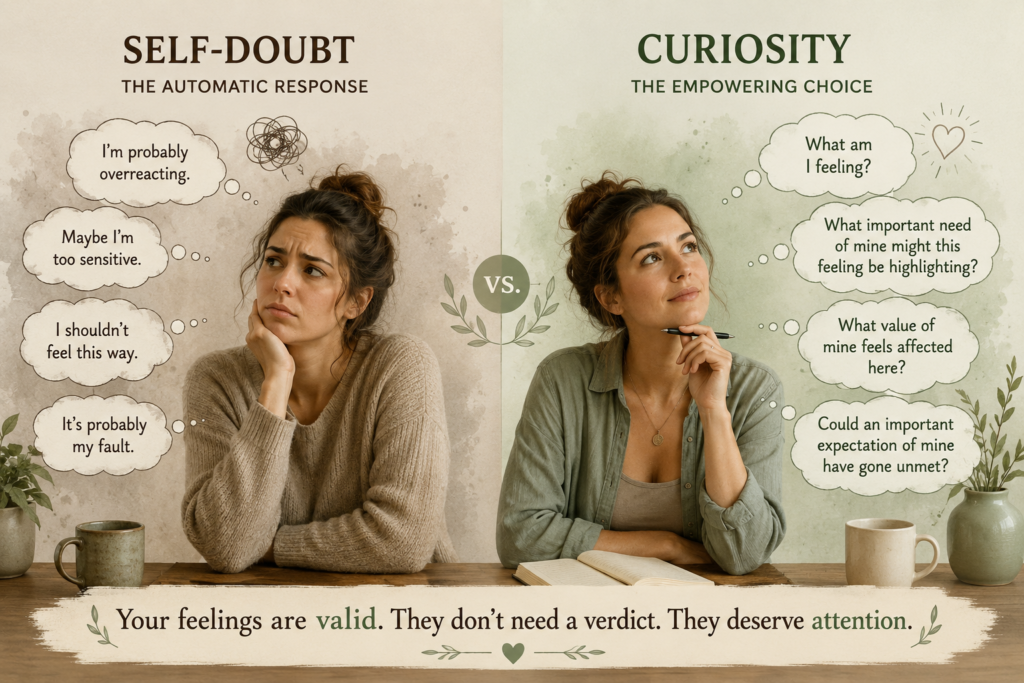
“Healthy” reflection sounds like being curious about what stands behind your emotions, while self-doubt denies that what you’re feeling is valid in the first place.
Notice the difference: “healthy” reflection says: “I wonder why I feel this way.”, while self-doubt sounds more like:
“I shouldn’t feel this way.”
The first approach is curious, and helps to understand yourself, while the second is dismissive and urges you to argue with yourself.
The goal is not to immediately judge your feelings as right or wrong, but to become curious about what they may be highlighting.
How To Learn to Trust Your Emotions Again
1. Notice How Quickly You Try to Disprove Them
The next time you feel uncomfortable, pay attention to what happens next.
Do you become curious? Or do you immediately begin building a case against your own experience?
Many people spend years automatically invalidating themselves without noticing. Awareness is often the first step toward change.
2. Replace Judgment with Curiosity
Instead of questioning if your emotions are valid, you might ask:
“What is this feeling trying to tell me? What important need, value, boundary, or expectation might this feeling be highlighting?”
For example: you feel disappointed.
When you are questioning your emotions, you could answer something like, “I am disappointed, but I guess I’m too sensitive. Maybe I shouldn’t take this to heart”.
But if you check your feelings from a different approach, you might get a totally different answer. Maybe some of your needs, values, or boundaries are affected. Maybe an expectation that was important to you has not been met.
And then, instead of questioning the validity of your emotion (disappointment), maybe you can ask if the expectation was real or maybe exaggerated in the first place.
That can lead to a completely different conversation and also, might give much more clarity, as well. Because although the feeling won’t tell you who is right or what the solution is, but it can highlight what is important to you.
3. Imagine A Friend Said the Same Thing
A close friend tells you:
“That really hurt my feelings.”
Would your first response be:
“Come on, you’re probably overreacting.”
Most likely not. Still, many people speak to themselves this way every day.
Sometimes the compassion you naturally offer others can reveal the harshness of your own inner dialogue.
You can take this one step further if you are totally lost about your situation: open a voice note and tell your story there. Don’t filter your thoughts, don’t even analyze them, just honestly tell what you feel and think. One day later listen to it as if your friend were asking for advice. Hearing it with fresh ears, you might gain clarity about the pattern that is running behind your thoughts.
4. Let The Feeling Exist Before You Analyze It
You don’t always have to examine your feelings. Not every emotion needs immediate interpretation or verdict. Sometimes it is totally okay if you just simply say: “I feel this right now.”
Final Thoughts
Many people spend years trying to decide whether their emotions are justified or even allow themselves to feel them. But emotions do not need permission to exist.
Your emotions are valid.
The stories you build around them may or may not be accurate.
Learning the difference is one of the most important parts of developing self-trust.
If you found this article interesting, you might also want to read about why you are seeking reassurance before a decision, why you are always explaining yourself or what is the difference between self-confidence, self-trust and self-worth in the first place.
AI Transparency : At SelfWorkNotes, we use generative AI as a collaborative tool during the research, writing and creative process. Every article is carefully reviewed, edited and finalized by the author, who remains fully responsible for the published content. Unless otherwise stated, illustrations are created using generative AI.
Gentle reminder: The content on SelfWorkNotes is provided for informational and educational purposes only. It does not constitute medical, psychological, legal or financial advice. Always consult a qualified professional regarding your personal situation.